

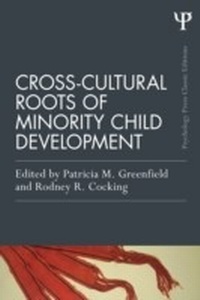
Cross-Cultural Roots of Minority Child Development
1st Edition
Published on 5. December 2014
452 pages
978-1-317-59867-1 (ISBN)
Description

Cross-Cultural Roots of Minority Child Development was the first volume to analyze minority child development by comparing minority children to children in their ancestral countries, rather than to children in the host culture. It was a ground-breaking volume that not only offered an historical reconstruction of the cross-cultural roots of minority child development, but a new cultural-historical approach to developmental psychology as well. It was also one of the best attempts to develop guidelines for building models of development that are multicultural in perspective, thus challenging scholars across the behavioral sciences to give more credence to the impact of culture on development and socialization in their respective fields of work.
A true classic, Cross-Cultural Roots of Minority Child Development will remain an essential resource for any scholar who is interested in minority child development and engages in cross-cultural research and multidisciplinary methodologies.
A true classic, Cross-Cultural Roots of Minority Child Development will remain an essential resource for any scholar who is interested in minority child development and engages in cross-cultural research and multidisciplinary methodologies.
More details
Series
Language
English
Place of publication
London
United Kingdom
Publishing group
Taylor & Francis Ltd
Target group
Professional and scholarly
Product notice
Reflowable
Illustrations
22 s/w Tabellen
22 Tables, black and white
File size
8,34 MB
ISBN-13
978-1-317-59867-1 (9781317598671)
Copyright in bibliographic data and cover images is held by Nielsen Book Services Limited or by the publishers or by their respective licensors: all rights reserved.
Schweitzer Classification
Other editions
Additional editions
Patricia M. Greenfield | Rodney R. Cocking
Cross-Cultural Roots of Minority Child Development
Book
12/2014
1st Edition
Psychology Press Ltd
€233.20
Shipment within 3-4 weeks
Patricia M. Greenfield | Rodney R. Cocking
Cross-Cultural Roots of Minority Child Development
Book
12/2014
1st Edition
Psychology Press Ltd
€85.50
Shipment within 3-4 weeks
Persons
Patricia M. Greenfield is Distinguished Professor of Psychology at the University of California, Los Angeles. Her central theoretical and research interest is in the relationship between culture and human development. In 2010, she received the Urie Bronfenbrenner Award for Lifetime Contribution to Developmental Psychology in the Service of Science and Society from the American Psychological Association. In 2013, she received the Award for Distinguished Contributions to Cultural and Contextual Factors in Child Development from the Society for Research in Child Development.
Rodney R. Cocking was director of the Developmental and Learning Sciences program in the division of Behavioral and Cognitive Sciences at the National Science Foundation in Arlington, and was one of the founding editors of the Journal of Applied Developmental Psychology. He made significant contributions to the areas of developmental theory; cognitive development; linguistic, cultural, and media influences on development; and environments for learning and education. Tragically murdered in 2002, his death was a great loss to his family, his friends and colleagues, and the field.
Rodney R. Cocking was director of the Developmental and Learning Sciences program in the division of Behavioral and Cognitive Sciences at the National Science Foundation in Arlington, and was one of the founding editors of the Journal of Applied Developmental Psychology. He made significant contributions to the areas of developmental theory; cognitive development; linguistic, cultural, and media influences on development; and environments for learning and education. Tragically murdered in 2002, his death was a great loss to his family, his friends and colleagues, and the field.
Content
Introduction to the Classic Edition
Independence and Interdependence as Developmental Scripts: Implications for Theory, Research, and Practice
Part I: American Roots
Maternal Behavior in a Mexican Community: The Changing Environments of Children, F.M.T. Uribe, R.A. LeVine, S.E. LeVine
Socializing Young Children in Mexican-American Families: An Intergenerational Perspective, C. Delgado-Gaitan
Intergroup Differences Among Native Americans in Socialization and Child Cognition: An Ethnogenetic Analysis, R.G. Tharp.
Revaluing Native-American Concepts of Development and Education, J.R. Joe
From Natal Culture to School Culture to Dominant Society Culture: Supporting Transitions for Pueblo Indian Students, J.H. Suina, L.B. Smolkin
Part II: African Roots
Socialization of Nso Children in the Bamenda Grassfields of Northwest Cameroon, A.B. Nsamenang, M.E. Lamb
Language and Socialization of the Child in African Families Living in France, J. Rabain-Jamin
Language Development and Socialization in Young African-American Children, I.K. Blake
Children's Street Work in Urban Nigeria: Dilemma of Modernizing Tradition, B.A. Oloko
Part III: Asian Roots
Individualism, Collectivism, and Child Development: A Korean Perspective, U. Kim, S-H. Choi
Mother and Child in Japanese Socialization: A Japan-U.S. Comparison, T.S. Lebra
Two Modes of Cognitive Socialization in Japan and the United States, H. Azuma
Cognitive Socialization in Confucian Heritage Cultures, D.Y.F. Ho
Moving Away From Stereotypes and Preconceptions: Students and Their Education in East Asia and the United States, H. Stevenson
East-Asian Academic Success in the United States: Family, School, and Community Explanations, B. Schneider, J.A. Hieshima, S. Lee, S. Plank
Continuities and Discontinuities in the Cognitive Socialization of Asian-Originated Children: The Case of Japanese Americans, R. Takanishi
Part IV: Concluding Perspectives
From Cultural Differences to Differences in Cultural Frame of Reference, J.U. Ogbu
Ecologically Valid Frameworks of Development: Accounting for Continuities and Discontinuities Across Contexts, R.R. Cocking
Independence and Interdependence as Developmental Scripts: Implications for Theory, Research, and Practice
Part I: American Roots
Maternal Behavior in a Mexican Community: The Changing Environments of Children, F.M.T. Uribe, R.A. LeVine, S.E. LeVine
Socializing Young Children in Mexican-American Families: An Intergenerational Perspective, C. Delgado-Gaitan
Intergroup Differences Among Native Americans in Socialization and Child Cognition: An Ethnogenetic Analysis, R.G. Tharp.
Revaluing Native-American Concepts of Development and Education, J.R. Joe
From Natal Culture to School Culture to Dominant Society Culture: Supporting Transitions for Pueblo Indian Students, J.H. Suina, L.B. Smolkin
Part II: African Roots
Socialization of Nso Children in the Bamenda Grassfields of Northwest Cameroon, A.B. Nsamenang, M.E. Lamb
Language and Socialization of the Child in African Families Living in France, J. Rabain-Jamin
Language Development and Socialization in Young African-American Children, I.K. Blake
Children's Street Work in Urban Nigeria: Dilemma of Modernizing Tradition, B.A. Oloko
Part III: Asian Roots
Individualism, Collectivism, and Child Development: A Korean Perspective, U. Kim, S-H. Choi
Mother and Child in Japanese Socialization: A Japan-U.S. Comparison, T.S. Lebra
Two Modes of Cognitive Socialization in Japan and the United States, H. Azuma
Cognitive Socialization in Confucian Heritage Cultures, D.Y.F. Ho
Moving Away From Stereotypes and Preconceptions: Students and Their Education in East Asia and the United States, H. Stevenson
East-Asian Academic Success in the United States: Family, School, and Community Explanations, B. Schneider, J.A. Hieshima, S. Lee, S. Plank
Continuities and Discontinuities in the Cognitive Socialization of Asian-Originated Children: The Case of Japanese Americans, R. Takanishi
Part IV: Concluding Perspectives
From Cultural Differences to Differences in Cultural Frame of Reference, J.U. Ogbu
Ecologically Valid Frameworks of Development: Accounting for Continuities and Discontinuities Across Contexts, R.R. Cocking
