

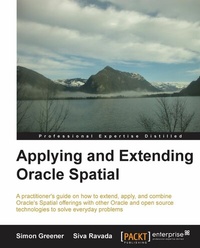
Applying and Extending Oracle Spatial
This guide takes you straight into the attributes of Oracle Spatial and teaches you to extend, apply, and combine them with other Oracle and open source technologies. A vital manual for solving everyday problems.
Published on 13. January 2025
568 pages
978-1-84968-637-2 (ISBN)
Description

This guide takes you straight into the attributes of Oracle Spatial and teaches you to extend, apply, and combine them with other Oracle and open source technologies. A vital manual for solving everyday problems.
Key Features
Understand how to develop Oracle Spatial data models and applications that use PL/SQL and Java to solve common problems using practical, hands-on examples
Design a data model for spatial applications
Use standard database technologies for managing Spatial data
Learn how to combine spatial and non-spatial data in the database
Get to grips with how to use Oracle Spatial's standards compliant geometry data types to develop cross-vendor database solutions to common problems
Book DescriptionSpatial applications should be developed in the same way that users develop other database applications: by starting with an integrated data model in which the SDO_GEOMETRY objects are just another attribute describing entities and by using as many of the database features as possible for managing the data. If a task can be done using a database feature like replication, then it should be done using the standard replication technology instead of inventing a new procedure for replicating spatial data. Sometimes solving a business problem using a PL/SQL function can be more powerful, accessible, and easier to use than trying to use external software. Because Oracle Spatial's offerings are standards compliant, this book shows you how Oracle Spatial technology can be used to build cross-vendor database solutions. Applying and Extending Oracle Spatial shows you the clever things that can be done not just with Oracle Spatial on its own, but in combination with other database technologies. This is a great resource book that will convince you to purchase other Oracle technology books on non-spatial specialist technologies because you will O?Anally see that "spatial is not special: it is a small, fun, and clever part of a much larger whole".What you will learn
Design a data model for a spatial application
?NBuild and use database triggers that manage data validation and other tasks
?NUse Oracle s materialized view, replication, and PL/SQL technologies with a spatial database
?NUnderstand and use Oracle s raster data management technology to implement solutions within a range of applications
?NExplore advanced queuing for managing spatial data processing
?NApply linear referencing programming to solve business problems
?NDiscover Oracle s OGC and SQLMM-compliant geometry types when implementing solutions capable of cross-vendor database deployment
?NUse partitioning to manage large spatial datasets in the database
?NLoad spatial data (raster and vector) from different data sources in the database
Who this book is forThis book is for existing users of Oracle and Oracle Spatial and so assumes you have a basic knowledge of Oracle in terms of understanding the SDO_GEOMETRY type, creating tables, indexes, and views, executing basic to moderately complex queries, and some idea of PL/SQL programming of triggers and stored procedures.
Key Features
Understand how to develop Oracle Spatial data models and applications that use PL/SQL and Java to solve common problems using practical, hands-on examples
Design a data model for spatial applications
Use standard database technologies for managing Spatial data
Learn how to combine spatial and non-spatial data in the database
Get to grips with how to use Oracle Spatial's standards compliant geometry data types to develop cross-vendor database solutions to common problems
Book DescriptionSpatial applications should be developed in the same way that users develop other database applications: by starting with an integrated data model in which the SDO_GEOMETRY objects are just another attribute describing entities and by using as many of the database features as possible for managing the data. If a task can be done using a database feature like replication, then it should be done using the standard replication technology instead of inventing a new procedure for replicating spatial data. Sometimes solving a business problem using a PL/SQL function can be more powerful, accessible, and easier to use than trying to use external software. Because Oracle Spatial's offerings are standards compliant, this book shows you how Oracle Spatial technology can be used to build cross-vendor database solutions. Applying and Extending Oracle Spatial shows you the clever things that can be done not just with Oracle Spatial on its own, but in combination with other database technologies. This is a great resource book that will convince you to purchase other Oracle technology books on non-spatial specialist technologies because you will O?Anally see that "spatial is not special: it is a small, fun, and clever part of a much larger whole".What you will learn
Design a data model for a spatial application
?NBuild and use database triggers that manage data validation and other tasks
?NUse Oracle s materialized view, replication, and PL/SQL technologies with a spatial database
?NUnderstand and use Oracle s raster data management technology to implement solutions within a range of applications
?NExplore advanced queuing for managing spatial data processing
?NApply linear referencing programming to solve business problems
?NDiscover Oracle s OGC and SQLMM-compliant geometry types when implementing solutions capable of cross-vendor database deployment
?NUse partitioning to manage large spatial datasets in the database
?NLoad spatial data (raster and vector) from different data sources in the database
Who this book is forThis book is for existing users of Oracle and Oracle Spatial and so assumes you have a basic knowledge of Oracle in terms of understanding the SDO_GEOMETRY type, creating tables, indexes, and views, executing basic to moderately complex queries, and some idea of PL/SQL programming of triggers and stored procedures.
All prices
More details
Edition
Digital original
Language
English
Place of publication
Birmingham
United Kingdom
Edition type
Digital original
File size
4,78 MB
ISBN-13
978-1-84968-637-2 (9781849686372)
Copyright in bibliographic data and cover images is held by Nielsen Book Services Limited or by the publishers or by their respective licensors: all rights reserved.
Schweitzer Classification
Other editions
Additional editions
Simon Greener | Siva Ravada
Applying and Extending Oracle Spatial
Book
09/2013
Packt Publishing
€76.20
Shipment within 3-4 weeks
Persons
Simon Greener has university qualifications in geomatics, computing science, database technologies, and project management. He started his working career with mining and surveying experience. He then found his calling as a computer scientist with his first job as a database programmer on IBM mainframes for Telstra. He switched to GIS three years later through working in a multi-disciplinary GIS research team at Telecom's Research Laboratories (TRL) in Clayton, Victoria. While at TRL, he worked on projects whose outcome saw the creation of what is now Telstra's Sensis group. After leaving TRL, he worked as a lecturer and consultant for CenSIS (University of Tasmania) under Professor Peter Zwart, writing student and technical training courses. While there, he continued to consult to Telstra's Directory Services and Mobile groups. It was here that he came in contact with the Spatial DataBase Engine (SDBE) from Geographic Technologies Incorporated (GTI) and saw its potential for the management of large scale spatial databases within relational database technologies, a merging of his IT and GIS worlds. This led to the foundation of Salamanca Software Pvt Ltd (SalSoft), for which he was a Director until it was purchased by ESRI Australia in 1996. Some notable achievements while at SalSoft included helping brokers with the sale of SDBE to ESRI Inc (now ArcSDE), winning the first ArcSDE sale to Telstra to power its White pages/Yellow pages mapping portal, co-authoring a geocoding specification for Spatial Decision Systems (now Sensis), consulting for Geographic Technologies Australia on numerous projects based on Universal Press street directory data, and the creation of GeoCASE/Blueprint, the world's first data modeling tool that enabled the modeling of spatial data and relationships. In 1997, he was appointed GIS Manager for Forestry Tasmania (FT) in Hobart, Tasmania. While at FT, he architected the complete revamp of FT's GIS systems using Oracle Spatial (being one of the earliest adopters of the Sdo_Geometry implementation) as the core data management technology. He was concentrating on embedding geospatial data and processing within business systems via a value-oriented, business-centric computing model. He designed and built numerous systems during those years, the best of which was MapComposer, a three-click web-enabled business map production system that, when he left in 2005, had grown (2000-) to over 320 online uses, producing over 50,000 maps a year from a repository of over 100 different map templates (still in operation in 2013). His years at FT concluded with the writing of a GIS Strategy that saw the use of GIS increase yet the cost of the technology to the organization decrease. He left FT in September 2005 for the precarious world of self-employment. He was a sometime copyist for Directions Magazine. As a subcontractor to a Spatial distributor in Australia, he wrote a Radius Topology training course and provided Radius Topology and Oracle Spatial consulting services for them at numerous customer sites until May 2006. From May to August 2006, he was engaged by Spatial, Cambridge, UK, under a UK Government Department of Trade and Industry's GlobalWatch program to conduct research and development in relation to enhancing the export potential of their latest product, Radius Studio (this resulted in Radius Studio being integrated with Feature Data Objects FDO technology to extend its data access capabilities). In his consulting career, he has written a spatial strategy document and conducted a database performance analysis review for a large Tasmanian Government department. He has conducted a number of Oracle spatial database best practice, tender and system, and return on investment reviews at a number of Victorian Government departments. He wrote and delivered a user requirements document for Enterprise GIS at a large Australian corporation. He also provided guidance and implementation services to an ambulance service helping integrate Oracle Spatial into a data warehouse project that used Oracle Portal, Discoverer, and Data Warehouse Builder. He delivered many solutions for a NSW water authority; and finally, he successfully completed many migration, publication, return on investment, process improvement, and database design contracts for a number of Canberra-based Federal Government departments. Simon makes available a collection of PL/SQL and Java-based sample solutions for the Oracle database via his website. He is also principal programmer for the SQL Developer spatial extension, GeoRaptor. Finally, he was awarded, the 2011 Oracle Spatial Excellence Award for Education and Research by Oracle. His technical areas of expertise include systems design and architecture (spatial and attribute), data management, and modeling in both the OLTP and OLAP spaces, and he is also an evangelist for O-RDMS-based spatial data. He is available for free-lance geospatial solutions architecture work, Java and PL/SQL programming, and he provides Oracle Spatial benchmarking and performance enhancement services. His non-technical interests are his family, friends, walking, reading, singing, and motorcycle riding. Siva Ravada earned a PhD degree from the University of Minnesota in the field of Spatial Databases before joining Oracle's Spatial development team. He is now a Senior Director of Development at Oracle Corporation. At Oracle, Siva was one of the founding team members of the Spatial development team before taking over the team management responsibilities. Siva now manages the Spatial and MapViewer development teams at Oracle. He has more than 15 years of experience in spatial databases and application development. He has also co-authored more than 30 articles published in journals, and holds more than 30 patents. He has also presented key-note speeches at several conferences on the topics of spatial databases and GIS. Oracle is the second largest software company and the number one database company in the world.
Content
Table of Contents

