

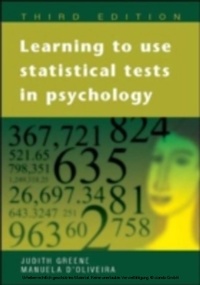
Learning To Use Statistical Tests In Psychology
1st Edition
Published on 1. December 2005
227 pages
978-0-335-22560-6 (ISBN)
Description

This book provides students with a step-by-step guide to the simplest non-parametric tests through to more complex analysis of variance designs. There are clear summaries in progress boxes and questions for the student to answer in order to be sure that they have understood what they have read.
More details
Other editions
Additional editions
Judith Greene | Manuela D'Oliveira
Learning to Use Statistical Tests in Psychology
Book
12/2005
3rd Edition
Open University Press
€42.50
Shipment within 15-20 days
Content
- Front cover
- Halftitle
- Title
- Copyright
- Dedication
- Contents
- Preface to the third edition
- Study guide for students
- Acknowledgements
- Part 1 Introduction
- Chapter 1 Research in psychology
- 1.1 Psychological research and statistics
- 1.2 Variability in human behaviour
- 1.3 Relationships between variables
- 1.4 Research hypothesis
- 1.5 Null hypothesis
- 1.6 Rationale for using statistical tests
- 1.7 Participants in psychological research
- Chapter 2 Experiments in psychology
- 2.1 The experimental method
- 2.2 Independent and dependent variables
- 2.3 Experimental and control conditions
- 2.4 Three or more experimental conditions
- 2.5 Same participants (related designs)
- 2.6 Different participants (unrelated designs)
- Chapter 3 Selecting statistical tests
- 3.1 Basic principles for selecting tests
- 3.2 Experiments
- 3.3 Number of experimental conditions
- 3.4 Related or unrelated designs
- 3.5 Non-parametric or parametric tests
- 3.6 Using the Decision Chart
- Chapter 4 Using statistical tests
- 4.1 Variability in data
- 4.2 Probabilities in statistical tables
- 4.3 Selecting a level of significance
- 4.4 One-tailed and two-tailed hypotheses
- Part 2 Statistical tests for experiments
- Chapter 5 Introduction to non-parametric tests
- 5.1 Ordinal data
- 5.2 Assigning ranks to scores
- 5.3 Assigning tied ranks
- 5.4 Standard headings for presenting statistical tests
- Chapter 6 Wilcoxon test (related)
- 6.1 Scores from same participants
- 6.2 Ranking differences between conditions
- 6.3 Ranking plus and minus differences
- 6.4 Ties between scores
- 6.5 Selecting a statistical test in the Decision Chart
- 6.6 Using the Wilcoxon test (related)
- Chapter 7 Mann-Whitney test (unrelated)
- 7.1 Scores from different participants
- 7.2 Overall ranking of scores
- 7.3 Rank totals for each condition
- 7.4 Selecting a statistical test in the Decision Chart
- 7.5 Using the Mann-Whitney test (unrelated)
- Chapter 8 Introduction to parametric t tests
- 8.1 Comparisons between parametric and non-parametric tests
- 8.2 Numerical calculations for parametric tests
- 8.3 Calculating variances
- 8.4 Ratio of variances
- Chapter 9 t test (related)
- 9.1 Scores from same participants
- 9.2 Squaring differences
- 9.3 Ratio of variances
- 9.4 Selecting a statistical test in the Decision Chart
- 9.5 Using the t test (related)
- Chapter 10 t test (unrelated)
- 10.1 Scores from different participants
- 10.2 Squaring scores
- 10.3 Ratio of variances
- 10.4 Selecting a statistical test in the Decision Chart
- 10.5 Using the t test (related)
- Chapter 11 Friedman test (related)
- 11.1 Scores from same participants for three conditions
- 11.2 Ranking three conditions
- 11.3 Assigning tied ranks
- 11.4 Rank totals
- 11.5 Selecting a statistical test in the Decision Chart
- 11.6 Using the Friedman test (related)
- Chapter 12 Kruskal-Wallis test (unrelated)
- 12.1 Scores from different participants for three (or more) conditions
- 12.2 Overall ranking of scores
- 12.3 Totals of ranks for each condition
- 12.4 Selecting a statistical test in the Decision Chart
- 12.5 Using the Kruskal-Wallis test (unrelated)
- 12.6 Note about names of non-parametric tests
- Part 3 Analysis of variance
- Chapter 13 Introduction to ANOVA
- 13.1 Parametric tests
- 13.2 Analysis of variance
- 13.3 Sources of variance
- 13.4 Degrees of freedom
- 13.5 Requirements for parametric tests
- 13.6 Normal distribution
- 13.7 Computer statistical packages
- Chapter 14 One-way ANOVA (unrelated)
- 14.1 Scores from different participants
- 14.2 Definitions of variance
- 14.3 Selecting a statistical test in the Decision Chart
- 14.4 Using one-way ANOVA (unrelated)
- Chapter 15 One-way ANOVA (related)
- 15.1 Scores from same participant
- 15.2 Definitions of variance
- 15.3 Selecting a statistical test in the Decision Chart
- 15.4 Using one-way ANOVA (related)
- Chapter 16 Comparisons between ANOVA conditions
- 16.1 Overall differences in ANOVA
- 16.2 Graphs showing patterns of mean scores
- 16.3 Comparisons between individual conditions
- 16.4 Multiple comparisons between conditions
- 16.5 Using t tests for pairs of conditions
- 16.6 Adjusting significance levels
- 16.7 Bonferroni test
- 16.8 Tukey's honestly significant difference
- Chapter 17 Introduction to two-way ANOVA
- 17.1 Comparison with one-way ANOVA
- 17.2 Two-way ANOVA
- 17.3 Two-by-two tables
- 17.4 Interpreting interactions
- 17.5 Using graphs to demonstrate interactions
- Chapter 18 Two-way ANOVA (unrelated)
- 18.1 Scores from different participants
- 18.2 Definitions of variances
- 18.3 Selecting a statistical test in the Decision Chart
- 18.4 Using two-way ANOVA (unrelated)
- 18.5 Using graphs
- Chapter 19 Two-way ANOVA (related)
- 19.1 Scores from same participants
- 19.2 Definitions of variances
- 19.3 Selecting a statistical test in the Decision Chart
- 19.4 Using two-way ANOVA (related)
- 19.5 Using the SPSS computer program
- 19.6 Note about mixed designs
- Part 4 Relationships between variables
- Chapter 20 Chi-square
- 20.1 Comparison with experiments
- 20.2 Measuring categories
- 20.3 Nominal data
- 20.4 Predicting categories
- 20.5 Selecting a statistical test in the Decision Chart
- 20.6 Using the chi-square test
- Chapter 21 Pearson product moment correlation
- 21.1 Comparison with experiments
- 21.2 Measuring variables in correlations
- 21.3 Predicting positive correlations
- 21.4 Predicting negative correlations
- 21.5 Correlation coefficients
- 21.6 Selecting a statistical test in the Decision Chart
- 21.7 Using Pearson correlation product moment correlation
- Chapter 22 Introduction to simple linear regression
- 22.1 Comparisons with correlation
- 22.2 Predictor variable and criterion variable
- 22.3 Scatterplots
- 22.4 Regression equation for calculating a regression line
- 22.5 Residual error
- 22.6 Rationale for using ANOVA as a test of linear regression
- 22.7 ANOVA table to test linear regression
- Chapter 23 Multiple regression
- 23.1 Comparisons with simple regression
- 23.2 Objectives of multiple regression
- 23.3 Types of multiple regression
- 23.4 Selecting a statistical test in the Decision Chart
- 23.5 Using multiple regression
- Chapter 24 General linear model
- 24.1 Introduction
- 24.2 The role of error in GLM
- 24.3 Application of the GLM to linear regression
- 24.4 Application of GLM to ANOVA
- 24.5 Conclusions
- Answers to Questions
- Recommended Reading
- References
- Statistical Tables
- Decision Chart
- Back cover
