

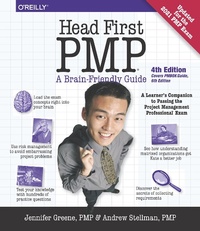
Head First PMP
A Learner's Companion to Passing the Project Management Professional Exam
4th Edition
Published on 11. September 2018
928 pages
978-1-4920-2959-5 (ISBN)
Description

What will you learn from this book?Head First PMP teaches you the latest principles and certification objectives in The PMBOK Guide in a unique and inspiring way. This updated fourth edition takes you beyond specific questions and answers with a unique visual format that helps you grasp the big picture of project management. By putting PMP concepts into context, youll be able to understand, remember, and apply themnot just on the exam, but on the job. No wonder so many people have used Head First PMP as their sole source for passing the PMP exam.This book will help you:Learn PMPs underlying concepts to help you understand the PMBOK principles and pass the certification exam with flying colorsGet 100% coverage of the latest principles and certification objectives in The PMBOK Guide, Sixth EditionMake use of a thorough and effective preparation guide with hundreds of practice questions and exam strategiesExplore the material through puzzles, games, problems, and exercises that make learning easy and entertainingWhy does this book look so different?Based on the latest research in cognitive science and learning theory, Head First PMP uses a visually rich format to engage your mind, rather than a text-heavy approach that puts you to sleep. Why waste your time struggling with new concepts? This multi-sensory learning experience is designed for the way your brain really works.
More details
Other editions
Additional editions
Jennifer Greene | Andrew Stellman
Head First PMP 4e
A Learner's Companion to Passing the Project Management Professional Exam
Book
09/2018
4th Edition
O'Reilly
€74.50
Article not available at the moment
Previous edition
Andrew Stellman | Jennifer Greene
Head First PMP
A Brain-Friendly Guide to Passing the Project Management Professional Exam
E-Book
03/2007
1st Edition
O'Reilly
€37.99
Available for download
Content
- Intro
- Intro: How to use this book
- Who is this book for?
- Read me
- Acknowledgments
- O'Reilly Safari
- 1: Introduction
- Do these problems seem familiar?
- Projects don't have to be this way
- Your problems.already solved
- What you need to be a good project manager
- Understand your company's big picture
- Your project has value
- Your project follows a lifecycle
- Portfolios, programs, and projects have a lot in common
- Portfolios, programs, and projects all use charters
- What a project IS.
- . and what a project is NOT
- A day in the life of a project manager
- How project managers run great projects
- Project management offices help you do a good job, every time
- Good leadership helps the team work together
- Project teams are made of people
- Operations management handles the processes that make your company tick
- A PMP certification is more than just passing a test
- Meet a real-life PMP-certified project manager
- Exam Questions
- Exam Answers
- A day in Kate's life
- Kate wants a new job
- There are different types of organizational structures
- A few more types of organizations
- PMOs can be supportive, controlling, or directive
- Kate takes a new job
- Back to Kate's maintenance nightmare
- Managing project constraints
- Don't reinvent the wheel
- You can't manage your project in a vacuum
- Kate's project needs to follow company processes
- Kate makes some changes.
- .and her project is a success!
- Exam Questions
- 2: The organizational environment
- A day in Kate's life
- Kate wants a new job
- There are different types of organizational structures
- A few more types of organizations
- PMOs can be supportive, controlling, or directive
- Kate takes a new job
- Back to Kate's maintenance nightmare
- Managing project constraints
- Don't reinvent the wheel
- You can't manage your project in vacuum
- Kate's project needs to follow company processes
- Kate makes some changes...
- ...and her project is a success!
- Exam Questions
- Exam Answers
- 3: The process framework and the project manager's role
- Cooking up a project
- Projects are like recipes
- If your project's really big, you can manage it in phases
- Phases can also overlap
- Break it down
- Anatomy of a process
- Combine processes to complete your project
- Knowledge areas organize the processes
- The project manager's role
- Your technical skills make successful projects happen
- Leadership is different than management
- Project managers need to understand how power dynamics affect the team
- Exam Questions
- Exam Answers
- 4: Project integration management
- Time to book a trip
- The teachers are thrilled...for now
- These clients are definitely not satisfied
- The day-to-day work of a project manager
- The seven Integration Management processes
- Start your project with the Initiating processes
- Integration Management and the process groups
- The Develop Project Charter process
- Make the case for your project
- Use expert judgment and data gathering techniques to write your project charter
- A closer look at the project charter
- Two things you'll see over and over and over...
- Plan your project!
- The Project Management plan lets you plan ahead
- A quick look at all those subsidiary plans
- Question Clinic: The just-the-facts-ma'am question
- The Direct and Manage Project Word process
- The project team creates deliverables
- Executing the project includes repairing defects
- The Manage Project Knowledge process
- Knowledge is the lifeblood of any project
- Eventually, things WILL go wrong...
- Sometimes you need to change your plans
- Look for changes and deal with them
- Make only the changes that are right for your project
- How the processes interact with one another
- Changes, defects, and corrections
- Control your changes
- use change control
- Preventing or correcting problems
- Finish the work, close the project
- You don't have to go home, but you can't stay here
- So why INTEGRATION Management?
- Integration Management kept your project on track, and the teachers satisfied
- Key Concept Review
- Exam Questions
- Exam Answers
- 5: Scope management
- Out of the frying pan...
- ...and right back into the fire
- It looks like we have a scope problem
- You've got to know what (and how) you will build before you build it
- The power of Scope Management
- The six Scope Management processes
- Plan your scoping processes
- Now you've got a roadmap for managing scope
- Collect requirements for your project
- Talk to your stakeholders
- Make decisions about requirements
- Understand your requirements
- See your ideas better
- Use a questionnaire to get requirements from a bigger group of people
- A prototype shows users what your product will be like
- Now you're ready to write a requirements document
- Define the scope of the project
- How do you define the scope?
- The project scope statement tells you what you have to do
- Question Clinic: The which-is-BEST question
- Create the work breakdown structure
- The inputs for the WBS come from other processes
- Breaking down the work
- Break it down by project or phase
- Decompose deliverables into work packages
- Inside the work package
- The project scope baseline is a snapshot of the plan
- The outputs of the Create WBS process
- Why scope changes
- The Control Scope process
- Anatomy of a change
- A closer look at the change control system
- Just two Control Scope tools and techniques
- Make sure the team delivered the right product
- The stakeholders give you criteria for deciding when you're done
- Is the product ready to go?
- The project is ready to ship!
- Key Concept Review
- Exam Questions
- Exam Answers
- 6: Project schedule management
- Reality sets in for the happy couple
- Meet the wedding planner
- Schedule management helps with aggressive timelines
- Plan your scheduling processes
- Now you know how you'll track your schedule
- Use the Define Activities process to break down the work
- Tools and techniques for Define Activities
- Rolling wave planning lets you plan as you go
- Define activities outputs
- The Sequence Activities process puts everything in order
- Diagram the relationship between activities
- Network diagrams put your tasks in perspective
- Dependencies help you sequence your activities
- Leads and lags add time between activities
- Scheduling software can help you see the sequence of activities
- Create the network diagram
- Figuring out how long the project will take
- Estimation tools and techniques
- Create the duration estimate
- Back to the wedding
- Bringing it all together
- Question Clinic: The which-comes-next question
- One thing leads to another
- Use the critical path method to avoid big problems
- How to find the critical path
- Finding the float for any activity
- Float tells you how much extra time you have
- Figure out the early start and early finish
- Figure out the latest possible start and finish
- Add early and late durations to your diagrams
- Take a backward pass to find late start and finish
- Let's take some time out to walk through this!
- Crash the schedule
- Fast-tracking the project
- Use data analysis techniques when you build your schedule
- Other Develop Schedule tools and techniques
- Outputs of Develop Schedule
- Influence the factors that cause change
- Control Schedule inputs and outputs
- What Control Schedule updates
- Measuring and reporting performance
- Control Schedule tools and techniques
- Key Concept Review
- Another satisfied customer
- Exam Questions
- Exam Answers
- 7: Cost management
- Time to expand Head First Kitchen
- The renovation goes overboard
- Introducing the Cost Management processes
- Plan how you'll estimate, track, and control your costs
- Now you've got a consistent way to manage costs
- What Alice needs before she can estimate costs
- Other tools and techniques used in Estimate Costs
- Let's talk numbers
- Now Alice knows how much the Kitchen will cost
- The Determine Budget process
- What you need to build your budget
- Determine budget: how to build a budget
- Question Clinic: The red herring
- The Control Costs process is a lot like schedule control
- A few new tools and techniques
- Look at the schedule to figure out your budget
- How to calculate planned value
- Earned value tells you how you're doing
- How to calculate earned value
- Put yourself in someone else's shoes
- Is your project behind or ahead of schedule?
- Are you over budget?
- The earned value management formulas
- Interpret CPI and SPI numbers to gauge your project
- Forecast what your project will look like when it's done
- Once you've got an estimate, you can calculate a variance!
- Finding missing information
- Keep your project on track with TCPI
- A high TCPI means a tight budget
- Party time!
- Key Concept Review
- Exam Questions
- Exam Answers
- 8: Quality management
- What is quality?
- You need more than just tests to figure out quality
- Once you know what the product is supposed to do, it's easy to tell which tests pass and which fail
- Quality up close
- Quality vs. grade
- An ounce of prevention...
- Plan Quality is how you prevent defects
- How to plan for quality
- The Quality Management plan gives you what you need to manage quality
- Inspect your deliverables
- Use the planning outputs for Control Quality
- Tools for data gathering
- Tools for data analysis
- Inspection, testing, and product evaluation
- Tools for data representation
- Question Clinic: The which-one question
- Control Quality means finding and correcting defects
- Trouble at the Black Box 3000 factory
- Introducing Manage Quality
- A closer look at some tools and techiques
- More ideas behind managing quality
- The Black Box 3000 makes record profits!
- Key Concept Review
- Exam Questions
- Exam Answers
- 9: Project resource management
- Mike needs a new team
- Get your team together and keep them moving
- Figure out who you need on your team
- A closer look at the Plan Resource Management outputs
- The Resource Management plan
- What you need to estimate resources
- Estimating the resources
- Get the team together
- Develop your team
- Develop the team with your management skills
- Your interpersonal and team skills can make a big difference for your team
- Lead the team with your management skills
- Motivate your team
- Stages of team development
- How's the team doing?
- Managing your team means solving problems
- Conflict management up close
- How to resolve a conflict
- Make sure to control resources to keep your project on track
- Outputs of the Control Resources process
- Key Concept Review
- Question Clinic: The have-a-meeting question
- Exam Questions
- Exam Answers
- 10: Communications management
- Party at the Head First Lounge!
- But something's not right
- Anatomy of communication
- Get a handle on communication
- Tell everyone what's going on
- Get the message?
- More Manage Communications tools
- Let everyone know how the project's going
- Take a close look at the work being done
- Now you can get the word out
- Count the channels of communication
- Key Concept Review
- Question Clinic: The calculation question
- Exam Questions
- Exam Answers
- 11: Risk management
- What's a risk?
- How you deal with risk
- Plan Risk Management
- Use a risk breakdown structure to categorize risks
- Anatomy of a risk
- What could happen to your project?
- Data-gathering techniques for Identify Risks
- More Identify Risks techniques
- Where to look for risks
- Now put it in the risk register
- Rank your risks
- Examine each risk in the register
- Qualitative vs. quantitative analysis
- Perform Quantitative Risk Analysis
- First gather the data...
- ...then analyze it
- Calculate the expected monetary value of your risks
- Decision tree analysis uses EMV to help you make choices
- Update the risk register based on your quantitative analysis results
- How do you respond to a risk?
- Add risk responses to the register
- Implement Risk Responses
- You can't plan for every risk at the start of the project
- Monitor Risks is another change control process
- How to monitor your risks
- More control risk tools and techniques
- Question Clinic: The which-is-NOT question
- Exam Questions
- Exam Answers
- 12: Procurement management
- Victim of her own success
- Calling in the calvary
- Ask the legal expert
- Anatomy of an agreement
- Start with a plan for the whole project
- The decision is made
- Types of contractual agreements
- More about contracts
- Figure out how you'll sort out potential sellers
- Get in touch with potential sellers
- Pick a partner
- Keep an eye on the contract
- Stay on top of the seller
- Key Concept Review
- Kate closes the contract
- Question Clinic: BYO questions
- Exam Questions
- Exam Answers
- 13: Stakeholder management
- Party at the Head FIrst Lounge (again)!
- Not everybody is thrilled
- Understanding your stakeholders
- Find out who your stakeholders are
- How engaged are your stakeholders?
- Managing stakeholder engagement means clearing up misunderstandings
- Monitor your stakeholders' engagement
- Now you can tell when you need to change the way you deal with stakeholders
- Exam Questions
- Exam Answers
- 14: Professional responsibility
- Doing the right thing
- Keep the cash?
- Fly business class?
- New software
- Shortcuts
- A good price or a clean river?
- We're not all angels
- Exam Questions
- Exam Answers
- 15: A little last-minute review
- A long-term relationship for your brain
- How to do this next section
- Use the Examination Content Outline as a study tool
- How to do this next section
- The People domain
- The Process domain
- The Business Environment domain
- People domain answers
- Process domain answers
- Business environment domain answers
- 16: Practice makes perfect
- Exam Questions
- Before you look at the answers...
- Exam Answers
- Index
