

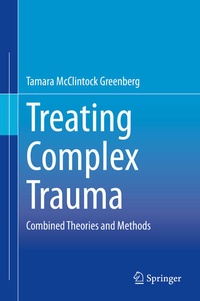
Treating Complex Trauma
Description

Reviews / Votes
"The merits of this book are many, the most important being to make a serious and pervasive disorder such as complex trauma more understandable and therefore more treatable, providing clinicians with a wide framework of concepts and therapeutic tools, and a sustained example of how to build one's own personal toolbox for these often difficult, long and challenging psychotherapies." (Monica Luci, Psychoanalytic Psychotherapy, May 28, 2021)More details
Other editions
Additional editions
Person
Tamara McClintock Greenberg, Psy.D., M.S. , is a clinical psychologist in private practice in San Francisco, CA, where she specializes in treating adults with depression, anxiety, relationship issues, trauma, and those who are coping with medical illness, either as a patient or affected family member. She has been practicing psychology in San Francisco since 1997.
As a Full Clinical Professor of Psychiatry at the University of California, San Francisco, Tamara spent over 12 years seeing medical patients and their families in the UCSF hospitals and clinics and has spent the last 22 years supervising psychiatry residents, psychology interns and students in a number of different training centers.
Tamara received a post-doctorate master's degree in Clinical Psychopharmacology from Alliant University/California School of Professional Psychology in 2004, her Doctorate Degree in Clinical Psychology from Argosy University/Minnesota School of Professional Psychology, Minneapolis, MN in 1997.
She received the Jacob Markovitz Memorial Scholarship toward her graduate school studies. Her APA-approved predoctoral internship was at the Veterans Affairs Medical Center in North Chicago, IL from 1996-1997. She has been licensed as a clinical psychologist in the state of California since 1999 (PSY 16206).Her publishing has focused on care taking, health psychology, psychodynamic psychology, women's issues and trauma, with the aim of helping people navigate complex physical and/or psychological issues.
Tamara has written for multiple publications, including The Huffington Post, Psych Central, Psychology Today, The Good Men Project, Maria Shriver's website, The San Francisco Chronicle, and has been quoted as an expert in Forbes, USA Today, Newsweek, Next Avenue (PBS), The Washington Post and more. She has been interviewed by numerous radio stations, including several NPR stations and affiliates.
Tamara lives in San Francisco with her husband and two pugs, Roscoe and Rufus.
Content
Chapter One: The Need for Utilizing Multiple Approaches for Complex PTSD: No Theory Has It All.- Chapter Two: How Trauma Stokes Fear: Considerations in Beginning of Therapy.- Chapter Three: Nurturing the Therapeutic Alliance: Mentalizing and Emotional Safety.- Chapter Four: The Therapeutic Alliance and Maintaining Physical Safety.- Chapter Five: Dissociation: Controversies and Clinical Strategies.- Chapter Six: The Need to Numb: Substance Abuse and Therapeutic Management.- Chapter Seven: When Trauma is in the Body: Managing Physical Concerns.- Chapter Eight: When Fight Impulses Dominate: Managing Anger.- Chapter Nine: Sociocultural Consideration in Trauma Treatment.- Chapter Ten: Vicarious Trauma and Self Care for the Trauma Therapist.
