

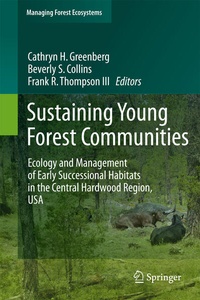
Sustaining Young Forest Communities
Description

Reviews / Votes
From the reviews:
"This book attempts to synthesize information from various fields about early successional habitats to help researchers and resource managers understand, sustain, and protect wildlife and plant species across these ecosystems. . Chapters are thoroughly referenced with citation lists at the end of each. . the book can serve as a useful practical management guide. Includes numerous black-and-white and color photographs, figures, and maps. Summing Up: Recommended. Upper-division undergraduates and above." (D. L. Richter, Choice, Vol. 49 (6), February, 2012)
"Sustaining Young Forest Communities is a good compilation of knowledge about an important forest ecosystem and belongs on the bookshelf of every natural resource practitioner tasked with managing this important resource. One of the principal benefits for anyone who reads this book is that it provides both a broad overview and a reference source for the various disciplines, particularly for those with which the reader is not familiar, allowing one to gain understanding of the opportunities and issues." (W. Keith Moser, Journal of Forestry, June, 2012)
More details
Other editions
Additional editions
Content
1. Introduction: What are Early Successional Habitats, Why are they Important, and How Can they be Sustained?.- 2. Subregional Variation in Upland Hardwood Forest Composition and Disturbance Regimes of the Central Hardwood Region.- 3. Natural Disturbances and Early Successional Habitats.- 4. Fire in Eastern Hardwood Forests through 14,000 Years.- 5. Structure and Species Composition of Upland Hardwood Communities After Regeneration Treatments Across Environmental Gradients.- 6. Spatial and Temporal Patterns in the Amount of Young Forests and Implications for Biodiversity.- 7. Herbaceous Response to Type and Severity of Disturbance.- 8. The Role of Young, Recently Disturbed Upland Hardwood Forest as High Quality Food Patches.- 9. Population Trends for Eastern Scrub-Shrub Birds Related to Availability of Small-diameter Upland Hardwood Forests.- 10. Bats and Gaps: The Role of Early Successional Patches in the Roosting and Foraging Ecology of Bats.- 11. Reptile and Amphibian Response to Hardwood Forest Management and Early Successional Habitats.- 12. Managing Early Successional Habitats for Wildlife in Novel Places.- 13. Conservation of Early Successional Habitats in the Applachian Mountains: A Manager's Perspective.- 14. Early Successional Forest Habitats and Water Resources.- 15. Carbon Dynamics Following the Creation of Early Successional Habitats in Forests of the Central Hardwood Region.- 16. Forecasting Forest Type and Age Classes in the Appalachian-Cumberland Subregion of the Central Hardwood Region.
