Processing
Description

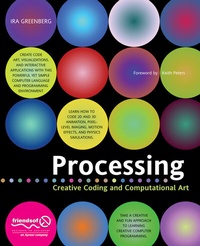
If you're interested in creating cutting-edge code-based art and animations, you've come to the right place! Processing (available at www.processing.org) is a revolutionary open source programming language and environment designed to bridge the gap between programming and art, allowing non-programmers to learn programming fundamentals as easily as possible, and empowering anyone to produce beautiful creations using math patterns. With the software freely available, Processing provides an accessible alternative to using Flash for creative coding and computational art--both on and off the Web.
This book is written especially for artists, designers, and other creative professionals and students exploring code art, graphics programming, and computational aesthetics. The book provides a solid and comprehensive foundation in programming, including object-oriented principles, and introduces you to the easy-to-grasp Processing language, so no previous coding experience is necessary. The book then goes through using Processing to code lines, curves, shapes, and motion, continuing to the point where you'll have mastered Processing and can really start to unleash your creativity with realistic physics, interactivity, and 3D! In the final chapter, you'll even learn how to extend your Processing skills by working directly with the powerful Java programming languagethe language Processing itself is built with.
Reviews / Votes
From the reviews:
"Processing is a didactic that is based on the idea that programming can be learned very easily through the creation of screen art. . The main goal is to educate designers and artists . . the book in combination with the programming environment also presents an excellent implementation of the concept. I recommend this work for anybody who wants to explore programming in a different way, or for a teacher who wants to get inspired for his or her own programming class." (Gerald Friedland, ACM Computing Reviews, October, 2008)
"The book is intended as an introduction to programming for designers and artists using the Processing language and environment, a language designed 'by artists for artists' and available as open source. It contains 13 chapters, and begins with a relatively gentle introduction to Processing. It continues with chapters focusing on imaging, animation, and three-dimensional (3D) graphics." (Jeffrey Putnam, ACM Computing Reviews, Vol. 49 (8), August, 2008)
More details
Other editions
New editions
Additional editions