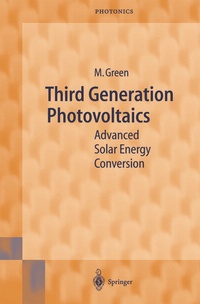
Third Generation Photovoltaics
Description

Photovoltaics, the direct conversion of sunlight to electricity, is now the fastest growing technology for electricity generation. Present "first generation" products use the same silicon wafers as in microelectronics. "Second generation" thin-films, now entering the market, have the potential to greatly improve the economics by eliminating material costs. Martin Green, one of the world's foremost photovoltaic researchers, argues in this book that "second generation" photovoltaics will eventually reach its own material cost constraints, engendering a "third generation" of high performance thin-films. The book explores, self-consistently, the energy conversion potential of advanced approaches for improving photovoltaic performance and outlines possible implementation paths.
Reviews / Votes
"Martin A. Green of the University of New South Wales, Sydney, is arguably the most renowned scientist in the field of photovoltaics . The book is well written, covers all the important concepts, and gives the right references. Green manages to keep the reader's attention in spite of some arduous derivations . Third Generation Photovoltaics will be invaluable as a reference for anyone involved in long-term photovoltaics research and useful as textbook for courses on advanced solar energy conversion." MATERIALS TODAY
More details
Other editions
Additional editions