

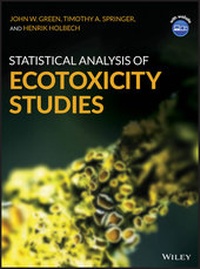
Statistical Analysis of Ecotoxicity Studies
Description

Statistical Analysis of Ecotoxicity Studies offers a guide to the design, analysis, and interpretation of a range of experiments that are used to assess the toxicity of chemicals. While the book highlights ecotoxicity studies, the methods presented are applicable to the broad range of toxicity studies. The text contains myriad datasets (from laboratory and field research) that clearly illustrate the book's topics. The datasets reveal the techniques, pitfalls, and precautions derived from these studies.
The text includes information on recently developed methods for the analysis of severity scores and other ordered responses, as well as extensive power studies of competing tests and computer simulation studies of regression models that offer an understanding of the sensitivity (or lack thereof) of various methods and the quality of parameter estimates from regression models. The authors also discuss the regulatory process indicating how test guidelines are developed and review the statistical methodology in current or pending OECD and USEPA ecotoxicity guidelines. This important guide:
* Offers the information needed for the design and analysis to a wide array of ecotoxicity experiments and to the development of international test guidelines used to assess the toxicity of chemicals
* Contains a thorough examination of the statistical issues that arise in toxicity studies, especially ecotoxicity
* Includes an introduction to toxicity experiments and statistical analysis basics
* Includes programs in R and excel
* Covers the analysis of continuous and Quantal data, analysis of data as well as Regulatory Issues
* Presents additional topics (Mesocosm and Microplate experiments, mixtures of chemicals, benchmark dose models, and limit tests) as well as software
Written for directors, scientists, regulators, and technicians, Statistical Analysis of Ecotoxicity Studies provides a sound understanding of the technical and practical issues in designing, analyzing, and interpreting toxicity studies to support or challenge chemicals for use in the environment.
More details
Other editions
Additional editions
Persons
JOHN W. GREEN, PHD, PHD is currently a Principal Consultant Biostatistics in DuPont Data Science and Informatics Group. Dr. Green is the lead DuPont statistician developing internal expertise and training in probabilistic risk assessment methods following guidance developed by EUFRAM and has been very active in OECD expert groups developing test guidelines and guidance documents.
TIMOTHY A. SPRINGER, PHD has served as the statistician for Wildlife International, a leading contract ecotoxicology testing laboratory, for over 25 years.
HENRIK HOLBECH, PHD is an Associate Professor in Ecotoxicology at the University of Southern Denmark.
Content
Preface ix Acknowledgments xi
About the Companion Website xiii
1. An Introduction to Toxicity Experiments 1
1.1 Nature and Purpose of Toxicity Experiments 1
1.2 Regulatory Context for Toxicity Experiments 7
1.3 Experimental Design Basics 8
1.4 Hierarchy of Models for Simple Toxicity Experiments 12
1.5 Biological vs. Statistical Significance 13
1.6 Historical Control Information 15
1.7 Sources of Variation and Uncertainty 15
1.8 Models with More Complex Structure 16
1.9 Multiple Tools to Meet a Variety of Needs or Simple Approaches to Capture Broad Strokes? 16
2. Statistical Analysis Basics 19
2.1 Introduction 19
2.2 NOEC/LOEC 19
2.3 Probability Distributions 24
2.4 Assessing Data for Meeting Model Requirements 29
2.5 Bayesian Methodology 30
2.6 Visual Examination of Data 30
2.10 Time-to-Event Data 37
2.11 Experiments with Multiple Controls 38
3. Analysis of Continuous Data: NOECs 47
3.1 Introduction 47
3.2 Pairwise Tests 47
3.3 Preliminary Assessment of the Data to Select the Proper Method of Analysis 53
3.4 Pairwise Tests When Data do not Meet Normality or Variance Homogeneity Requirements 62
3.5 Trend Tests 67
3.6 Protocol for NOEC Determination of Continuous Response 75
3.7 Inclusion of Random Effects 75
3.8 Alternative Error Structures 76
3.9 Power Analyses of Models 77 Exercises 81
4. Analysis of Continuous Data: Regression 89
4.1 Introduction 89
4.2 Models in Common Use to Describe Ecotoxicity Dose-Response Data 92
4.3 Model Fitting and Estimation of Parameters 95
4.4 Examples 104
4.5 Summary of Model Assessment Tools for Continuous Responses 112
Exercises 114
5. Analysis of Continuous Data with Additional Factors 123
5.1 Introduction 123
5.2 Analysis of Covariance 123
5.3 Experiments with Multiple Factors 135
Exercises 41
6. Analysis of Quantal Data: NOECs 157
6.1 Introduction 157
6.2 Pairwise Tests 157
6.3 Model Assessment for Quantal Data 160
6.4 Pairwise Models that Accommodate Overdispersion 162
6.5 Trend Tests for Quantal Response 165
6.6 Power Comparisons of Tests for Quantal Responses 168
6.7 Zero-Inflated Binomial Responses 172
6.8 Survival- or Age-Adjusted Incidence Rates 175
Exercises 179
7. Analysis of Quantal Data: Regression Models 181
7.1 Introduction 181
7.2 Probit Model 181
7.3 Weibull Model 188
7.4 Logistic Model 188
7.5 Abbott's Formula and Normalization to the Control 190
7.6 Proportions Treated as Continuous Responses 197
7.7 Comparison of Models 198
7.8 Including Time-Varying Responses in Models 199
7.9 Up-and-Down Methods to Estimate LC50 204
7.10 Methods for ECx Estimation When there is Little or no Partial Mortality 206
Exercises 215
8. Analysis of Count Data: NOEC and Regression 219
8.1 Reproduction and Other Nonquantal Count Data 219
8.2 Transformations to Continuous 219
8.3 GLMM and NLME Models 223
8.4 Analysis of Other Types of Count Data 228
Exercises 237
9. Analysis of Ordinal Data 243
9.1 Introduction 243
9.2 Pathology Severity Scores 243
9.3 Developmental Stage 249
Exercises 255
10. Time-to-Event Data 259
10.1 Introduction 259
10.2 Kaplan-Meier Product-Limit Estimator 261
10.3 Cox Regression Proportional Hazards Estimator 266
10.4 Survival Analysis of Grouped Data 268
Exercises 271
11. Regulatory Issues 275
11.1 Introduction 275
11.2 Regulatory Tests 275
11.3 Development of International Standardized Test Guidelines 276
11.4 Strategic Approach to International Chemicals Management (SAICM) 279
11.5 The United Nations Globally Harmonized System of Classification and Labelling of Chemicals (GHS) 279
11.6 Statistical Methods in OECD Ecotoxicity Test Guidelines 279
11.7 Regulatory Testing: Structures and Approaches 279
11.8 Testing Strategies 287
11.9 Nonguideline Studies 291
12. Species Sensitivity Distributions 293
12.1 Introduction 293
12.2 Number, Choice, and Type of Species Endpoints to Include 294
12.3 Choice and Evaluation of Distribution to Fit 294
12.4 Variability and Uncertainty 300
12.5 Incorporating Censored Data in an SSD 302
Exercises 307
13. Studies with Greater Complexity 309
13.1 Introduction 309
13.2 Mesocosm and Microcosm Experiments 310
13.3 Microplate Experiments 316
13.4 Errors-in-Variables Regression 321
13.5 Analysis of Mixtures of Chemicals 323
13.6 Benchmark Dose Models 326
13.7 Limit Tests 327
13.8 Minimum Safe Dose and Maximum Unsafe Dose 329
13.9 Toxicokinetics and Toxicodynamics 331
Exercises 343
Appendix 1 Dataset 345
Appendix 2 Mathematical Framework 347
A2.3 Method of Maximum Likelihood 350
A2.4 Bayesian Methodology 352
A2.5 Analysis of Toxicity Experiments 354
A2.6 Newton's Optimization Method 358 Table A3.3 Linear and Quadratic Contrast
A2.7 The Delta Method 359 Coefficients 366
A2.8 Variance Components 360 Table A3.4 Williams' Test ta¯ ,k for a = 0.05 367
Appendix 3 Tables
Table A3.1 Studentized Maximum Distribution 364
Table A3.2 Studentized Maximum Modulus Distribution 365
Table A3.3 Linear and Quadratic Contrast Coefficients 366
Table A3.4 Williams' Test t¯a,k for a = 0.05 367
References 371
Author Index 385
Subject Index 389
Preface
John Green and Tim Springer developed a one-day training course, Design and Analysis of Ecotox Experiments, for the Society for Environmental Toxicology and Chemistry (SETAC) and delivered it for the first time at the SETAC Europe 13th Annual Meeting in Hamburg, Germany, in 2003. Since then, in many years we have taught this course at the annual SETAC conferences in Europe and North America, updating it each time to stay abreast of the evolving regulatory requirements. In 2011, Henrik Holbech joined us and has made valuable contributions ever since. In 2014, Michael Leventhal of Wiley approached us with the idea of turning the training course into a textbook. The result is the current book, and we appreciate the opportunity to reach a wider audience.
This book covers the statistical methods in all current OECD test guidelines related to ecotoxicity. Most of these have counterparts in the United States Environmental Protection Agency (USEPA) guidelines. In addition, statistical methods in several WHO and UN guidelines are also covered, as are guidelines in development or that have been proposed. Chapter 11 provides a good coverage of all the test guidelines covered in this book with reference to the chapters in which guideline-specific statistical methods are developed. With very few exceptions, the data used in the examples and exercises are from studies done for product submissions or in developing some regulatory test guideline. The authors have been members for a combined total of more than 30 years of the OECD validation management group for ecotoxicity (VMG-eco) responsible for development and update of significant portions of numerous current test guidelines including OECD TG 210, 229, 230, 234, 236, 240, 241, 242, and 243. We have also been actively involved in designing and analyzing ecotoxicity studies for more than a combined total of 60 years. One or more of us were also members of the expert groups that developed (i) the European Framework for Probabilistic Risk Assessment (Chapman et al., 2007), (ii) OECD Fish Toxicity Testing Framework (OECD, 2014c), (iii) Current Approaches in the Statistical Analysis of Ecotoxicity Data: A Guidance to Application (OECD, 2014a, 2006a), (iv) OECD test guideline 223 that describes a sequential test designed to measure mortality in avian acute tests, (v) OECD Guidance Document on Standardised Test Guidelines for Evaluating Chemicals for Endocrine Disruption (OECD, 2012a) and (vi) OECD test guideline 305 for assessing bioaccumulation in fish.
Our intent is to provide an understanding of the statistical methods used in the regulatory context of ecotoxicity. However, the coverage and treatment of the topics should appeal to a much wider audience. A mathematical appendix is included to provide technical issues, but the focus is on the practical aspects of model fitting and hypothesis tests. There are numerous exercises based on real studies to help the reader enhance his or her understanding of the topics. Ample references are provided to allow the interested reader to pursue topics in greater depth. We have not shied away from controversies in the field. We think it important that the reader understand that statistics is not free of controversy and should be well-informed on these issues. Nonetheless, while we have points of view on these topics and express them, we have tried to take an even-handed approach in describing the different points of view and provide references to allow the reader to more fully appreciate the arguments on these issues.
A frequent question from participants in the training course was where one could find software to carry out the methods of analysis we taught and were required or at least recommended in regulatory test guidelines. While we have developed in-house proprietary SAS-based software for this purpose, it has not been possible to share it. One of the benefits of this textbook is the availability of a website created by Wiley where we are providing SAS and R programs for almost all methods presented. In some instances, rather than present programs, we provide a link to free online software that has been developed for specific guidelines or for a more general use. In some cases, we have been unable to find R programs to carry out the recommended methods. For those cases especially, we invite the readers of this book to develop and send such programs to us. In a few cases, no SAS program is provided. In all cases, a program or link is provided for all analyses discussed. After we test programs supplied by readers, we will put them on the website with appropriate acknowledgments. Also, if any shortcomings are found in the initially provided programs, we encourage the readers to bring them to our attention and we will post corrections or improvements. As regulatory requirements change or methods improve, we will update the website.
We have had support from numerous people over the years in developing the training material and the material for this book. Colleagues too numerous to name from DuPont, Wildlife International/EAG, USEPA, OECD, and other companies, universities, and CROs have contributed ideas and data that have been very helpful in improving our understanding of ecotoxicology. Two instructors joined us, Michael Newman of Virginia Institute of Marine Science, School of Marine Science, The College of William and Mary, and Chen Teel of DuPont, each for one offering of the course and both added value. In addition, we have SAS expertise, but more limited experience with R. As a consequence, while we developed some R programs ourselves, several very capable people were engaged to develop most R programs for the website. Several deserve special acknowledgment. We have modified their programs in minor ways to fit the needs of the website and accept responsibility for any errors.
Joe Swintek is a statistician working with the Duluth office of the USEPA. He was a contributor to one of our publications (Green et al., 2014) and turned the SAS version of the StatCHARRMS software John and Amy Saulnier developed under contract for the USEPA into an R package. The SAS version is provided in Appendix 1 (the website) and the R version is now in the CRAN library. A link is provided in the references (Swintek, 2016). In addition to the RSCABS program for histopathology severity scores (Chapter 9), StatCHARRMS contains the Dunnett and Dunn tests, the step-down trend tests Jonckheere-Terpstra (Chapter 3), Cochran-Armitage and Fisher's exact tests (Chapter 6), Shapiro-Wilk and Levene tests for normality and variance homogeneity (Chapter 3), and repeated measures ANOVA for multi-generation medaka reproduction studies (Chapter 5). Several of these tests are provided in Appendix 1 in stand-alone versions, as well as in the full CRAN version. In addition, Joe developed a versatile R program for the important Williams' test, and that is in Appendix 1 and has been added to the StatCHARRMS package. We were surprised to find that this test had not previously been released in an R package, so far as we are aware. There is an R package, multcomp, that refers to Williams' type contrasts within the function mcp, but the results deviate substantially from Williams' test. We have verified with the developer, Ludwig Hothorn, that package mcp does not provide Williams' test. More discussion on this is provided in Chapter 3. Joe also provided numerous other R programs for several chapters as well as pointing out a simple R function based on the package sas7bdat for reading a SAS dataset into R without the need to have SAS installed or converting the dataset to excel or text first. We are very grateful for his contributions.
Chapter 13 leans heavily on discussions of the expert group that developed guidance on implementation of OECD test guideline 305 on bioaccumulation in fish. In particular, Tom Aldenberg of RIVM has provided invaluable communications to us concerning the R program, bcmfR, that he has provided to OECD for analysis of bioconcentration and biomagnification studies.
Georgette Asherman also deserves special mention, primarily for her R programming work for Chapter 5. Among her notable contributions were versatile and robust versions of the Shapiro-Wilk and Levene tests, the Shirley nonparametric ANCOVA program, two parametric ANCOVA programs, programs to add confidence bounds to the graphic output for nonlinear regression, and zero-inflated binomial and beta-binomial models.
Erand Smakaj provided training in the use of R-Studio and contributed programs for survival analysis and for several topics in Chapter 13 and was very accommodating throughout the text and code development.
Xiaopei Jin made important contributions to the R programs for Chapter 8 and demonstrated useful capabilities of R that can be applied to programs in all chapters.
Finally, we would be remiss not to acknowledge the many contributions Amy Saulnier has made to SAS programming used in this book and elsewhere. John has worked with Amy over the entire 29+ years of his DuPont career. In addition to turning his SAS programs into the user-friendly StatCHARRMS program, she has done the same for two other heavily used SAS-based in-house software packages routinely used for our toxicology and ecotoxicology analyses for regulatory submissions. She has maintained these programs, updated them as needed to stay current with regulatory requirements and changes in the computing environment, and has been an essential contributor to DuPont's work for over three decades.
The...
