

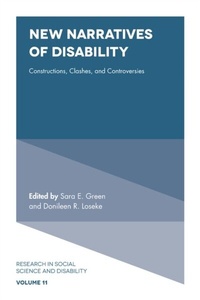
New Narratives of Disability
Constructions, Clashes, and Controversies
1st Edition
Published on 25. November 2019
304 pages
978-1-83909-145-2 (ISBN)
Description

This volume explores questions about narrative frameworks in disability research. Narrative is a omnipresent meaning-producing communication form in social life that is both cultural and personal.
Public understandings of disability tend to follow a medical storyline in which disability is a personal tragedy to be treated through professional intervention - a frame that disempowers and fails to resonate with many disabled people. Scholars in disability studies and the social sciences have proposed an alternative that portrays social structures, forces, and attitudes as the problems to be resolved - a frame that, while empowering, may neglect, or even repress, some kinds of personal disability stories.
This volume seeks to answer the call for richer, more diverse understandings of disability. We explore how narrative inquiry can broaden perspectives on disability to include pain, suffering, chronic illness, and episodic disability, as well as the perspectives of family members and caregivers, while also serving as a platform for dismantling prejudice and discrimination in order to promote positive social change.
Public understandings of disability tend to follow a medical storyline in which disability is a personal tragedy to be treated through professional intervention - a frame that disempowers and fails to resonate with many disabled people. Scholars in disability studies and the social sciences have proposed an alternative that portrays social structures, forces, and attitudes as the problems to be resolved - a frame that, while empowering, may neglect, or even repress, some kinds of personal disability stories.
This volume seeks to answer the call for richer, more diverse understandings of disability. We explore how narrative inquiry can broaden perspectives on disability to include pain, suffering, chronic illness, and episodic disability, as well as the perspectives of family members and caregivers, while also serving as a platform for dismantling prejudice and discrimination in order to promote positive social change.
More details
Series
Language
English
Place of publication
Bingley
United Kingdom
Target group
Professional and scholarly
File size
0,46 MB
ISBN-13
978-1-83909-145-2 (9781839091452)
Copyright in bibliographic data and cover images is held by Nielsen Book Services Limited or by the publishers or by their respective licensors: all rights reserved.
Schweitzer Classification
Other editions
Additional editions
Sara E. Green | Donileen R. Loseke
New Narratives of Disability
Constructions, Clashes, and Controversies
Book
11/2019
Emerald Publishing Limited
€139.30
Shipment within 3-4 weeks
Persons
Sara E. Green, Ph.D. is Director of the Interdisciplinary Social Sciences Program and Professor of
Sociology at the University of South Florida, USA; past chair and career award
recipient of the American Sociological Association (ASA) Section on Disability
& Society; and past co-chair of the ASA Committee on the Status of Persons
with Disabilities. Donileen R. Loseke, Ph.D. is Professor of Sociology at the University of South Florida, USA; Past
President of both the Society for the Study of Symbolic Interaction and the
Society for the Study of Social Problems; and received the Mead, Cooley and
Mentor Awards from the Society for the Study of Symbolic Interaction.
Sociology at the University of South Florida, USA; past chair and career award
recipient of the American Sociological Association (ASA) Section on Disability
& Society; and past co-chair of the ASA Committee on the Status of Persons
with Disabilities. Donileen R. Loseke, Ph.D. is Professor of Sociology at the University of South Florida, USA; Past
President of both the Society for the Study of Symbolic Interaction and the
Society for the Study of Social Problems; and received the Mead, Cooley and
Mentor Awards from the Society for the Study of Symbolic Interaction.
Content
Introduction Exploring Narrative as a Social Science Framework on Disability and Disabled People; Donileen R. Loseke & Sara E. Green
Part I: Cultural Stories of Disability and Individual Lives
Chapter 1. Reframing the Story of Helen Keller and Anne Sullivan: Resisting (Dis)Ability Stereotypes Through an Analysis of Children's Literature; Cheryl Najarian Souza
Chapter 2. 'It's Not That Way You Know, She Has a Good Future': Women's Experiences of Disability and Community-Based Rehabilitation in Sri Lanka; Carmen Rebecca Britton & Laura Mauldin
Chapter 3. Test Anxiety: Participation and Exclusion beyond the Institution; M. Nickie Coomer & Kenzie Latham-Mintus
Chapter 4. Narratives of Care and Citizenship: Managing "Precariously Normal" Sons and Daughters in an Age of Inequality; Linda M. Blum
Chapter 5. 'More Than a Parent, You're a Caregiver': Narratives of Fatherhood in Families of Adult Sons and Daughters with Life-Long Disabilities; Heidi Steinour & Sara E. Green
Part II: Cultural Stories of Disability and Organizations
Chapter 6.'You Won't Tell That You Have Schizophrenia, Right? You Should Say You Have a Small Depression': Organizational Narratives of 'Adjusted' Workers with Disabilities and the Rhetoric of Reassurance in France; Lisa D. Buchter
Chapter 7. 'I Want to Go Places on My Own': A Case-Study of Virginia Commonwealth University Ace-It in College; Stephanie J. Lau & Liza H. Weiss
Chapter 8. More than Therapy: Conformity and Resistance in an Organizational Narrative of Disability and the Performing Arts; Melinda Leigh Maconi
Part III: Cultural Stories of Disability and Social Policies
Chapter 9. Narrative Productions of Problems and People in the Americans with Disabilities Amendment Act; Melissa Jane Welch
Chapter 10. Institutional and Personal Narratives of Chronic Pain Management: Interrogating the Medical and Social Models of Disability; Loren E. Wilbers
Chapter 11. Stuck in Transition With You: Variable Pathways to In(ter)dependence for Emerging Adult Men With Mobility Impairments; J. Dalton Stevens
Chapter 12. Conflicting Narratives of Corporeal Citizenship: Medicaid Personal Care Attendant (PCA) Policy and Experiences of Cross-State Move Plans and Pursuits; Brian R. Grossman
Part IV: Cultural Stories of Disability and Resistance
Chapter 13. Neither Victim Nor Super-Hero: Reflections on Disability and Mental Health Counseling; Richard A. Chapman
Chapter 14. Self-Study of Intersectional and Emotional Narratives: Narrative Inquiry, Disability Studies in Education, and Praxis in Social Science Research; Lisa Boskovich, Mercedes Adell Cannon, David Hernandez-Saca, Laurie Gutmann Kahn & Emily A. Nusbaum
Chapter 15. Neoliberalism and the Fight for the Child: Narratives of Queer Mothering; Ahoo Tabatabai
Chapter 16. Sick and Tired: Narratives of Contested Illness in Chronic Fatigue Syndrome Blogs; Morgan V. Sanchez
Chapter 17. 'We Love Each Other Into Meaning': Queer Disabled Tumblr Users Constructing Identity Narratives through Love and Anger; Justine E. Egner
Part I: Cultural Stories of Disability and Individual Lives
Chapter 1. Reframing the Story of Helen Keller and Anne Sullivan: Resisting (Dis)Ability Stereotypes Through an Analysis of Children's Literature; Cheryl Najarian Souza
Chapter 2. 'It's Not That Way You Know, She Has a Good Future': Women's Experiences of Disability and Community-Based Rehabilitation in Sri Lanka; Carmen Rebecca Britton & Laura Mauldin
Chapter 3. Test Anxiety: Participation and Exclusion beyond the Institution; M. Nickie Coomer & Kenzie Latham-Mintus
Chapter 4. Narratives of Care and Citizenship: Managing "Precariously Normal" Sons and Daughters in an Age of Inequality; Linda M. Blum
Chapter 5. 'More Than a Parent, You're a Caregiver': Narratives of Fatherhood in Families of Adult Sons and Daughters with Life-Long Disabilities; Heidi Steinour & Sara E. Green
Part II: Cultural Stories of Disability and Organizations
Chapter 6.'You Won't Tell That You Have Schizophrenia, Right? You Should Say You Have a Small Depression': Organizational Narratives of 'Adjusted' Workers with Disabilities and the Rhetoric of Reassurance in France; Lisa D. Buchter
Chapter 7. 'I Want to Go Places on My Own': A Case-Study of Virginia Commonwealth University Ace-It in College; Stephanie J. Lau & Liza H. Weiss
Chapter 8. More than Therapy: Conformity and Resistance in an Organizational Narrative of Disability and the Performing Arts; Melinda Leigh Maconi
Part III: Cultural Stories of Disability and Social Policies
Chapter 9. Narrative Productions of Problems and People in the Americans with Disabilities Amendment Act; Melissa Jane Welch
Chapter 10. Institutional and Personal Narratives of Chronic Pain Management: Interrogating the Medical and Social Models of Disability; Loren E. Wilbers
Chapter 11. Stuck in Transition With You: Variable Pathways to In(ter)dependence for Emerging Adult Men With Mobility Impairments; J. Dalton Stevens
Chapter 12. Conflicting Narratives of Corporeal Citizenship: Medicaid Personal Care Attendant (PCA) Policy and Experiences of Cross-State Move Plans and Pursuits; Brian R. Grossman
Part IV: Cultural Stories of Disability and Resistance
Chapter 13. Neither Victim Nor Super-Hero: Reflections on Disability and Mental Health Counseling; Richard A. Chapman
Chapter 14. Self-Study of Intersectional and Emotional Narratives: Narrative Inquiry, Disability Studies in Education, and Praxis in Social Science Research; Lisa Boskovich, Mercedes Adell Cannon, David Hernandez-Saca, Laurie Gutmann Kahn & Emily A. Nusbaum
Chapter 15. Neoliberalism and the Fight for the Child: Narratives of Queer Mothering; Ahoo Tabatabai
Chapter 16. Sick and Tired: Narratives of Contested Illness in Chronic Fatigue Syndrome Blogs; Morgan V. Sanchez
Chapter 17. 'We Love Each Other Into Meaning': Queer Disabled Tumblr Users Constructing Identity Narratives through Love and Anger; Justine E. Egner
