

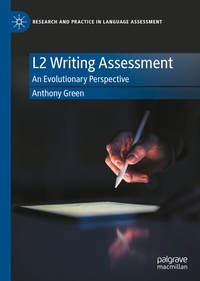
L2 Writing Assessment
Description

This book tackles three choices that face developers of L2 writing assessments: defining L2 writing abilities; collecting evidence of those abilities (usually by getting L2 writers to write something); and judging their performance (usually by assigning a score or grade to it). It takes a historical view of how assessment developers have made those choices, how contemporary practices emerged, and of alternative techniques that have risen and fallen over time.
The three sections each tackle one of these choices. The first considers the social functions that define L2 writing and assessment; the second relates how assessment tasks have adapted to changing conceptions of languages, writing, and assessment; and the third explores how scoring systems have evolved. Each section brings the reader up to date with current issues confronting writing assessment (both in large-scale testing and in language classrooms) before considering the new opportunities and challenges of the digital age. This book will be of interest to students, scholars and practitioners in language assessment, language education, and applied linguistics.Reviews / Votes
"It offers graduate students with an interest in L2 writing assessment, as well as novice researchers and practitioners, important historical context and background information. . As for seasoned scholars, researchers, and practitioners, the book provides a historical and critical understanding of the current state of the field, along with optimism and promising directions for the field's future. Anyone engaged, or planning to engage, with L2 writing assessment theory, research, policy, or practice will gain significant insights from reading this book." (Khaled Barkaoui, Language Testing, March 22, 2024)
"L2 Writing Assessment: An Evolutionary Perspective written by Anthony Green provides an in-depth look at L2 writing assessment from a critical angle which has been under-investigated to date. . Language assessment provides valuable feedback to both teachers and students about their progress and areas for improvement, which is an essential part of language learning. . This book, L2 Writing Assessment: An Evolutionary Perspective, deserves a recommendation for its compelling content." (Hassan Mohebbi and Eunjeong Park, Assessing Writing, Vol. 57, July, 2023)
More details
Other editions
Additional editions
Person
Anthony Green is Professor in Language Assessment and Director of the Centre for Research in English Language Learning and Assessment at the University of Bedfordshire, UK. He conducts training courses and has served as a consultant on language assessment projects around the world. His books include Exploring Language Assessment and Testing (2020) and Language Functions Revisited (2012).
Content
Part I Getting started with L2 writing.- Chapter 1 Introduction.- Part II Getting writers to write.- Chapter 2 Public education, rhetoric, and examinations.- Chapter 3 The dawn of the language test.- Chapter 4 Assessment trends and the revival of writing.- Chapter 5 Shifting views of L2 writing.- Part III Judging language learners' writing.- Chapter 6 Compelling consensus: from mark schemes to the scaling of samples.- Chapter 7 Rating scales and beyond.- Chapter 8 Directions in L2 writing assessment.
