

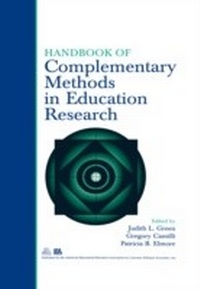
Handbook of Complementary Methods in Education Research
3rd Edition
Published on 4. January 2012
896 pages
978-1-135-28331-5 (ISBN)
Description

Published for the American Educational Research Association by Routledge.
The Handbook of Complementary Methods in Education Research is a successor volume to AERA's earlier and highly acclaimed editions of Complementary Methods for Research in Education. More than any book to date (including its predecessors), this new volume brings together the wide range of research methods used to study education and makes the logic of inquiry for each method clear and accessible. Each method is described in detail, including its history, its research design, the questions that it addresses, ways of using the method, and ways of analyzing and reporting outcomes. Key features of this indispensable book include the following: Foundations Section-Part I is unique among research books. Its three chapters examine common philosophical, epistemological, and ethical issues facing researchers from all traditions, and frames ways of understanding the similarities and differences among traditions. Together they provide a tripartite lens through which to view and compare all research methods. Comprehensive Coverage-Part II (the heart of the book) presents 35 chapters on research design and analysis. Each chapter includes a brief historical overview of the research tradition, examines the questions that it addresses, and presents an example of how the approach can be used. Programs of Research-Part III examines how research programs connected to eight specific lines of inquiry have evolved over time. These chapters examine phenomena such as classroom interaction; language research; issues of race, culture, and difference; policy analysis; program evaluation; student learning; and teacher education. Complementary Methods-As the title suggests, a central mission of this book is to explore the compatibility of different research methods. Which methods can be productively brought together and for what purposes? How and on what scale can they be made compatible and what phenomena are they best suited to explore? Flexibility-The chapters in Parts II and III are largely independent. Therefore, selected portions of the book can be used in courses devoted to specific research methods and perspectives or to particular areas of education. Likewise, established researchers interested in acquiring new techniques or greater expertise in a given methodology will find this an indispensable reference volume. This handbook is appropriate for any of the following audiences: faculty teaching and graduate students studying education research, education researchers and other scholars seeking an accessible overview of state-of-the-art knowledge about specific methods, policy analysts and other professionals needing to better understand research methods, and academic and research libraries serving these audiences.
The Handbook of Complementary Methods in Education Research is a successor volume to AERA's earlier and highly acclaimed editions of Complementary Methods for Research in Education. More than any book to date (including its predecessors), this new volume brings together the wide range of research methods used to study education and makes the logic of inquiry for each method clear and accessible. Each method is described in detail, including its history, its research design, the questions that it addresses, ways of using the method, and ways of analyzing and reporting outcomes. Key features of this indispensable book include the following: Foundations Section-Part I is unique among research books. Its three chapters examine common philosophical, epistemological, and ethical issues facing researchers from all traditions, and frames ways of understanding the similarities and differences among traditions. Together they provide a tripartite lens through which to view and compare all research methods. Comprehensive Coverage-Part II (the heart of the book) presents 35 chapters on research design and analysis. Each chapter includes a brief historical overview of the research tradition, examines the questions that it addresses, and presents an example of how the approach can be used. Programs of Research-Part III examines how research programs connected to eight specific lines of inquiry have evolved over time. These chapters examine phenomena such as classroom interaction; language research; issues of race, culture, and difference; policy analysis; program evaluation; student learning; and teacher education. Complementary Methods-As the title suggests, a central mission of this book is to explore the compatibility of different research methods. Which methods can be productively brought together and for what purposes? How and on what scale can they be made compatible and what phenomena are they best suited to explore? Flexibility-The chapters in Parts II and III are largely independent. Therefore, selected portions of the book can be used in courses devoted to specific research methods and perspectives or to particular areas of education. Likewise, established researchers interested in acquiring new techniques or greater expertise in a given methodology will find this an indispensable reference volume. This handbook is appropriate for any of the following audiences: faculty teaching and graduate students studying education research, education researchers and other scholars seeking an accessible overview of state-of-the-art knowledge about specific methods, policy analysts and other professionals needing to better understand research methods, and academic and research libraries serving these audiences.
Reviews / Votes
'The book is an excellent resource for introducing students and faculty to the diversity of research methods that are available for exploring and investigating educational phenomena....a prize for new researchers and seasoned individuals who are already conducting research in the noted areas of the text because it validates existing tools and methods.' -PsycCRITIQUESMore details
Edition
3rd edition
Language
English
Place of publication
London
United Kingdom
Publishing group
Taylor & Francis Ltd
Target group
Professional and scholarly
File size
18,31 MB
ISBN-13
978-1-135-28331-5 (9781135283315)
Copyright in bibliographic data and cover images is held by Nielsen Book Services Limited or by the publishers or by their respective licensors: all rights reserved.
Schweitzer Classification
Other editions
Additional editions
Judith L. Green | Judith Green | Gregory Camilli
Handbook of Complementary Methods in Education Research
Book
04/2006
3rd Edition
Routledge
€489.40
Shipment within 10-20 days
Judith L. Green | Judith Green | Gregory Camilli
Handbook of Complementary Methods in Education Research
Book
04/2006
3rd Edition
Routledge
€195.90
Shipment within 10-20 days
Persons
Judith L. Green, Gregory Camilli, Patricia B. Elmore, Audra Skukauskaiti, Elizabeth Grace
Content
Part 1 Foundations; Chapter 1 Philosophies of Educational Research, Eric Bredo; Chapter 2 Epistemology and Educational Research, Gregory J. Kelly; Chapter 3 The Ethics of Educational Research, Kenneth A. Strike; Part 2 Introduction to Design and Analysis; Chapter 4 Analyzing the Multidimensionality of Texts in Education, Charles Bazerman; Chapter 5 Arts-Based Educational Research, Tom Barone, Elliot Eisner; Chapter 6 Case Study Methods, Robert K. Yin, Christopher Clarke, Bridget Cotner, Reginald Lee; Chapter 7 Cross-Case Analysis, Kathryn M. Borman, Christopher Clarke, Bridget Cotner, Reginald Lee; Chapter 8 Curriculum Assessment, Andrew C. Porter; Chapter 9 Data Modeling: Structural Equation Modeling, Kevin H. Kim, Peter M. Bentler; Chapter 10 Definition and Analysis of Data from Videotape: Some Research Procedures and Their Rationales, Frederick Erickson; Chapter 11 Design Experiments, Alan H. Schoenfeld; Chapter 12 Developmental Research: Theory, Method, Design and Statistical Analysis, Hsiu-Zu Ho, Stacy L. O'Farrell, Sehee Hong, Sukkyung You; Chapter 13 Discourse-in-Use, David Bloome, Caroline Clark; Chapter 14 Empirical Bayes, Henry Braun; Chapter 15 Estimation, Juliet Popper Shaffer; Chapter 16 Ethnography, Kathryn M. Anderson-Levitt; Chapter 17 Finding Patterns with Field Notes, Jan Nespor; Chapter 18 Generalizability Theory, Richard J. Shavelson, Noreen M. Webb; Chapter 19 Historical Research in Education, John L. Rury; Chapter 20 Historical Studies: Groups/Institutions, Annette Henry; Chapter 21 Interviewing in Educational Research, Mary E. Brenner; Chapter 22 Introduction to Measurement Theory, Linda Crocker; Chapter 23 Item Response Theory, Susan Embretson, Xiangdong Yang; Chapter 24 Linear Regression and Hierarchical Linear Models, Delena M. Harrison, Stephen W. Raudenbush; Chapter 25 Meta-Analysis: The Quantitative Synthesis of Research Findings, Gene V Glass; Chapter 26 The Microgenetic Method: Current Work and Extensions to Classroom Research, Clark A. Chinn; Chapter 27 Multiple Methodology in Education Research, Mary Lee Smith; Chapter 28 Narrative Inquiry, F. Michael Connelly, D. Jean Clandinin; Chapter 29 Philosophical Inquiry, Nicholas C. Burbules, Bryan R. Warnick; Chapter 30 Practitioner Inquiry: Blurring the Boundaries of Research and Practice, Marilyn Cochran-Smith, Kelly Donnell; Chapter 31 Probability and Hypothesis Testing, Joel R. Levin; Chapter 32 Quasi-Experimental Design, William R. Shadish, Jason K. Luellen; Chapter 33 Randomized Experiments in Educational Research, Thomas D. Cook, Vandna Sinha; Chapter 34 Representing Qualitative Data, Margaret Eisenhart; Chapter 35 Research Synthesis: Effect Sizes, Bruce Thompson; Chapter 36 Statistical Graphics: A Guidepost for Scientific Discovery, Howard Wainer, Paul F. Velleman; Chapter 37 Survey Methods in Educational Research, Mark Berends; Chapter 38 Survey Sampling, James Chromy; Part 3 Programs of Research; Chapter 39 Language and Literacy Research: Multiple Methods and Perspectives, Celia Genishi, Tamara Glupczynski; Chapter 40 Official and Unofficial Stories: Getting at the Impact of Policy on Educational Practice, Linda McSpadden McNeil, Eileen M. Coppola; Chapter 41 Policy Analysis: Studying Policy Implementation, Margaret E. Goertz; Chapter 42 Program Evaluation: A Democratic Practice, Saville Kushner, Clem Adelman; Chapter 43 Researching the Complexity of Classroom Interaction, Lesley A. Rex, Sharilyn C. Steadman, Mary K. Graciano; Chapter 44 Researching Race, Culture, and Difference: Epistemological Challenges and Possibilities, James A. Banks; Chapter 45 Theoretical and Practical Advances Through Research on Learning, James G. Greeno; Chapter 46 Programs of Research in Teacher Education, Susan Noffke, Ken Zeichner;
