

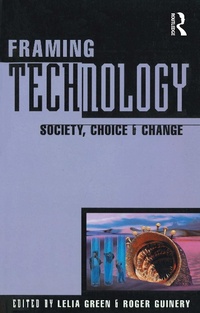
Framing Technology
1st Edition
Published on 9. May 2023
236 pages
978-1-000-94469-3 (ISBN)
Description

Framing Technology uses an interdisciplinary approach to explore some of the key issues in technology today, including virtual reality, gender, health, the environment, regulation, the information society, surveillance and globalisation.
Reviews / Votes
'I'm sure there are lots of people who think machines descend from the sky ready-made, keen to plug themselves in and take over. Others assume technology evolves, like Darwin's creatures, through a force of its own. These distinguished writers present ideas on where our technological world really comes from and what a difference it makes to people.' - Robyn Williams, Science Unit, ABC RadioFraming Technology Does cybersex have side effects? Is technology a masculine culture? Who lords it over the global village?
Technology is the bedrock of our information society, but public debates on technology tend to be conducted by experts and to concentrate on the microchip and employment. Framing Technology reframes the discussion. It argues that technology ranges from language to a transnational corporation, and that we should all share in technology choice.
Framing Technology uses an interdisciplinary approach to explore some of the key issues in technology today, including virtual reality, gender, health, the environment, regulation, the information society, surveillance and globalisation. The contributors include some of the best thinkers on technology in Australia: Judy Wajcman, Albert Moran, Susan Oliver, Trevor Barr, Julianne Schultz and Dick Bryan.
More details
Edition
1. Auflage
Language
English
Place of publication
London
United Kingdom
Publishing group
Taylor & Francis Ltd
Target group
College/higher education
ISBN-13
978-1-000-94469-3 (9781000944693)
Copyright in bibliographic data and cover images is held by Nielsen Book Services Limited or by the publishers or by their respective licensors: all rights reserved.
Schweitzer Classification
Other editions
Additional editions
Lelia Green | Roger Guinery
Framing Technology
Book
03/2021
1st Edition
Routledge
€199.10
Shipment within 15-20 days
Lelia Green | Roger Guinery
Framing Technology
Book
09/1994
1st Edition
Allen & Unwin
€45.90
Article not available at the moment
Persons
Lelia Green lectures in Media Studies at Edith Cowan University. She and Roger Guinery are the principals of a communications consultancy.
Content
Acknowledgments
Contributors
Abbreviations and glossary
Introduction - Lelia Green
PART I FRAMING THE INDIVIDUAL
1 Technological genders: technology, culture and class
Judy Wajcman
2 Virtual reality fakes the future: cybersex, lies and computer games
David McKie
3 The technology of television
Albert Moran
4 Anticipating tomorrow: technology and the future
Susan Oliver
5 Till death us do part: technology and health
David More and Elizabeth More
PART II FRAMING THE COMMUNAL
6 Regulating technology
Len Palmer
7 Australia's information society: clever enough?
Trevor Barr
8 Universal suffrage? Technology and democracy
Julianne Schultz
9 Dataveillance: delivering 1984
Roger Clarke
10 Electronic neighbourhoods: communicating power in computer-based networks
Lynda Davies and Wayne Harvey
PART III FRAMING THE GLOBAL
11 The multilocals: transnationals and communications technology
Dick Bryan
12 Missing the pos
Contributors
Abbreviations and glossary
Introduction - Lelia Green
PART I FRAMING THE INDIVIDUAL
1 Technological genders: technology, culture and class
Judy Wajcman
2 Virtual reality fakes the future: cybersex, lies and computer games
David McKie
3 The technology of television
Albert Moran
4 Anticipating tomorrow: technology and the future
Susan Oliver
5 Till death us do part: technology and health
David More and Elizabeth More
PART II FRAMING THE COMMUNAL
6 Regulating technology
Len Palmer
7 Australia's information society: clever enough?
Trevor Barr
8 Universal suffrage? Technology and democracy
Julianne Schultz
9 Dataveillance: delivering 1984
Roger Clarke
10 Electronic neighbourhoods: communicating power in computer-based networks
Lynda Davies and Wayne Harvey
PART III FRAMING THE GLOBAL
11 The multilocals: transnationals and communications technology
Dick Bryan
12 Missing the pos
