

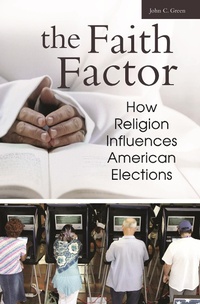
The Faith Factor
How Religion Influences American Elections
1st Edition
Published on 30. March 2007
232 pages
978-0-313-05084-8 (ISBN)
Description

The impact of religion on the 2004 presidential election results provoked widespread consternation and surprise. In fact, religion and faith have played a vital role in American elections for some time, and here, Green explores the links and how they have changed over time.Green posits that an old religion gap describing longstanding political differences among religious communities has been supplanted by a new religion gap revealing political divisions based on religious behavior and belief. He puts the differences into context and documents the changing role of religion in politics over the last 60 years.
The impact of religion on the 2004 presidential election results provoked widespread consternation and surprise. Given the intensity and closeness of the results, however, the role of religion should not have come as a shock. In fact, religion and faith have played a vital role in American elections for some time, and here, Green explores the links and how they have changed over time. Specifically, he concludes that there was an old religion gap that described longstanding political differences among religious communities, which has been supplanted by a new religion gap that shows political divisions based on religious behavior and belief. Green puts the differences into context and documents the changing role of religion in politics over the last sixty years.
Covering three areas of religion that tend to influence election outcomes, Green illuminates the meaning of religious belonging, behaving, and believing in current political context. Each of these aspects of religion affects the way people vote and their views of issues, ideology, and partisanship. He reviews the importance of moral values in the major party coalitions and discusses the role religious appeals have in presidential campaigns. In addition, he compares the influence of religion to other factors such as gender, age, and income. Given the emphasis on the influence of religion on American politics and elections in recent years, this book serves as a cogent reminder that the situation is not new, and offers a careful analysis of the real role faith plays in the electing of government officials.
The impact of religion on the 2004 presidential election results provoked widespread consternation and surprise. Given the intensity and closeness of the results, however, the role of religion should not have come as a shock. In fact, religion and faith have played a vital role in American elections for some time, and here, Green explores the links and how they have changed over time. Specifically, he concludes that there was an old religion gap that described longstanding political differences among religious communities, which has been supplanted by a new religion gap that shows political divisions based on religious behavior and belief. Green puts the differences into context and documents the changing role of religion in politics over the last sixty years.
Covering three areas of religion that tend to influence election outcomes, Green illuminates the meaning of religious belonging, behaving, and believing in current political context. Each of these aspects of religion affects the way people vote and their views of issues, ideology, and partisanship. He reviews the importance of moral values in the major party coalitions and discusses the role religious appeals have in presidential campaigns. In addition, he compares the influence of religion to other factors such as gender, age, and income. Given the emphasis on the influence of religion on American politics and elections in recent years, this book serves as a cogent reminder that the situation is not new, and offers a careful analysis of the real role faith plays in the electing of government officials.
More details
Series
Edition
1. Auflage
Language
English
Place of publication
New York
United States
Publishing group
Bloomsbury Publishing Plc
Target group
Interest Age: From 7 to 17 years
ISBN-13
978-0-313-05084-8 (9780313050848)
Copyright in bibliographic data and cover images is held by Nielsen Book Services Limited or by the publishers or by their respective licensors: all rights reserved.
Schweitzer Classification
Other editions
Additional editions
Book
03/2007
Praeger Publishers Inc
€58.50
Shipment within 15-20 days
Person
John C. Green is Senior Fellow at the Pew Forum on Religion and Public Life and Distinguished Professor of Political Science at the University of Akron. He is also Director of the Ray C. Bliss Institute of Applied Politics at the University of Akron. He is the author or editor of The Christian Right in American Politics: Marching to the Millennium, The Financiers of Congressional Elections, The Diminishing Divide: Religion's Changing Role in American Politics, and The Bully Pulpit: The Politics of Protestant Clergy. He has published many other books and articles.
Content
- Intro
- Table of Contents
- Figures and Tables
- Series Foreword
- Preface
- 1. Consternation and Surprise: Religion and the 2004 Presidential Election
- 2. The Old Religion Gap: The Politics of Belonging
- 3. The New Religion Gap: The Politics of Behaving and Believing
- 4. The Meaning of the Religion Gaps: Issues and Coalitions
- 5. The Religion Gaps in Social Context: Gender, Age, and Income
- 6. The Religion Gaps in Regional Context
- 7. The Religion Gaps in Action: Campaign Contact and Activism
- 8. The Religion Gaps and the Future
- Appendix A: Major Religious Traditions and Denominational Affiliation
- Appendix B: Major Religious Traditions by State
- Notes
- Selected Bibliography on Religion and Politics
- Index
- About the Author
