

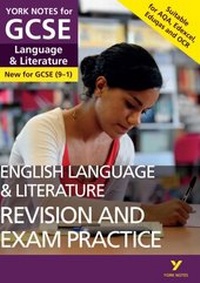
English Language and Literature Revision and Exam Practice: York Notes for GCSE (9-1)
1st Edition
Published on 5. February 2018
168 pages
978-1-292-24573-7 (ISBN)
Description

Learn every essential skill Use The Basics sections to feel positive about reading well, writing creatively and getting to grips with grammar, punctuation and spelling right from the start.Keep learning and improving Exam focus Sample answer sections will help you effortlessly build on your skills through modelling, while the bespoke Applying your skills tasks will enable you to recall all your knowledge, analyse texts and confidently structure your responses.Stay focused and save time With each chapter focused on a specific exam paper and sections on every type of question, York Notes guides are expertly structured to help you learn, practise, revise and remember so youre always on the right track for top marks.Feel ready for the exam Full exam papers, worked answers and lots of quick tests will help ensure you are prepared to perform at your best.
More details
Other editions
Additional editions
Mary Green
English Language and Literature Revision and Exam Practice York Notes GCSE - for 2026, 2027 exams
Book
02/2017
Pearson Education Limited
€8.50
Shipment within 10-20 days
Content
- Front Cover
- Contents
- Part One: The Basics
- The Assessment Objectives
- English Language
- English Literature
- Chapter 1: The basics: Spelling, punctuation and grammar
- Grammatical terms
- How's your SPAG?
- Word Classes
- Determiners
- Modifiers
- Noun Phrases
- Prepositional Phrases
- Sentence construction and clauses
- Simple Sentences
- Compound Sentences
- Complex Sentences
- Adverbial Clauses
- Sentence types and tenses
- Subject-Verb Agreement
- Tenses
- The Active and The Passive
- Punctuation
- Commas
- Colons
- Semicolons
- Dashes
- Brackets
- Ellipses
- Direct Speech
- Reported Speech
- Paragraph organisation
- Setting Out Paragraphs
- Connectives
- Spelling
- Plurals
- Prefixes and Suffixes
- Homophones
- Improving Your Spelling
- Part Two: GCSE English Language
- Chapter 2: Reading creative or fiction texts
- What's it all about?
- Timing and Approach
- Earning the Marks
- Finding explicit information
- What is Explicit Information and How do you Identify it?
- Finding implicit information
- What is Implicit Information and How do you Identify it?
- Quoting or paraphrasing effectively
- How can you Quote or Paraphrase a Text Effectively to Support your Points?
- Choosing a Quotation
- Presenting Quotations
- Paraphrasing
- Analysing language features and effects
- How does the Choice of Particular Words and Phrases Create Effects?
- Choosing Techniques to Create Effects
- Analysing the effects of different types of sentences
- how Do DIFFErENT SENTENCE TYPES CrEaTEEFFECTS?
- Analysing the structure of a text
- How do Fiction Writers Structure Texts?
- Structuring a Fiction Text
- Contrast, Conflict and Resolution
- Forming an interpretation: evaluating a text
- How do you Interpret and Evaluate a Text?
- The Language of Evaluation
- Support Ideas Using Evidence from the Text
- PEE and PEA
- Chapter 3: Writing imaginative, descriptive and narrative texts
- What's it all about?
- Skills Required
- Audience and Voice
- Effective descriptive writing
- What makes a Description Leave a Strong Impression on the Reader?
- Show Don't Tell
- Describing a Person
- Creating atmosphere and mood
- How do Language Features such as Punctuation or Varied Sentences Create Effects?
- Rhetorical Questions
- Repetition
- Generating ideas and structuring a description
- How can you use the Stimulus given to you in the Exam Effectively?
- Word Chains
- First Lines
- Structure Your Description
- Creating convincing characters and voices
- How can you make your Characters Convincing and Vivid?
- First Impressions
- Point of View and Voice
- Generating ideas and structuring a narrative
- How can you Plan a Story?
- Create A Plot
- Other Narrative Decisions
- Different Narrative Approaches
- Flashbacks
- Chapter 4: Reading non-fiction texts
- What's it all about?
- Timing and Approach
- Earning the Marks
- Sorces texts
- Text A: Twenty-First Century Non-Fiction
- Text B: Nineteenth-Century Non-Fiction
- Identifying factual information
- How Should you Deal with the Question?
- True or False Questions
- Selecting and synthesising information from two texts
- How can you Compare Two Texts?
- Explicit Opinions
- Implicit Opinions
- Writing your Response to both Texts
- Structuring your Response
- Understanding persuasive language
- How Should you Analyse Persuasive Language in a Text?
- Analysing Devices and Sentence Structures
- Comparing writers' viewpoints and techniques
- How can you Compare Attitudes and Techniques in Two Texts?
- Comparing Attitudes
- Identifying Style and Techniques
- Writing about Structure
- Chapter 5: Writing to present a viewpoint
- What's it all about?
- Timing and Approach
- Earning the Marks
- What is writing to express a viewpoint?
- What are 'Expressing' and 'Persuading'?
- Register and Tone
- Key features of non-fi ction texts expressing a viewpoint
- What Language Techniques are Effective in Expressing a Viewpoint?
- Rhetorical Devices
- Providing Evidence
- Direct Appeals and Calls to Action
- Using language to argue or persuade
- How can Language Techniques Strengthen an Argument?
- Figurative Language
- Emotive Language
- Using different types of sentences
- How can Sentence Types add Impact to your Writing?
- Simple Sentences
- Compound Sentences
- Complex (Subordinated) Sentences
- Using punctuation to persuade
- How can Punctuation help you get your Meaning Across?
- Full Stops
- Commas to Clarify
- Dashes and Parentheses
- Semicolons and Colons
- Question and Exclamation Marks
- Using structures creatively
- How can Structure Convey your Message?
- Structure within Paragraphs
- Connectives
- Overall Structure
- Chapter 6: GCSE English Language practice papers
- Introduction
- Paper 1: Reading and writing imaginative/creative texts
- Text A
- Section A: Reading
- Section B: Writing
- Paper 2: Reading and writing non-fiction texts
- Text A
- Text B
- Section A: Reading
- Section B: Writing
- Part Three: GCSE English Literature
- Chapter 7: The basics: Core Literature skills and effects
- How to comment on texts and use quotations
- Using Quotations
- Develop a Critical Style
- Plan Your Response
- Writing about an extract
- Understanding the Question
- Zoom in on Powerful Words and Phrases
- Commenting on key literary techniques
- Literary Technique: Image
- Literary Technique: Metaphor
- Literary Technique: Symbolism
- Literary Technique: Dramatic Irony
- Vocabulary Choices
- Sentence Structure
- Chapter 8: Shakespeare
- Context in Shakespeare
- History and Politics
- Culture and Society
- Religion, Beliefs and Moral Codes
- Structure and plot in Shakespeare
- Plots
- Shakespeare's language
- Reading Blank Verse
- Making the Most of Imagery
- Shakespeare's characters
- Shakespeare's themes
- How are Themes Revealed in the Plays?
- Chapter 9: The nineteenth-century novel
- Context in the nineteenth-century novel
- History and Politics
- Culture and Society
- Religion, Beliefs and Moral Codes
- Character and Context
- Structure and voice in the nineteenth-century novel
- Structure
- Point of View
- Characters and relationships in the nineteenth-century novel
- Understanding Characters Through dialogue
- How Characters and Relationships are Presented
- Themes in the nineteenth-century novel
- Recording Evidence
- Chapter 10: Modern prose and drama
- Context in modern prose and drama
- History and Politics
- Culture and Society
- Themes
- Structure in modern prose and drama
- Basic Structure
- Varieties of Structure
- Characters in modern prose and drama
- Narrative Voice
- Stage Directions in Dramatic Texts
- Dialogue
- Chapter 11: Poetry
- Poetry and context
- The Romantics
- Gothic Poetry
- The Natural World
- War
- Diverse Cultures and Gender
- Poetic language, form and structure
- Common Poetic Features
- Rhyme, Rhythm and Cadence
- Form and Structure
- Unseen poetry
- Stage 1: Read the Poem and the Question
- Stage 2: Make Notes and Annotations on the Page
- Stage 3: Write Your Response
- Comparing unseen poems
- How can you Compare Two Poems?
- What Should you do in the Exam?
- Chapter 12: GCSE English Literature practice papers
- Shakespeare questions
- Macbeth
- Romeo and Juliet
- The Tempest
- The Merchant of Venice
- Much Ado about Nothing
- Julius Caesar
- Henry V
- Othello
- Twelfth Night
- Nineteenth-century novel questions
- Robert Louis Stevenson: The Strange Case of Dr Jekyll and Mr Hyde
- Charles Dickens: A Christmas Carol
- Charles Dickens: Great Expectations
- Charlotte Brontë: Jane Eyre
- Mary Shelley: Frankenstein
- Jane Austen: Pride and Prejudice
- Sir Arthur Conan Doyle: The Sign of the Four
- H. G. Wells: War of the Worlds
- George Eliot: Silas Marner
- Modern prose and drama questions
- J. B. Priestley: An Inspector Calls
- Willy Russell: Blood Brothers
- Alan Bennett: The History Boys
- Dennis Kelly: Dna
- Simon Stephens: The Curious Incident of the Dog in the Night-Time
- Shelagh Delaney: A Taste of Honey
- William Golding: Lord of the Flies
- AQA Anthology: Telling Tales
- George Orwell: Animal Farm
- Kazuo Ishiguro: Never Let Me Go
- Meera Syal: Anita and Me
- Stephen Kelman: Pigeon English
- Harold Brighouse: Hobson's Choice
- R. C. Sherriff: Journey's End
- Charlotte Keatley: My Mother Said I Never Should
- Susan Hill: The Woman in Black
- Jeanette Winterson: Oranges are not the only Fruit
- Poetry questions
- AQA Anthology
- Edexcel Anthology
- Eduqas Anthology
- OCR Anthology
- Answers
- Glossary
- Back Cover
