

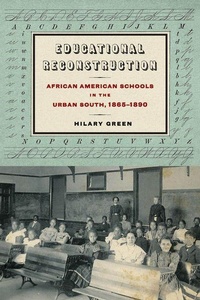
Educational Reconstruction
African American Schools in the Urban South, 1865-1890
1st Edition
Published on 1. April 2016
272 pages
978-0-8232-7014-9 (ISBN)
Description

Tracing the first two decades of state-funded African American schools, Educational Reconstruction addresses the ways in which black Richmonders, black Mobilians, and their white allies created, developed, and sustained a system of African American schools following the Civil War.
Hilary Green proposes a new chronology in understanding postwar African American education, examining how urban African Americans demanded quality public schools from their new city and state partners. Revealing the significant gains made after the departure of the Freedmen's Bureau, this study reevaluates African American higher education in terms of developing a cadre of public school educator-activists and highlights the centrality of urban African American protest in shaping educational decisions and policies in their respective cities and states.
Hilary Green proposes a new chronology in understanding postwar African American education, examining how urban African Americans demanded quality public schools from their new city and state partners. Revealing the significant gains made after the departure of the Freedmen's Bureau, this study reevaluates African American higher education in terms of developing a cadre of public school educator-activists and highlights the centrality of urban African American protest in shaping educational decisions and policies in their respective cities and states.
More details
Series
Language
English
Place of publication
NY
United States
Target group
Professional and scholarly
Edition type
Digital original
File size
2,16 MB
ISBN-13
978-0-8232-7014-9 (9780823270149)
Copyright in bibliographic data and cover images is held by Nielsen Book Services Limited or by the publishers or by their respective licensors: all rights reserved.
Schweitzer Classification
Other editions
Additional editions
Book
04/2016
Fordham University Press
€143.60
Shipment within 10-20 days
Person
Hilary N. Green is the James B. Duke Professor of Africana Studies at Davidson College. A distinguished scholar, her research explores the intersections of race, memory, and education in the post-Civil War American South. She is the author of Educational Reconstruction: African American Schools in the Urban South, 1865-1890, co-author of the NPS-OAH Historic Resource Study of African American Schools in the South, 1865-1900, and co-editor of The Civil War and the Summer of 2020 (Fordham).
Content
- Cover
- Contents
- List of Abbreviations
- Introduction
- PART I: ENVISIONING CITIZENSHIP AND THE AFRICAN AMERICAN SCHOOLHOUSE
- 1 Remaking the Former Confederate Capital: Black Richmonders and the Transition to Public Schools, 1865-1870
- 2 No Longer Slaves: Black Mobilians and the Hard Struggle for Schools, 1865-1870
- PART II: CREATING ESSENTIAL PARTNERSHIPS AND RESOURCES
- 3 To "Do That Which Is Best": Richmond Colored Normal and the Development of Public Schoolteachers
- 4 Remaking Old Blue College: Emerson Normal and Addressing the Need for Public Schoolteachers
- PART III: INTEGRATING THE AFRICAN AMERICAN SCHOOLHOUSE
- 5 Shifting Strategies: Black Richmonders' Quest for Quality Public Schools
- 6 Rethinking Partners: Black Mobilians' Struggle for Quality Public Schools
- PART IV: PERFECTING THE AFRICAN AMERICAN SCHOOLHOUSE
- 7 Walking Slowly but Surely: The Readjusters and the Quality School Campaigns in Richmond
- 8 Still Crawling: Black Mobilians' Struggle for Quality Schools Continues
- Epilogue: The Blair Education Bill and the Death of Educational Reconstruction, 1890
- Acknowledgments
- Notes
- Bibliography
- Index
- A
- B
- C
- D
- E
- F
- G
- H
- I
- J
- K
- L
- M
- N
- O
- P
- Q
- R
- S
- T
- V
- W
