

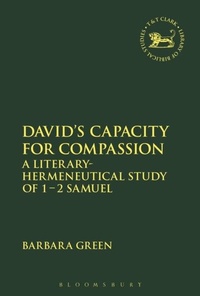
David's Capacity for Compassion
A Literary-Hermeneutical Study of 1 - 2 Samuel
1st Edition
Published on 20. April 2017
224 pages
978-0-567-67359-6 (ISBN)
Description

In this book Barbara Green demonstrates how David is shown and can be read as emerging from a young naive, whose early successes grow into a tendency for actions of contempt and arrogance, of blindness and even cruelty, particularly in matters of cult. However, Green also shows that over time David moves closer to the demeanor and actions of wise compassion, more closely aligned with God.
Leaving aside questions of historicity as basically undecidable Green's focus in her approach to the material is on contemporary literature. Green reads the David story in order, applying seven specific tools which she names, describes and exemplifies as she interprets the text. She also uses relevant hermeneutical theory, specifically a bridge between general hermeneutics and the specific challenges of the individual (and socially located) reader. As a result, Green argues that characters in the David narrative can proffer occasions for insight, wisdom, and compassion. Acknowledging the unlikelihood that characters like David and his peers, steeped in patriarchy and power, can be shown to learn and extend wise compassion, Green is careful to make explicit her reading strategies and offer space for dialogue and disagreement.
Leaving aside questions of historicity as basically undecidable Green's focus in her approach to the material is on contemporary literature. Green reads the David story in order, applying seven specific tools which she names, describes and exemplifies as she interprets the text. She also uses relevant hermeneutical theory, specifically a bridge between general hermeneutics and the specific challenges of the individual (and socially located) reader. As a result, Green argues that characters in the David narrative can proffer occasions for insight, wisdom, and compassion. Acknowledging the unlikelihood that characters like David and his peers, steeped in patriarchy and power, can be shown to learn and extend wise compassion, Green is careful to make explicit her reading strategies and offer space for dialogue and disagreement.
More details
Series
Edition
1. Auflage
Language
English
Place of publication
London
United Kingdom
Publishing group
Bloomsbury Publishing PLC
Target group
College/higher education
Professional and scholarly
ISBN-13
978-0-567-67359-6 (9780567673596)
Copyright in bibliographic data and cover images is held by Nielsen Book Services Limited or by the publishers or by their respective licensors: all rights reserved.
Schweitzer Classification
Other editions
Additional editions
Book
11/2018
T.& T.Clark Ltd
€63.39
Shipment within 3-4 weeks
Book
04/2017
T.& T.Clark Ltd
€177.00
Shipment within 3-4 weeks
Person
Barbara Green is Professor of Biblical Studies at the Dominican School of Philosophy and Theology, Berkeley, USA.
Content
Preface
Acknowledgements
Abbreviations
Introduction
1. Relevant Methodologies for Constructing an Ancient Fictive Work
2. Why a King? Choices of Saul and David (1 Samuel 8-18): Edges and Structures
3. Competition and Choices: Kings Interlocked (1 Samuel 19-26): Constructing Plots
4. Presence and Absence: David and the Death of Saul (1 Samuel 27-2 Samuel 1): The Narrator
5. David Consolidates his Rule (2 Samuel 2-8 and 21-24): Characterization
6. Fruits of Arrogance: David's Poorest Choices (2 Samuel 9-14): Converging Five Tools
7. Fruits of Suffering: David Experiences Compassion (2 Samuel 15-20): Converging Three Tools
8. David Goes the Way of all the Earth (1 Kings 1-2) the Sixth Tool: Narrative Analogy
9. Reception and Construction of David in a Western Painting: Reading Visual Art
Conclusions
Bibliography
Index
Acknowledgements
Abbreviations
Introduction
1. Relevant Methodologies for Constructing an Ancient Fictive Work
2. Why a King? Choices of Saul and David (1 Samuel 8-18): Edges and Structures
3. Competition and Choices: Kings Interlocked (1 Samuel 19-26): Constructing Plots
4. Presence and Absence: David and the Death of Saul (1 Samuel 27-2 Samuel 1): The Narrator
5. David Consolidates his Rule (2 Samuel 2-8 and 21-24): Characterization
6. Fruits of Arrogance: David's Poorest Choices (2 Samuel 9-14): Converging Five Tools
7. Fruits of Suffering: David Experiences Compassion (2 Samuel 15-20): Converging Three Tools
8. David Goes the Way of all the Earth (1 Kings 1-2) the Sixth Tool: Narrative Analogy
9. Reception and Construction of David in a Western Painting: Reading Visual Art
Conclusions
Bibliography
Index
