

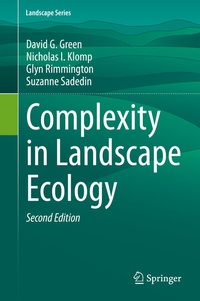
Complexity in Landscape Ecology
Description

This book examines key concepts and analytical approaches in complexity theory as it applies to landscape ecology, including complex networks, connectivity, criticality, feedback, and self-organisation. It then reviews the ways that these ideas have led to new insights into the nature of ecosystems and the role of processes in landscapes.
The updated edition explores innovations in ecotechnology, including automated monitoring, big data, simulation and machine learning, and shows how they are revolutionizing ecology by making it possible to deal more effectively with complexity. Addressing the topic in a progression of ideas from small to large, and from simple to sophisticated, the book examines the implications of complexity for major environmental issues of our time, particularly the urgencies of climate change and loss of biodiversity. Understanding ecological complexity is crucial in today's globalized and interconnected world. Successful management of the world's ecosystems must combine models of ecosystem complexity with biodiversity, environmental, geographic, and socioeconomic data. The book examines the impact of humans on landscapes and ecosystems, as well as efforts to embed sustainability, commerce and industrial development in the larger context of ecosystem services and ecological economics. Well-established as researchers in the field, the authors provide a new perspective on current and future understanding of complexity in landscape ecology.
The new edition offers a non-technical account of the topic, so it is both accessible and informative for general readers. For students of ecology, it provides a fresh approach to classical ideas.More details
Other editions
Additional editions
Persons
Nick Klomp is Professor of Environmental Science and President of CQUniversity, Australia. His research and teaching career has included significant contributions in terrestrial and marine ecology, population dynamics and modelling, conservation and land management.
Glyn Rimmington is Professor of Global Learning at Wichita State University. His research career includes many contributions to applications of complexity theory, especially environmental simulation and to helping people develop intercultural communication competence to work in globally distributed teams. Suzanne Sadedin is an evolutionary biologist and science writer. Her research at Monash, Tennessee, Harvard, and KU Leuven, and her writing, have contributed many deep insights about the role of evolution in the natural and human world.
Content
1. Towards a new paradigm.- 2. Complexity in ecology.- 3. Complexity in landscapes.- 4. Lessons from complexity theory.- 5. Individuals in landscapes.- 6. Populations and interactions.- 7. Communities.- 8. Genetics and adaptation in landscapes.- 9. Virtual worlds.- 10. Ecological informatics.- 11. The Global Picture.
