

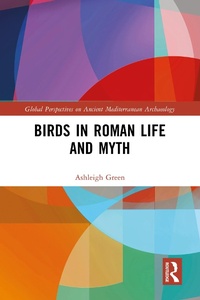
Birds in Roman Life and Myth
1st Edition
Published on 3. March 2023
248 pages
978-1-000-84201-2 (ISBN)
Description

This book explores the place of birds in Roman myth and everyday life, focusing primarily on the transitional period of 100 BCE to 100 CE within the Italian peninsula.
A diverse range of topics is considered in order to build a broad overview of the subject. Beginning with an appraisal of omens, augury, and auspices - including the 'sacred chickens' consulted by generals before battle - it goes on to examine how Romans farmed birds, hunted them, and kept them as pets. It demonstrates how the ownership and consumption of birds were used to communicate status and prestige, and how bird consumption mirrored wider economic and social trends. Each topic adopts an interdisciplinary approach, considering literary evidence alongside art, material culture, zooarchaeology, and modern ornithological knowledge. The inclusion of zooarchaeology adds another dimension to the work and highlights the value of using animals and faunal remains to interpret the past.
Studying the Roman view of birds offers great insight into how they conceived of their relationship with the gods and how they stratified and organised their society. This book is a valuable resource for bird lovers and researchers alike, particularly those studying animals in the ancient world.
A diverse range of topics is considered in order to build a broad overview of the subject. Beginning with an appraisal of omens, augury, and auspices - including the 'sacred chickens' consulted by generals before battle - it goes on to examine how Romans farmed birds, hunted them, and kept them as pets. It demonstrates how the ownership and consumption of birds were used to communicate status and prestige, and how bird consumption mirrored wider economic and social trends. Each topic adopts an interdisciplinary approach, considering literary evidence alongside art, material culture, zooarchaeology, and modern ornithological knowledge. The inclusion of zooarchaeology adds another dimension to the work and highlights the value of using animals and faunal remains to interpret the past.
Studying the Roman view of birds offers great insight into how they conceived of their relationship with the gods and how they stratified and organised their society. This book is a valuable resource for bird lovers and researchers alike, particularly those studying animals in the ancient world.
Reviews / Votes
The title of the series "Global Perspectives on Ancient Mediterranean Archaeology," of which Green's monograph is the inaugural volume, helps the reader refine his/her expectations, as it suggests a focus on the physical remnants of avian bones and avian detritus; yet at the same time, "Global Perspectives" points at a breadth not limited to an archaeological lens. Indeed, Green's work (and I assume the goal of the series) moves beyond disciplinary divisions and instead tackles the topic from a range of approaches and sources: zooarchaeological evidence, (e.g., in her discussion of chickens on p. 96) and, just as importantly, its absence (e.g., the absence of peacock bones from Roman archaeological sites, p. 118); a range of literary works (e.g., by Columella, Juvenal, and Pliny); and an array of artistic works, including paintings, mosaics, and carvings. Using this range of primary sources, Green successfully shows how "taking a 'bird's-eye view' of history is an effective method for interpreting and understanding cultural beliefs and social stratification" (p. 7).- Alison L. Beringer, Montclair State University
More details
Series
Edition
1. Auflage
Language
English
Place of publication
London
United Kingdom
Publishing group
Taylor & Francis Ltd
Target group
Professional and scholarly
Illustrations
3 Line drawings, black and white; 43 Halftones, black and white; 46 Illustrations, black and white
ISBN-13
978-1-000-84201-2 (9781000842012)
Copyright in bibliographic data and cover images is held by Nielsen Book Services Limited or by the publishers or by their respective licensors: all rights reserved.
Schweitzer Classification
Other editions
Additional editions
Ashleigh Green
Birds in Roman Life and Myth
Book
11/2024
1st Edition
Routledge
€63.30
Shipment within 10-20 days
Ashleigh Green
Birds in Roman Life and Myth
Book
03/2023
1st Edition
Routledge
€186.20
Shipment within 10-20 days
Person
Dr Ashleigh Green is a graduate of The University of Melbourne and a fellow of the State Library of Victoria. Her research interests include the study of birds in the classical world, and more generally what human-animal studies can tell us about societies both past and present. She was the 2021 recipient of the Australasian Society for Classical Studies Early Career Award and a 2022 Virtual Fellow for the Centre for the History of Emotions.
Content
Introduction; 1. Omens, Augury, and Auspices; 2. The Augural Chickens; 3.Farming and Aviculture; 4. Fowling and Bird-Catching; 5. Pets and Pleasure
