

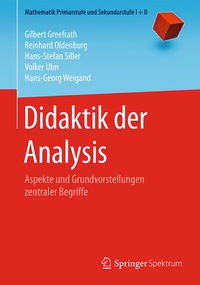
Didaktik der Analysis
Description

Im Mathematikunterricht der Sekundarstufe II kommt der Analysis eine zentrale Rolle zu. Dieses Buch bietet eine umfassende Darstellung der Didaktik der Analysis unter Berücksichtigung der aktuellen didaktischen Diskussion, theoretischer Konzepte, praktischer Unterrichtserfahrungen und der Bildungsstandards der Kultusministerkonferenz. Es unterstützt Studierende, Referendarinnen und Referendare, aber auch Lehrkräfte dabei, das Gebiet angemessen - kompetenzorientiert - unterrichten zu können. Dazu gibt es Orientierung über die allgemeinbildende Bedeutung der Analysis und beleuchtet die zentralen Begriffe Funktion, Folge, Grenzwert, Ableitung und Integral. Für diese, für den Analysisunterricht, zentralen Begriffe werden wichtige Aspekte und Grundvorstellungen herausgearbeitet sowie typische unterrichtliche Zugänge vorgestellt. Die Chancen digitaler Mathematikwerkzeuge für das Lernen und ihre Bedeutung im Analysisunterricht werden besprochen. Übungsaufgaben geben Impulse für selbstständiges Anwenden und Vertiefen der Inhalte.
More details
Other editions
Additional editions
Persons
Prof. Dr. Gilbert Greefrath ist Professor für Mathematikdidaktik mit dem Schwerpunkt Sekundarstufen an der Westfälischen Wilhelms-Universität Münster.
Prof. Dr. Reinhard Oldenburg ist Professor für Didaktik der Mathematik an der Universität Augsburg.
Prof. Dr. Hans-Stefan Siller ist Professor für Didaktik der Mathematik an der Universität Koblenz Landau, Campus Koblenz.
Prof. Dr. Volker Ulm ist Professor für Mathematik und ihre Didaktik an der Universität Bayreuth.
Prof. Dr. Hans-Georg Weigand ist Professor für Didaktik der Mathematik an der Julius-Maximilians-Universität Würzburg.
Content
Einleitung.- Ziele der Analysis, Aspekte und Grundvorstellungen.- Funktionen.- Folgen und Grenzwerte.- Differenzialrechnung.- Integralrechnung.- Literatur.
