

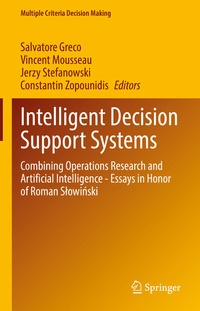
Intelligent Decision Support Systems
Description

This book presents a collection of essays written by leading researchers to honor Roman Slowinski's major scholarly interests and contributions. He is well-known for conducting extensive research on methodologies and techniques for intelligent decision support, where he combines operational research and artificial intelligence. The book reconstructs his main contributions, presents cutting-edge research and provides an outlook on the most promising and advanced domains of computer science and multiple criteria decision aiding.
The respective chapters cover a wide range of related research areas, including decision sciences, ordinal data mining, preference learning and multiple criteria decision aiding, modeling of uncertainty and imprecision in decision problems, rough set theory, fuzzy set theory, multi-objective optimization, project scheduling and decision support applications. As such, the book will appeal to researchers and scholars in related fields.
More details
Other editions
Additional editions

Persons
Salvatore Greco is a Professor at the University of Catania, Italy. His research focuses on multiple criteria decision making (MCDM), an area in which he has proposed several new methodologies such as the Dominance-based Rough Set Approach and Robust Ordinal Regression. For his contributions in the field, he received the Gold Medal from the MCDM International Society.
Vincent Mousseau is a Professor of Computer Science at Centrale Supélec, University of Paris-Saclay (France). His research interests include decision modeling and preference elicitation with a particular focus on multiple criteria decisions. He is also interested in filling the gap between preference learning in artificial intelligence and preference elicitation in multiple criteria decision making.
Jerzy Stefanowski is a Professor at the Poznan University of Technology (Poland). He is also a corresponding member of the Polish Academy of Sciences. His research interests include machine learning, data mining and intelligent decision support, in particular multiple classifiers, dealing with class imbalance, concept drift, classification of data streams, rule induction, classification of big data and handling uncertain data.
Constantin Zopounidis is a Professor at the Technical University of Crete (Greece) and the Audencia Business School (France). He is an Honorary Professor at the Department of Economics of the Aristotle University of Thessaloniki (Greece). His research interests are in multiple criteria decision aiding (MCDA) and preference disaggregation, sorting methods and classification problems. For his contributions to the field, he received the Edgeworth-Pareto Award from the MCDM International Society
Content
Roman Slowinski and His Research Program: Intelligent Decision Support Systems Between Operations Research and Artificial Intelligence.- Roman's Scientific Trajectory: A Retrospective with an Emphasis on the Beginning.- ELECTRE Methods: A Survey on Roman Slowinski Contributions.- How Can Decision Sciences and MCDM Help Solve Challenging World Problems?.- Preference Disaggregation Analysis: An Overview of Methodological Advances and Applications.- Modeling and Learning of Hierarchical Decision Models: The Case of the Choquet Integral.- Preference Learning Applied to Credit Rating: Applications and Perspectives.- U Sort-nB and U Sort-nC: Two Multi-criteria Ordinal Classification Methods Using Interval Value Functions.- Constructing an Outranking Relation from Semantic Criteria and Ordinal Criteria for the ELECTRE Method.- Robust Ordinal Regression for Multiple Criteria Decision Aiding.- What Is Legitimate Decision Support?.- MR-Sort with Partial Information to Decide Whether to Invest in Innovation Projects.- Meta-Rankings of Journals Publishing Multiple Criteria Decision Aiding Research: Benefit-of-Doubt Composite Indicators for Heterogeneous Qualitative Scales.- Interactive Multicriteria Methodology Based on a Synergy of PROMETHEE II and Robust Simos Methods: Application to the Evaluation of E-government in Europe.- The Use of Decision Maker's Preferences in Multiobjective Metaheuristics.- Decomposition and Coordination for Many-Objective Optimization.- Fuzzy Linear Programming with General Necessity Measures.- Dominance-Based Rough Set Approach: Basic Ideas and Main Trends.- Rule Set Complexity for Mining Incomplete Data Using Probabilistic Approximations Based on Generalized Maximal Consistent Blocks.- Rule Confirmation Measures: Properties, Visual Analysis and Applications.- An Approach to Combining Adherence-to-Therapy and Patient Preference Models for Evaluation of Therapies in Patient-Centered Care.
