

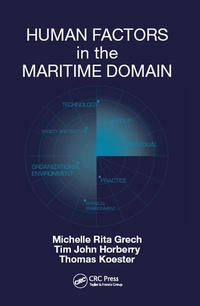
Human Factors in the Maritime Domain
1st Edition
Published on 25. June 2019
216 pages
978-1-000-70880-6 (ISBN)
Description

The piecemeal fashion in which human factors research has been conducted in the maritime domain makes information retrieval available only by scanning through numerous research journals and conference papers. Bringing together human factors information from this and other domains, Human Factors in the Maritime Domain integrates a common body of knowledge into one single volume.
The book provides the vital background information necessary to acquire a core knowledge base and a much-needed overview of human factors within the maritime domain. It starts by putting the topic into an historical and theoretical context, moves onto more specific and detailed topics and contemporary thinking in human factors, then reviews new maritime technology. The authors take a holistic approach based on a model of the socio-technical system of work in the maritime domain. They synthesize available knowledge and research, then present in an easily acceptable framework with example, illustrations, and case studies whenever possible, making the text rigorous, useful, and enjoyable.
The three authors draw on a range of diverse backgrounds including working as a maritime surveyor, transport consultant, human factors lecturer, and mechanical engineer. They have undertaken maritime research in Denmark, Australia, Malta, and the UK. They have published several other human factor books on related topics. This combination of human factors knowledge, maritime wisdom, and substantial publication experience results in a book that is effective and practical.
The book provides the vital background information necessary to acquire a core knowledge base and a much-needed overview of human factors within the maritime domain. It starts by putting the topic into an historical and theoretical context, moves onto more specific and detailed topics and contemporary thinking in human factors, then reviews new maritime technology. The authors take a holistic approach based on a model of the socio-technical system of work in the maritime domain. They synthesize available knowledge and research, then present in an easily acceptable framework with example, illustrations, and case studies whenever possible, making the text rigorous, useful, and enjoyable.
The three authors draw on a range of diverse backgrounds including working as a maritime surveyor, transport consultant, human factors lecturer, and mechanical engineer. They have undertaken maritime research in Denmark, Australia, Malta, and the UK. They have published several other human factor books on related topics. This combination of human factors knowledge, maritime wisdom, and substantial publication experience results in a book that is effective and practical.
More details
Edition
1. Auflage
Language
English
Place of publication
London
United Kingdom
Publishing group
Taylor & Francis Ltd
Target group
Professional and scholarly
Illustrations
5 Tables, black and white; 22 Halftones, black and white; 45 Illustrations, black and white
ISBN-13
978-1-000-70880-6 (9781000708806)
Copyright in bibliographic data and cover images is held by Nielsen Book Services Limited or by the publishers or by their respective licensors: all rights reserved.
Schweitzer Classification
Other editions
Additional editions
Michelle Grech | Tim Horberry | Thomas Koester
Human Factors in the Maritime Domain
Book
07/2019
1st Edition
CRC Press
€69.20
Shipment within 15-20 days
Michelle Grech | Tim Horberry | Thomas Koester
Human Factors in the Maritime Domain
Book
03/2008
1st Edition
CRC Press
€145.50
Shipment within 15-20 days
Persons
Michelle Rita Grech works for the Maritime Platforms Division within the Defence Science and Technology Organisation (DTSO) in Australia. Her current work involves maritime-focused research on human systems integration and human factors. She joined DSTO after completeing her Ph.D. in human factors from the University of Queensland in 2005, specializing in fatigue, workload, and situation awareness in maritime domain. During her career she was involved in teaching and tutoring in human factors-related topics. Through her academic research work and experience, Michelle has acquired a comprehesive publications list, including refereed journal articles, as well as national and international conference papers. Michelle has also been involved in a number of European Union (EU) maritime safety projects. She is periodically involved as a maritime human factors expert in the evaluation of maritime research projects for the EU Director General of Transport. Michelle, a chartered engineer, has spent most of her career working within the maritime industry in Malta and in Australia starting off as a project engineer, engineering consultant, marine surveyor, and maritime human factors researcher.
Tim Horberry is associate professor of human factors at the University of Queensland, Australia. Before that, he was head of human factors within the transportation division at the UK Transport Research Laboratory. Dr. Horberry has successfully supervised several Ph.D. students working in the field of transport human factors. He has published his work widely and is a registered member of the UK Ergonomics Society. He coedited another book on transport safety, which was published by CRC Press in 2004.
Thomas Koester, psychologist, MA, is employed at FORCE Technology in Kongens Lyngby near Copenhagen. Thomas has during the last seven years worked with applied psychology and human factors in safety-critical domains including maritime transport, power plants, off-shore industry, railroads, and hospitals. Thomas has participated in EU projects and thematic networks about maritime safety and human factors, and he is working with development and teaching of human factors and crew resource management courses for maritime personnel, off-shore personnel, power plant personnel, personnel from the health care secotr, and accident investigators. He is cofounder of the Maritime Human Factors Research Group (www.maritimehumanfactors.org), member of Danish Human Factors Centre (www.dhfc.dk), and associated member of Centre for Human-Machine Interaction 2000-2003.
Tim Horberry is associate professor of human factors at the University of Queensland, Australia. Before that, he was head of human factors within the transportation division at the UK Transport Research Laboratory. Dr. Horberry has successfully supervised several Ph.D. students working in the field of transport human factors. He has published his work widely and is a registered member of the UK Ergonomics Society. He coedited another book on transport safety, which was published by CRC Press in 2004.
Thomas Koester, psychologist, MA, is employed at FORCE Technology in Kongens Lyngby near Copenhagen. Thomas has during the last seven years worked with applied psychology and human factors in safety-critical domains including maritime transport, power plants, off-shore industry, railroads, and hospitals. Thomas has participated in EU projects and thematic networks about maritime safety and human factors, and he is working with development and teaching of human factors and crew resource management courses for maritime personnel, off-shore personnel, power plant personnel, personnel from the health care secotr, and accident investigators. He is cofounder of the Maritime Human Factors Research Group (www.maritimehumanfactors.org), member of Danish Human Factors Centre (www.dhfc.dk), and associated member of Centre for Human-Machine Interaction 2000-2003.
Content
Introduction. Individual Factors (or Characteristics). Task/Individual Interaction Factors. Environmental/Individual Interaction Factors (Noise, Vibration, Seasickness). Technology/Individual Interaction Factors. Organisation/Individual Interaction Factors. Human Factors and Maritime Safety. Some Methodologies Used for Collection of Human Factors Data (Accidents, Incidents, and Near Miss). The Future. Appendix.
