

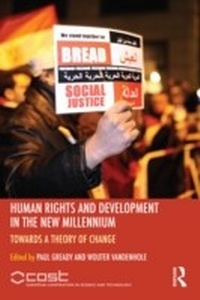
Human Rights and Development in the new Millennium
Towards a Theory of Change
1st Edition
Published on 23. October 2013
320 pages
978-1-136-01760-5 (ISBN)
Description

In recent years human rights have assumed a central position in the discourse surrounding international development, while human rights agencies have begun to more systematically address economic and social rights. This edited volume brings together distinguished scholars to explore the merging of human rights and development agendas at local, national and international levels. They examine how this merging affects organisational change, operational change and the role of relevant actors in bringing about change. With a focus on practice and policy rather than pure theory, the volume also addresses broader questions such as what human rights and development can learn from one another, and whether the connections between the two fields are increasing or declining.
The book is structured in three sections:
Part I looks at approaches that combine human rights and development, including chapters on drivers of change; indicators; donor; and legal empowerment of the poor.
Part II focuses on organisational contexts and includes chapters on the UN at the country level; EU development cooperation; PLAN's children's rights-based approach; and ActionAid's human rights-based approach.
Part III examines country contexts, including chapters on the ILO in various settings; the Congo; Ethiopia; and South Africa.
Human Rights and Development in the new Millennium: Towards a Theory of Change will be of strong interest to students and scholars of human rights, development studies, political science and economics.
The book is structured in three sections:
Part I looks at approaches that combine human rights and development, including chapters on drivers of change; indicators; donor; and legal empowerment of the poor.
Part II focuses on organisational contexts and includes chapters on the UN at the country level; EU development cooperation; PLAN's children's rights-based approach; and ActionAid's human rights-based approach.
Part III examines country contexts, including chapters on the ILO in various settings; the Congo; Ethiopia; and South Africa.
Human Rights and Development in the new Millennium: Towards a Theory of Change will be of strong interest to students and scholars of human rights, development studies, political science and economics.
More details
Language
English
Place of publication
London
United Kingdom
Publishing group
Taylor & Francis Ltd
Target group
College/higher education
Illustrations
3 s/w Abbildungen, 1 s/w Tabelle, 3 s/w Zeichnungen
1 Tables, black and white; 3 Line drawings, black and white; 3 Illustrations, black and white
File size
1,38 MB
ISBN-13
978-1-136-01760-5 (9781136017605)
Copyright in bibliographic data and cover images is held by Nielsen Book Services Limited or by the publishers or by their respective licensors: all rights reserved.
Schweitzer Classification
Other editions
Additional editions
Paul Gready | Wouter Vandenhole
Human Rights and Development in the new Millennium
Towards a Theory of Change
Book
10/2013
1st Edition
Routledge
€206.90
Shipment within 15-20 days
Paul Gready | Wouter Vandenhole
Human Rights and Development in the new Millennium
Towards a Theory of Change
Book
10/2013
1st Edition
Routledge
€74.00
Shipment within 15-20 days
Persons
Paul Gready is Professor of Applied Human Rights and Director of the Centre for Applied Human Rights at the University of York, UK.
Wouter Vandenhole teaches human rights law and holds the UNICEF Chair in Children's Rights at the University of Antwerp, Belgium.
Wouter Vandenhole teaches human rights law and holds the UNICEF Chair in Children's Rights at the University of Antwerp, Belgium.
Content
Chapter 1: P Gready with W Vandenhole, Introduction - What are we Trying to Change? Theories of Change in Development and Human Rights
Approaches
Chapter 2: H-O Sano, The drivers of human rights change in development
Chapter 3: G de Beco, Human rights indicators and MDG indicators: Building a common language for human rights and development organizations
Chapter 4: A Tostensen, H Stokke and S Trygged, Means, Modes and Methods: Donor Support Strategies for Child Rights in Kenya
Chapter 5: B Andreassen, Legal empowerment of the poor - A strategy for social change?
Organisational Contexts
Chapter 6: Wouter Vandenhole, Overcoming the Protection Promotion Dichotomy Human Rights Based Approaches to Development and Organisational Change within the UN at Country Level
Chapter 7: M van Reisen and D Mekonnen, EU Development Cooperation: The Contours of Global and National Engagement
Chapter 8: K Arts, Countering Violence against Children in the Philippines: Positive RBA Practice Examples from PLAN
Chapter 9: P Gready, ActionAid's Human Rights-based Approach and its Impact on Organisational and Operational Change
Country Contexts
Chapter 10: H Stokke, Standardised practice - From international labour standards to development practice
Chapter 11: K De Feyter and R Lumbika Nlandu, Skimming the Surface: Human Rights-Related Donor Interventions in the Bas-Congo
Chapter 12: S Porter, A Change of Road for the Rights-Based Approach? A Reflection on Piloting a Health-Enabling Mobile Technology Programme in KwaZulu-Natal, South Africa
Chapter 13: S Yeshanew, The Ethiopian Law Governing Civil Society Organizations: Divorcing Human Rights and Development?
Chapter 14: W Vandenhole, C Lennox, P Gready and H Stokke, In Lieu of a Conclusion: Some Cross-cutting Issues and their Policy Implications
Approaches
Chapter 2: H-O Sano, The drivers of human rights change in development
Chapter 3: G de Beco, Human rights indicators and MDG indicators: Building a common language for human rights and development organizations
Chapter 4: A Tostensen, H Stokke and S Trygged, Means, Modes and Methods: Donor Support Strategies for Child Rights in Kenya
Chapter 5: B Andreassen, Legal empowerment of the poor - A strategy for social change?
Organisational Contexts
Chapter 6: Wouter Vandenhole, Overcoming the Protection Promotion Dichotomy Human Rights Based Approaches to Development and Organisational Change within the UN at Country Level
Chapter 7: M van Reisen and D Mekonnen, EU Development Cooperation: The Contours of Global and National Engagement
Chapter 8: K Arts, Countering Violence against Children in the Philippines: Positive RBA Practice Examples from PLAN
Chapter 9: P Gready, ActionAid's Human Rights-based Approach and its Impact on Organisational and Operational Change
Country Contexts
Chapter 10: H Stokke, Standardised practice - From international labour standards to development practice
Chapter 11: K De Feyter and R Lumbika Nlandu, Skimming the Surface: Human Rights-Related Donor Interventions in the Bas-Congo
Chapter 12: S Porter, A Change of Road for the Rights-Based Approach? A Reflection on Piloting a Health-Enabling Mobile Technology Programme in KwaZulu-Natal, South Africa
Chapter 13: S Yeshanew, The Ethiopian Law Governing Civil Society Organizations: Divorcing Human Rights and Development?
Chapter 14: W Vandenhole, C Lennox, P Gready and H Stokke, In Lieu of a Conclusion: Some Cross-cutting Issues and their Policy Implications
