

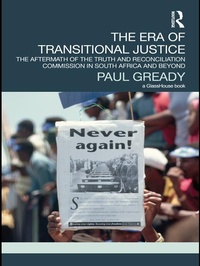
The Era of Transitional Justice
The Aftermath of the Truth and Reconciliation Commission in South Africa and Beyond
1st Edition
Published on 18. October 2010
270 pages
978-1-136-90219-2 (ISBN)
Description

The Era of Transitional Justice explores a broad set of issues raised by political transition and transitional justice through the prism of the South African TRC. South Africa constitutes a powerful case study of the enduring structural legacies of a troubled past, and of both the potential and limitations of transitional justice and human rights as agents of transformation in the contemporary era. South Africa's story has wider relevance because it helped to launch constitutional human rights and transitional justice as global discourses; as such, its own legacy is to some extent writ large in post-authoritarian and post-conflict contexts across the world. Based on a decade of research, and in an analysis that is both comparative and interdisciplinary, Paul Gready maintains that transitional justice needs to do more to address structural violence and in particular poverty, inequality and social and criminal violence as these have emerged as stubborn legacies from an oppressive or war-torn past in many parts of the world. Organised around four central themes new keyword conceptualisation (truth, justice, reconciliation); re-imagining human rights; engaging with the past and present; remaking the public sphere it is an argument that will be of considerable relevance to those interested in the law and politics of transitional societies.
Reviews / Votes
"Paul Gready has written a well-researched, thoughtful and unique volume.His assertion that those working on transitional justice and human rights must do more to address the structural poverty and violence which are the enduring legacies of the past - including through greater attention to realizing economic, social and cultural rights for all - is an important message for the 21st century. This book offers a wealth of insights for those working in a range of fields including, but going well beyond, transitional justice." - Mary Robinson, President of Realizing Rights: The Ethical Globalization Initiative; former President of Ireland
"This superb book provides an insightful, provocative and timely critique of the strengths and weaknesses of transitional justice mechanisms, through the prism of truth commissions. In recent years transitional justice mechanisms have spread somewhat promiscuously and have been asked to take on a rapidly expanding array of tasks. But too little attention has been paid to coherence, manageability, or the deeper assumptions underpinning the process. This book analyses those shortcomings critically but constructively and provides important guidelines for the future." - Philip Alston, John Norton Pomeroy Professor of Law, New York University School of Law
"The Era of Transitional Justice is a brilliant inquiry into the sensitive domain of transitional justice given concreteness by a focus on post-apartheid South Africa's struggle for truth and reconciliation, but it is more than this. What really makes this book indispensable is its exceptionally clarifying conceptual framework for thought and action across the whole spectrum of human rights/justice concerns." - Richard Falk, Research Professor, Global Studies, UCSB
"By focusing on the development of a transitional justice 'industry,' Gready not only interrogates the pathways of power within the field (such as the ways in which the production and transmission of knowledge on rights and justice may mimic global power inequities) but also demonstrates the power of the industry to shape conceptions of justice and the contours of transition." - Zinaida Miller, Harvard Law School, USA for The International Journal of Transitional Justice (Vol. 7, 2013, 370-380)
More details
Series
Edition
1. Auflage
Language
English
Place of publication
London
United Kingdom
Publishing group
Taylor & Francis Ltd
Target group
College/higher education
Product notice
Reflowable
File size
0,63 MB
ISBN-13
978-1-136-90219-2 (9781136902192)
Copyright in bibliographic data and cover images is held by Nielsen Book Services Limited or by the publishers or by their respective licensors: all rights reserved.
Schweitzer Classification
Other editions
Additional editions
Paul Gready
The Era of Transitional Justice
The Aftermath of the Truth and Reconciliation Commission in South Africa and Beyond
Book
12/2011
1st Edition
Routledge
€83.90
Shipment within 15-20 days
Paul Gready
The Era of Transitional Justice
The Aftermath of the Truth and Reconciliation Commission in South Africa and Beyond
Book
10/2010
1st Edition
Routledge
€232.00
Shipment within 15-20 days
Person
Paul Gready is Professor of Applied Human Rights and Director of the Centre for Applied Human Rights at the University of York (UK).
Content
Introduction 1. Truth as Genre 2. From Social Truth to Rights-Based Participation 3. Justice Past 4. Justice Present 5. Speaking Truth to Reconciliation 6. Reconciliation, Relationships and the Everyday. Conclusion
