

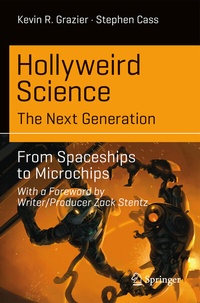
Hollyweird Science: The Next Generation
Description

Informative, entertaining and upbeat, this book continues Grazier and Cass's exploration of how technology, science, and scientists are portrayed in Hollywood productions. Both big and small-screen productions are featured and their science content illuminated-first by the authors and subsequently by a range of experts from science and the film world. Starring roles in this volume are played by, among other things, computers (human and mechanical), artificial intelligences, robots, and spacecraft. Interviews with writers, producers, and directors of acclaimed science-themed films stand side by side with the perspectives of scientists, science fiction authors, and science advisors. The result is a stimulating and informative reading experience for the layperson and professional scientist or engineer alike. The book begins with a foreword by Zack Stentz, who co-wrote X-Men: First Class and Thor , and is currently a writer/producer on CW's The Flash.
More details
Other editions
Additional editions
Persons
Stephen Cass is an Irish science and technology journalist based in New York City. He has been an editor at Discover magazine and MIT Technology Review , and has written for outlets such as Popular Science and Nautilus . He has also edited several science fiction anthologies. He is currently geeking it to the max as a senior editor at IEEE Spectrum .
Kevin R. Grazier, Ph.D. is currently a professor of computer science at the United States Military Academy. Prior to West Point, Grazier was a research scientist for fifteen years at NASA's Jet Propulsion Laboratory, working on the Cassini/Huygens Mission to Saturn and Titan. Still an active researcher, he performs large-scale computer simulations of early Solar System dynamics and evolution. Grazier served as the science advisor for the features Gravity and Pirates of the Caribbean: Dead Men Tell No Tales, as well as for the television series Eureka, Defiance, and the Peabody-Award-winning Battlestar Galactica.
Content
Preface: For the Sake of Argument.- English vs. Sciencespeak.- The Many-Body Problem: The Culture of Science.- The Scarecrow's Blunder: Mathematics and Statistics.- Let's Get Digital: Computers in Cinema.- Heavy Metal: AI and Robots in Cinema.- Boldly Going: Cinematic Spaceships.- The Gravity of the Situations: Orbits.- Getting from There to Here: Navigation in Space.- Life. In. Spaaaaace.- Putting Science in, Not Taking Drama Out: The Culture of Hollywood.
