

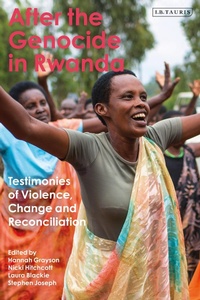
After the Genocide in Rwanda
Testimonies of Violence, Change and Reconciliation
1st Edition
Published on 27. June 2019
224 pages
978-1-78673-669-7 (ISBN)
Description

Since the Genocide against the Tutsi, when up to one million Rwandan people were brutally killed, Rwanda has undergone a remarkable period of reconstruction. Driven by a governmental programme of unity and reconciliation, the last 25 years have seen significant changes at national, community, and individual levels. This book gathers previously unpublished testimonies from individuals who lived through the genocide. These are the voices of those who experienced one of the most horrific events of the 20th Century. Yet, their stories do not simply paint a picture of lives left destroyed and damaged; they also demonstrate healing relationships, personal growth, forgiveness and reconciliation. Through the lens of positive psychology, the book presents a range of perspectives on what happened in Rwanda in 1994, and shows how people have been changed by their experience of genocide.
Reviews / Votes
After the Genocide in Rwanda is a carefully edited collection of numerous short testimonies which foregrounds Rwandans' voices and stories ... Even though the speakers' circumstances shape the testimonies, they strikingly embody hope. This hope for a better future is a powerful message, which asks readers to reconsider their assumptions about post-genocide Rwanda. * Wasafiri *More details
Edition
1. Auflage
Language
English
Place of publication
London
United Kingdom
Publishing group
Bloomsbury Publishing PLC
Target group
College/higher education
ISBN-13
978-1-78673-669-7 (9781786736697)
Copyright in bibliographic data and cover images is held by Nielsen Book Services Limited or by the publishers or by their respective licensors: all rights reserved.
Schweitzer Classification
Other editions
Additional editions
Hannah Grayson | Nicki Hitchcott | Laura Blackie
After the Genocide in Rwanda
Testimonies of Violence, Change and Reconciliation
Book
06/2019
I.B. Tauris
€50.94
Shipment within 3-4 weeks
Hannah Grayson | Nicki Hitchcott | Laura Blackie
After the Genocide in Rwanda
Testimonies of Violence, Change and Reconciliation
Book
06/2019
I.B. Tauris
€119.04
Shipment within 3-4 weeks
Persons
Dr Hannah Grayson is Research Fellow at the University of St Andrews. She previously taught in the School of Modern Languages and Cultures at Durham University and in the French department at the University of Warwick.
Professor Nicki Hitchcott is based in the School of Modern Languages at the University of St Andrews. She is Principal Investigator on the AHRC-funded project, 'Rwandan Stories of Change'.
Dr Laura Blackie is Assistant Professor in the School of Psychology at the University of Nottingham. Previously she was Post-Doctoral Research Associate at Wake Forest University and Research Fellow on the 'Rwandan Stories of Change' project.
Professor Stephen Joseph is based at the University of Nottingham where he is convener of the Human Flourishing Research Group in the School of Education. Previously he was Co-Director of the Centre for Trauma, Resilience and Growth. He is Co-Investigator on the project, 'Rwandan Stories of Change'.
Professor Nicki Hitchcott is based in the School of Modern Languages at the University of St Andrews. She is Principal Investigator on the AHRC-funded project, 'Rwandan Stories of Change'.
Dr Laura Blackie is Assistant Professor in the School of Psychology at the University of Nottingham. Previously she was Post-Doctoral Research Associate at Wake Forest University and Research Fellow on the 'Rwandan Stories of Change' project.
Professor Stephen Joseph is based at the University of Nottingham where he is convener of the Human Flourishing Research Group in the School of Education. Previously he was Co-Director of the Centre for Trauma, Resilience and Growth. He is Co-Investigator on the project, 'Rwandan Stories of Change'.
Content
Acknowledgements
Foreword: Esther Mujawayo-Keiner
Introduction
Chapter One: 'We Moved from There to Here'
Chapter Two: 'One Wall Cannot Build a House'
Chapter Three: 'We are All Holding the Same Rope'
Chapter Four: 'Let's Make Bricks and Build for Them'
Afterword: Malaika Uwamahoro
Glossary
Works Cited
Foreword: Esther Mujawayo-Keiner
Introduction
Chapter One: 'We Moved from There to Here'
Chapter Two: 'One Wall Cannot Build a House'
Chapter Three: 'We are All Holding the Same Rope'
Chapter Four: 'Let's Make Bricks and Build for Them'
Afterword: Malaika Uwamahoro
Glossary
Works Cited
