

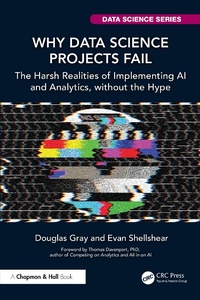
Why Data Science Projects Fail
The Harsh Realities of Implementing AI and Analytics, without the Hype
1st Edition
Published on 5. September 2024
222 pages
978-1-040-12629-5 (ISBN)
Description

The field of artificial intelligence, data science, and analytics is crippling itself. Exaggerated promises of unrealistic technologies, simplifications of complex projects, and marketing hype are leading to an erosion of trust in one of our most critical approaches to making decisions: data driven.
This book aims to fix this by countering the AI hype with a dose of realism. Written by two experts in the field, the authors firmly believe in the power of mathematics, computing, and analytics, but if false expectations are set and practitioners and leaders don't fully understand everything that really goes into data science projects, then a stunning 80% (or more) of analytics projects will continue to fail, costing enterprises and society hundreds of billions of dollars, and leading to non-experts abandoning one of the most important data-driven decision-making capabilities altogether.
For the first time, business leaders, practitioners, students, and interested laypeople will learn what really makes a data science project successful. By illustrating with many personal stories, the authors reveal the harsh realities of implementing AI and analytics.
This book aims to fix this by countering the AI hype with a dose of realism. Written by two experts in the field, the authors firmly believe in the power of mathematics, computing, and analytics, but if false expectations are set and practitioners and leaders don't fully understand everything that really goes into data science projects, then a stunning 80% (or more) of analytics projects will continue to fail, costing enterprises and society hundreds of billions of dollars, and leading to non-experts abandoning one of the most important data-driven decision-making capabilities altogether.
For the first time, business leaders, practitioners, students, and interested laypeople will learn what really makes a data science project successful. By illustrating with many personal stories, the authors reveal the harsh realities of implementing AI and analytics.
More details
Series
Edition
1. Auflage
Language
English
Place of publication
London
United Kingdom
Publishing group
Taylor & Francis Ltd
Target group
Professional and scholarly
Illustrations
2 Tables, black and white; 13 Line drawings, black and white; 13 Illustrations, black and white
ISBN-13
978-1-040-12629-5 (9781040126295)
Copyright in bibliographic data and cover images is held by Nielsen Book Services Limited or by the publishers or by their respective licensors: all rights reserved.
Schweitzer Classification
Other editions
Additional editions

Evan Shellsear
Why Data Science Projects Fail
The Harsh Realities of Implementing AI and Analytics, Without the Hype
Book
12/2024
CRC Press
Unfortunately, price unknown
Available (delivery time upon request)
Douglas Gray | Evan Shellshear
Why Data Science Projects Fail
The Harsh Realities of Implementing AI and Analytics, without the Hype
Book
09/2024
1st Edition
Chapman & Hall/CRC
€56.50
Shipment within 10-20 days
Douglas Gray | Evan Shellshear
Why Data Science Projects Fail
The Harsh Realities of Implementing AI and Analytics, without the Hype
Book
09/2024
1st Edition
Chapman & Hall/CRC
€170.90
Shipment within 10-20 days
Persons
Douglas Gray is a practitioner, leader, and educator with over 30 years of experience leading award-winning teams at industry luminaries in Analytics, including INFORMS Prize-winning American Airlines and Walmart. His teams have delivered advanced game-changing solutions in the airline operations, healthcare, and omnichannel retail supply chain domains which deliver hundreds of millions of dollars in business value and economic impact annually. He teaches Analytics and AI Strategy at Southern Methodist University (SMU) in the Executive MBA, Executive Education, and MS Data Science programs, and has published over a dozen articles on Analytics best practices and applications.
Dr Evan Shellshear is an expert in artificial intelligence with a Ph.D. in Game Theory from the Nobel Prize winning University of Bielefeld in Germany. He has almost two decades of international experience in the development and design of AI tools for a variety of industries having worked with the world's top companies on all aspects of advanced analytical solutions from optimisation to machine learning in applications from HR to oil and gas, and robotics to supply chain. He is also the author of the Amazon best seller, Innovation Tools. Evan is currently based in Brisbane, Australia and is the CEO of a global AI digital platform.
Dr Evan Shellshear is an expert in artificial intelligence with a Ph.D. in Game Theory from the Nobel Prize winning University of Bielefeld in Germany. He has almost two decades of international experience in the development and design of AI tools for a variety of industries having worked with the world's top companies on all aspects of advanced analytical solutions from optimisation to machine learning in applications from HR to oil and gas, and robotics to supply chain. He is also the author of the Amazon best seller, Innovation Tools. Evan is currently based in Brisbane, Australia and is the CEO of a global AI digital platform.
Content
ABOUT THE AUTHORS
FOREWORD
INTRODUCTION
The Sepsis Scourge
An Epic Challenge
A Focus on Failures: The Purpose Behind Our Literary Venture
The Epic Battle
Beyond the Clickbait: When Headlines Just Scratch the Surface
Data-driven Projects are Complex
Begin Your Journey to Outsmart Failure
Critical Thinking: How Not to Fail
Introduction Bibliography
ANALYTICALLY IMMATURE ORGANIZATIONS
The AI Hype
Mapping the Terrain: Prior Insights
What Happened to Best Practices?
What Counts as an ADSAI Failure?
Our Thesis
Facing Challenges
Critical Thinking: How Not to Fail
Chapter 1 Bibliography
STRATEGY
RetailCo's Strategic Nightmare
The Difficult and Critical Role of Strategy7Failing to Build Organizational Need
Not Understanding the Real Business Problem
The Problem with Selecting Good Business Problems
Mike's Story: AI in the Outback
Putting the Cart (Technology) Before the Horse (Business)
The Solution: Put Economics Back in the Driver's Seat
Resolving Mike's AI Investment Challenge
Solving a Problem That is Not a Business Priority
WayBlazer: Companies Will Not Always Pay for the Fancier Mousetrap
Challenges in Aligning Vision, Strategy, and Measuring Success
Lack of Leadership Buy-in
Critical Thinking: How Not to Fail
Chapter 2 Bibliography
PROCESS
Data Quality and Reliability Issues
Let the Data Hunt Begin
(Un)reasonable Expectations
Houston, We Have a Communication Problem
Presenting the Message
Breaking Down Silos
Starting Small and Simple
Project Management for ADSAI
Asking the Right Questions
Critical Thinking: How Not to Fail
Chapter 3 Bibliography
PEOPLE
Lacking the Right Resources
The New Digital Divide
Analytics (or AI) Translators
Where Do You Find Analytics Translators?
Strengthening ADSAI Curricula
Analytically-driven Leadership
Change Management
Justification for Change
Critical Thinking: How Not to Fail
Chapter 4 Bibliography
TECHNOLOGY
Model Mishaps
Misapplying the (Right or Wrong) Model
Keep it Simple: Overemphasizing the Model, Technique, or Technology
From Sandbox Model to Production System
Tools Make Mistakes
The Final Hurdle: Proper Data and Tool Infrastructure
Critical Thinking: How Not to Fail
Chapter 5 Bibliography
ANALYTICALLY MATURE ORGANIZATIONS
(More) Real-life Failures
Outside Influences
Humility
Small Stumbles, Solid Outcome
The Journey to Perfection
Critical Thinking: How Not to Fail
Chapter 6 Bibliography
CONCLUSION
Continuing the Success
Strategy
Process
People
Technology
Summary
Final Words
Critical Thinking: How Not to Fail
Conclusion Bibliography
FOREWORD
INTRODUCTION
The Sepsis Scourge
An Epic Challenge
A Focus on Failures: The Purpose Behind Our Literary Venture
The Epic Battle
Beyond the Clickbait: When Headlines Just Scratch the Surface
Data-driven Projects are Complex
Begin Your Journey to Outsmart Failure
Critical Thinking: How Not to Fail
Introduction Bibliography
ANALYTICALLY IMMATURE ORGANIZATIONS
The AI Hype
Mapping the Terrain: Prior Insights
What Happened to Best Practices?
What Counts as an ADSAI Failure?
Our Thesis
Facing Challenges
Critical Thinking: How Not to Fail
Chapter 1 Bibliography
STRATEGY
RetailCo's Strategic Nightmare
The Difficult and Critical Role of Strategy7Failing to Build Organizational Need
Not Understanding the Real Business Problem
The Problem with Selecting Good Business Problems
Mike's Story: AI in the Outback
Putting the Cart (Technology) Before the Horse (Business)
The Solution: Put Economics Back in the Driver's Seat
Resolving Mike's AI Investment Challenge
Solving a Problem That is Not a Business Priority
WayBlazer: Companies Will Not Always Pay for the Fancier Mousetrap
Challenges in Aligning Vision, Strategy, and Measuring Success
Lack of Leadership Buy-in
Critical Thinking: How Not to Fail
Chapter 2 Bibliography
PROCESS
Data Quality and Reliability Issues
Let the Data Hunt Begin
(Un)reasonable Expectations
Houston, We Have a Communication Problem
Presenting the Message
Breaking Down Silos
Starting Small and Simple
Project Management for ADSAI
Asking the Right Questions
Critical Thinking: How Not to Fail
Chapter 3 Bibliography
PEOPLE
Lacking the Right Resources
The New Digital Divide
Analytics (or AI) Translators
Where Do You Find Analytics Translators?
Strengthening ADSAI Curricula
Analytically-driven Leadership
Change Management
Justification for Change
Critical Thinking: How Not to Fail
Chapter 4 Bibliography
TECHNOLOGY
Model Mishaps
Misapplying the (Right or Wrong) Model
Keep it Simple: Overemphasizing the Model, Technique, or Technology
From Sandbox Model to Production System
Tools Make Mistakes
The Final Hurdle: Proper Data and Tool Infrastructure
Critical Thinking: How Not to Fail
Chapter 5 Bibliography
ANALYTICALLY MATURE ORGANIZATIONS
(More) Real-life Failures
Outside Influences
Humility
Small Stumbles, Solid Outcome
The Journey to Perfection
Critical Thinking: How Not to Fail
Chapter 6 Bibliography
CONCLUSION
Continuing the Success
Strategy
Process
People
Technology
Summary
Final Words
Critical Thinking: How Not to Fail
Conclusion Bibliography
