

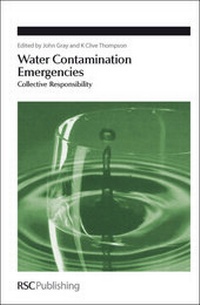
Water Contamination Emergencies
Collective Responsibility
1st Edition
Published on 10. February 2009
424 pages
978-1-84755-931-9 (ISBN)
Description

In the current international situation, the ability to deal effectively with water contamination emergencies is of rapidly increasing importance. The third in a series of conference proceedings, this book brings together contributions from leading scientists and experts in industry and academia. It offers an international perspective and develops the themes of the previous volumes entitled Water Contamination Emergencies: Can we cope? and Water Contamination Emergencies: Enhancing our response. The full range of potential chemical, microbiological and radiological contamination scenarios are addressed from the perspective of medical and health professionals, water companies and regulators, environmental protection professionals, risk and business continuity managers, emergency planners, local authorities, service and support providers, detection and equipment suppliers, disaster recovery specialists, water security experts, water distribution modellers and laboratories involved in round the clock emergency response. Emphasis is placed on the considerable effort required to prepare for and respond to an emergency. It is not sufficient for Individuals to simply identify their own responsibilities, they must also take action to establish effective and efficient working relationships with the other parties involved. In other words, they must take "Collective Responsibility". In summary, this book will provide readers with an up-to-date view of current strategies and the collaboration essential for an appropriate and timely response to water contamination emergencies.
More details
Series
Edition
1. Auflage
Language
English
Place of publication
Cambridge
United Kingdom
Target group
Professional and scholarly
ISBN-13
978-1-84755-931-9 (9781847559319)
DOI
10.1039/9781847559319
Copyright in bibliographic data and cover images is held by Nielsen Book Services Limited or by the publishers or by their respective licensors: all rights reserved.
Schweitzer Classification
Other editions
Additional editions
Book
02/2009
Royal Society of Chemistry
€155.50
Shipment within 3-4 weeks
Persons
John Gray spent 22 years working in UK Water Companies on all aspects of water treatment, supply and analysis. This was followed by 13 years as a regulator before retirement in 2007 from his position as Deputy Chief Inspector (Operations) with the Drinking Water Inspectorate. He has been involved in improving the safety and security of drinking water supplies and has established links with other Government Departments, academia and research organizations involved in "homeland defence" issues both in the UK and internationally. He was closely involved in the development of the specialized analytical capability for the water industry. Actively involved with the Royal Society of Chemistry, John Gray was for six years a member of the Applications Committee followed by seven years with the Ethical Practices Committee. He chaired of the organizing committee of the three Water Contamination Emergencies conferences. Professor Thompson has 37 years experience in the management of environmental laboratories including those at Severn Trent and Yorkshire Water. He is currently Chief Scientist of ALcontrol UK, one of the largest contract water, soil, air and food analysis organizations in Europe. Since its inception in 1995, he has chaired the UK Water Laboratory Mutual Aid Group and been closely involved with the three associated sub-groups on emergency organic and radioactivity analysis and the LEAP emergency incident proficiency scheme. He was Secretary of the organizing committee of the three Water Contamination Emergencies conferences.
Content
Introduction: Themes and Objectives;
Water Emergencies: Opening remarks;
Water is life: a view of organisational resilience in the Australian water industry;
Online toxicity monitors and their use in distribution system and watershed early warning systems;
Water supply security issues and trends;
Consequence management within the Environmental Protection Agency's water security initiative;
Application of a risk based approach to security and integrity of assets - a regulators view;
Let's get real: Real world experiences with real-time on-line monitoring for security and quality. Detecting and responding to events;
The organisational culture of managing incidents and risks in the water sector;
A simulation tool for contaminant warning system design and evaluation;
CBRN modelling: application to water contamination;
Planning, preparedness and security of the alternative water supply;
Procedures for the decontamination of building plumbing systems;
Lessons learned from summer floods 2007. Phase 1 report - Emergency response prepared by Water UK's Review Group on flooding;
Risk assessment methodology for water utilities - RAM-WTM - lessons learned;
Risk-based approaches to water quality management: integrating public health metrics in water safety planning;
How standards can assist the assessment of, recovery and prevention of future emergencies;
The XX edition of the Torino Olympic Games experience: planning for and responding to drinking water contamination threats;
Sensitive, selective and simple UV-spectrometry for contaminant alarm systems;
Fully automated instrumentation for nucleic acid testing in the field;
Optimisation of NMR methodology for non-targeted detection of water contaminants;
Preventing water contamination - a co-ordinated response;
Potential sources of man-made radiochemical contamination of water resources with special emphasis on the nuclear fuel cycle;
Rapid methods;
Processing and databasing spectroscopic analyses and its use in the elucidation of unkowns;
Handbooks to assist in the management of a radiological incident involving the contamination of drinking water supplies;
Robust on-line total organic carbon (TOC) analyser for security monitoring;
Water UK emergency planning;
The Scottish Waterborne Hazard Plan;
Research related to water security;
Early warning and reports;
OK, we've got a problem, so who do we tell? Inter-agency communication - a water company view;
Review and evaluation of water concentration technologies for analysis by real-time PCR;
Scientific and Technical Advisory Cell (STAC) - getting timely public health advice to multi-agency frontline responders;
Communicating with the public during water contamination events: addressing vulnerable populations;
Medical preparedness for water contamination events;
Keeping the public on-side and maintaining reputation;
Sociological and psychological constraints to learning from failure;
Lessons learned from major contamination incidents - a discussion;
Review of conference;
List of posters;
Subject Index.
Water Emergencies: Opening remarks;
Water is life: a view of organisational resilience in the Australian water industry;
Online toxicity monitors and their use in distribution system and watershed early warning systems;
Water supply security issues and trends;
Consequence management within the Environmental Protection Agency's water security initiative;
Application of a risk based approach to security and integrity of assets - a regulators view;
Let's get real: Real world experiences with real-time on-line monitoring for security and quality. Detecting and responding to events;
The organisational culture of managing incidents and risks in the water sector;
A simulation tool for contaminant warning system design and evaluation;
CBRN modelling: application to water contamination;
Planning, preparedness and security of the alternative water supply;
Procedures for the decontamination of building plumbing systems;
Lessons learned from summer floods 2007. Phase 1 report - Emergency response prepared by Water UK's Review Group on flooding;
Risk assessment methodology for water utilities - RAM-WTM - lessons learned;
Risk-based approaches to water quality management: integrating public health metrics in water safety planning;
How standards can assist the assessment of, recovery and prevention of future emergencies;
The XX edition of the Torino Olympic Games experience: planning for and responding to drinking water contamination threats;
Sensitive, selective and simple UV-spectrometry for contaminant alarm systems;
Fully automated instrumentation for nucleic acid testing in the field;
Optimisation of NMR methodology for non-targeted detection of water contaminants;
Preventing water contamination - a co-ordinated response;
Potential sources of man-made radiochemical contamination of water resources with special emphasis on the nuclear fuel cycle;
Rapid methods;
Processing and databasing spectroscopic analyses and its use in the elucidation of unkowns;
Handbooks to assist in the management of a radiological incident involving the contamination of drinking water supplies;
Robust on-line total organic carbon (TOC) analyser for security monitoring;
Water UK emergency planning;
The Scottish Waterborne Hazard Plan;
Research related to water security;
Early warning and reports;
OK, we've got a problem, so who do we tell? Inter-agency communication - a water company view;
Review and evaluation of water concentration technologies for analysis by real-time PCR;
Scientific and Technical Advisory Cell (STAC) - getting timely public health advice to multi-agency frontline responders;
Communicating with the public during water contamination events: addressing vulnerable populations;
Medical preparedness for water contamination events;
Keeping the public on-side and maintaining reputation;
Sociological and psychological constraints to learning from failure;
Lessons learned from major contamination incidents - a discussion;
Review of conference;
List of posters;
Subject Index.
