

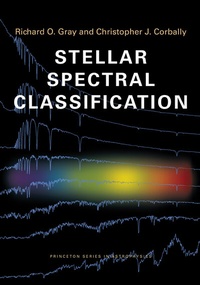
Stellar Spectral Classification
1st Edition
Published on 5. July 2021
592 pages
978-1-4008-3336-8 (ISBN)
Description

Written by leading experts in the field, Stellar Spectral Classification is the only book to comprehensively discuss both the foundations and most up-to-date techniques of MK and other spectral classification systems. Definitive and encyclopedic, the book introduces the astrophysics of spectroscopy, reviews the entire field of stellar astronomy, and shows how the well-tested methods of spectral classification are a powerful discovery tool for graduate students and researchers working in astronomy and astrophysics.
The book begins with a historical survey, followed by chapters discussing the entire range of stellar phenomena, from brown dwarfs to supernovae. The authors account for advances in the field, including the addition of the L and T dwarf classes; the revision of the carbon star, Wolf-Rayet, and white dwarf classification schemes; and the application of neural nets to spectral classification. Copious figures illustrate the morphology of stellar spectra, and the book incorporates recent discoveries from earth-based and satellite data. Many examples of spectra are given in the red, ultraviolet, and infrared regions, as well as in the traditional blue-violet optical region, all of which are useful for researchers identifying stellar and galactic spectra. This essential reference includes a glossary, handy appendixes and tables, an index, and a Web-based resource of spectra.
In addition to the authors, the contributors are Adam J. Burgasser, Margaret M. Hanson, J. Davy Kirkpatrick, and Nolan R. Walborn.
The book begins with a historical survey, followed by chapters discussing the entire range of stellar phenomena, from brown dwarfs to supernovae. The authors account for advances in the field, including the addition of the L and T dwarf classes; the revision of the carbon star, Wolf-Rayet, and white dwarf classification schemes; and the application of neural nets to spectral classification. Copious figures illustrate the morphology of stellar spectra, and the book incorporates recent discoveries from earth-based and satellite data. Many examples of spectra are given in the red, ultraviolet, and infrared regions, as well as in the traditional blue-violet optical region, all of which are useful for researchers identifying stellar and galactic spectra. This essential reference includes a glossary, handy appendixes and tables, an index, and a Web-based resource of spectra.
In addition to the authors, the contributors are Adam J. Burgasser, Margaret M. Hanson, J. Davy Kirkpatrick, and Nolan R. Walborn.
More details
Other editions
Additional editions
Richard O. Gray | Christopher J. Corbally
Stellar Spectral Classification
Book
03/2009
Princeton University Press
€75.30
Shipment within 10-20 days
Richard O. Gray | Christopher J. Corbally
Stellar Spectral Classification
Book
03/2009
Princeton University Press
€124.00
Article exhausted; check different version
Persons
Richard O. Gray is professor of astronomy at Appalachian State University. Christopher J. Corbally, SJ, is a vice director of the Vatican Observatory and adjunct associate professor of astronomy at the University of Arizona.
Content
- Cover Page
- Half-title Page
- Title Page
- Copyright Page
- Dedication Page
- Contents
- Preface
- Important Note on Terminology and Units
- Chapter 1. The History and Philosophy of Stellar Spectral Classification
- 1.1 Early History
- 1.2 Later Developments
- 1.3 The MK Process
- Chapter 2. An Overview of the Normal Stars
- 2.1 Introduction
- 2.2 The Spectral Sequence
- 2.3 Multicolor Photometry and Stellar Classification
- 2.4 Physical Principles Underlying the MK Sequence
- Chapter 3. The OB Stars-Nolan R. Walborn
- 3.1 Introduction
- 3.2 The Optical
- 3.3 The Ultraviolet
- 3.4 The Infrared-Margaret M. Hanson
- 3.5 Peculiar Categories
- 3.6 X-Ray Line Spectra
- 3.7 Calibration and Astrophysical Modeling
- Chapter 4. The B-type Stars
- 4.1 Introduction
- 4.2 Optical Classification
- 4.3 The Ultraviolet
- 4.4 Chemically Peculiar B-type Stars
- 4.5 Be Stars and B Shell Stars
- 4.6 Other B-type Emission-line Stars
- 4.7 B-type Stars in Advanced Evolutionary States
- Chapter 5. The A-type Stars
- 5.1 Introduction
- 5.2 Optical Spectral-type Criteria
- 5.3 Ultraviolet and Infrared Classification Schemes
- 5.4 Chemically Peculiar Stars
- 5.5 Herbig Ae/Be Stars
- 5.6 A-type Stars in Advanced Evolutionary Stages
- 5.7 A-type Shell Stars
- Chapter 6. The F-type Stars
- 6.1 Introduction
- 6.2 Optical Classification
- 6.3 Classification in the Ultraviolet and Infrared
- 6.4 Population II F-type Stars
- 6.5 Chemically Peculiar F-type Stars
- 6.6 F-type Stars in Advanced Evolutionary Stages
- Chapter 7. The G- and K-type Stars
- 7.1 Introduction
- 7.2 Optical Classification
- 7.3 The Infrared
- 7.4 The Search for a Solar Twin
- Chromospheric Activity
- 7.5 T Tauri Stars
- 7.6 Chemically Peculiar G- and K-giants
- 7.7 Population II and III Stars
- 7.8 The High Luminosity, Yellow Variables
- Chapter 8. The M-type, S-type, and Carbon Stars
- 8.1 Introduction
- 8.2 The M-type Stars
- 8.3 The Carbon Stars
- 8.4 The S-type Stars
- 8.5 Symbiotic and Algol Stars
- Chapter 9. M Dwarfs and L Dwarfs-J. Davy Kirkpatrick
- 9.1 Introduction
- 9.2 The Discovery of M Dwarfs and L Dwarfs
- 9.3 Spectroscopic Classification
- 9.4 Physical Interpretation of Types
- 9.4 Peculiar Objects
- Chapter 10. The T-type Dwarfs-Adam J. Burgasser
- 10.1 Introduction
- 10.2 Recognition of the T Dwarf Class and Early Discoveries
- 10.3 T Dwarf Spectral Characteristics
- 10.4 Near-Infrared Classification
- 10.5 Optical Classification
- 10.6 Mid-Infrared Classification
- 10.7 Additional Considerations for T-Dwarf Classification
- 10.8 Beyond the T Dwarfs
- Chapter 11. Wolf-Rayet Stars and the Luminous Blue Variables
- 11.1 The Wolf-Rayet Stars
- 11.2 Luminous Blue Variables
- 11.3 Evolutionary Connections
- Chapter 12. Endpoints of Stellar Evolution
- 12.1 Proto-Planetary Nebulae and Planetary Nebula Nucleus Stars
- 12.2 White Dwarf Stars
- 12.3 Novae
- 12.4 Supernovae
- Chapter 13. Further Techniques
- 13.1 Introduction
- 13.2 Composite Spectra
- 13.3 Classification Systems in the Thermal Infrared
- 13.4 Other Classification Systems
- 13.5 Automated Methods of Spectral Classification
- 13.6 Low Dispersion Techniques and Natural Groups
- Glossary
- Appendix A: MK Standard Stars
- Appendix B: Calibrations of the MK System
- Appendix C: The Book Website
- General Index
- Object Index
