

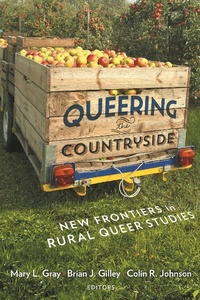
Queering the Countryside
New Frontiers in Rural Queer Studies
Published on 15. March 2016
277 pages
978-1-4798-9525-0 (ISBN)
Description

Choice Outstanding Academic Title of 2016
Rural queer experience is often hidden or ignored, and presumed to be alienating, lacking, and incomplete without connections to a gay culture that exists in an urban elsewhere. Queering the Countryside offers the first comprehensive look at queer desires found in rural America from a genuinely multi-disciplinary perspective. This collection of original essays confronts the assumption that queer desires depend upon urban life for meaning.
By considering rural queer life, the contributors challenge readers to explore queer experiences in ways that give greater context and texture to modern practices of identity formation. The book's focus on understudied rural spaces throws into relief the overemphasis of urban locations and structures in the current political and theoretical work on queer sexualities and genders. Queering the Countryside highlights the need to rethink notions of "the closet" and "coming out" and the characterizations of non-urban sexualities and genders as "isolated" and in need of "outreach." Contributors focus on a range of topics-some obvious, some delightfully unexpected-from the legacy of Matthew Shepard, to how heterosexuality is reproduced at the 4-H Club, to a look at sexual encounters at a truck stop, to a queer reading of TheWizard of Oz.
A journey into an unexplored slice of life in rural America, Queering the Countryside offers a unique perspective on queer experience in the modern United States and Canada.
Rural queer experience is often hidden or ignored, and presumed to be alienating, lacking, and incomplete without connections to a gay culture that exists in an urban elsewhere. Queering the Countryside offers the first comprehensive look at queer desires found in rural America from a genuinely multi-disciplinary perspective. This collection of original essays confronts the assumption that queer desires depend upon urban life for meaning.
By considering rural queer life, the contributors challenge readers to explore queer experiences in ways that give greater context and texture to modern practices of identity formation. The book's focus on understudied rural spaces throws into relief the overemphasis of urban locations and structures in the current political and theoretical work on queer sexualities and genders. Queering the Countryside highlights the need to rethink notions of "the closet" and "coming out" and the characterizations of non-urban sexualities and genders as "isolated" and in need of "outreach." Contributors focus on a range of topics-some obvious, some delightfully unexpected-from the legacy of Matthew Shepard, to how heterosexuality is reproduced at the 4-H Club, to a look at sexual encounters at a truck stop, to a queer reading of TheWizard of Oz.
A journey into an unexplored slice of life in rural America, Queering the Countryside offers a unique perspective on queer experience in the modern United States and Canada.
Reviews / Votes
"Queering the Countryside operationalizes the & rural as a queer analytic that serves as a productive framework to rethink the relationship between sexuality, space, and place. It is a welcomed addition to the queer studies canon." - E. Patrick Johnson,author of Sweet Tea: Black Gay Men of the South-An Oral History "Rather than simply populating rural landscapes with queer folk who, in multiple senses, have been there all along, Queering the Countryside opens with a much more ambitious question: What would the study of life in the countryside look like if it pushed past its historic dependence on the fantasy-ridden spatial dichotomy between rural and urban? Imaginative, capacious, and complex." - Kath Weston,author of Families We Choose: Lesbians, Gays, Kinship "Together these essays gift scholars with a new chapter in the rural turn that further cracks the foundations of metronormativity. Welcome to the backwoods of North America and the forefront of queer studies." - Scott Herring,author of Another Country: Queer Anti-Urbanism "This collection of essays is, in many ways, an important contribution to the study of LGBT individual living in rural areas." (Choice Connect) "These interdisciplinary essays, taken together, are generally successful in rejecting stereotypes of non-urban queer life as one of isolation and alienation." (Journal of American History) "This new book is the first detailed and comprehensive study of queer desire in rural American and it does so from a multi-disciplinary perspective.What we read here challenges us to look at our experiences in ways that have a great deal more to form identity." (Reviews by Amos Lassen) "An eclectic volume that serves the crucial function of relocating queer studies scholarship from city to country." (The Journal of Southern History)More details
Series
Language
English
Place of publication
New York
United States
Target group
Professional and scholarly
ISBN-13
978-1-4798-9525-0 (9781479895250)
Copyright in bibliographic data and cover images is held by Nielsen Book Services Limited or by the publishers or by their respective licensors: all rights reserved.
Schweitzer Classification
Other editions
Additional editions
Mary L. Gray | Colin R. Johnson | Brian J. Gilley
Queering the Countryside
New Frontiers in Rural Queer Studies
Book
03/2016
New York University Press
€34.00
Shipment within 10-20 days
Persons
Mary L. Gray is Associate Professor in The Media School, Affiliate Faculty of Gender Studies, and an Adjunct in American Studies and Anthropology at Indiana University. She is also a Senior Researcher at Microsoft Research New England. She is the author of In Your Face:Stories from the Lives of Queer Youth and Out in the Country: Youth, Media, and Queer Visibility in Rural America.
Colin R. Johnson is Associate Professor of Gender Studies and Adjunct Associate Professor of American Studies, History and Human Biology at Indiana University. He is the author of Just Queer Folks: Gender and Sexuality in Rural America.
Brian J. Gilley is Professor of Anthropology at Indiana University. He is the author of A Longhouse Fragmented: Ohio Iroquis Autonomy in the Nineteenth Century, Becoming Two-Spirit, and the co-editor, with S. Morgenson, Q. Driscoll and C. Finley of Queer Indigenous Studies.
Colin R. Johnson is Associate Professor of Gender Studies and Adjunct Associate Professor of American Studies, History and Human Biology at Indiana University. He is the author of Just Queer Folks: Gender and Sexuality in Rural America.
Brian J. Gilley is Professor of Anthropology at Indiana University. He is the author of A Longhouse Fragmented: Ohio Iroquis Autonomy in the Nineteenth Century, Becoming Two-Spirit, and the co-editor, with S. Morgenson, Q. Driscoll and C. Finley of Queer Indigenous Studies.
