

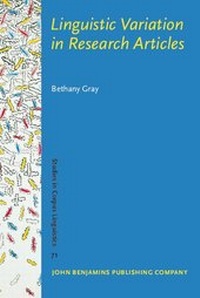
Linguistic Variation in Research Articles
When discipline tells only part of the story
1st Edition
Published on 17. December 2015
XIV, 222 pages
978-90-272-6804-4 (ISBN)
Description

Linguistic Variation in Research Articles investigates the linguistic characteristics of academic research articles, going beyond a traditional analysis of the generically-defined research article to take into account varied realizations of research articles within and across disciplines. It combines corpus-based analyses of 70+ linguistic features with analyses of the situational, or non-linguistic, characteristics of the Academic Journal Registers Corpus: 270 research articles from 6 diverse disciplines (philosophy, history, political science, applied linguistics, biology, physics) and representing three sub-registers (theoretical, quantitative, and qualitative research). Comprehensive analyses include a lexical/grammatical survey, an exploration of structural complexity, and a Multi-Dimensional analysis, all interpreted relative to the situational analysis of the corpus. The finding that linguistic variation in research articles does not occur along a single parameter like discipline is discussed relative to our understanding of disciplinary practices, the multidimensional nature of variation in research articles, and resulting methodological considerations for corpus studies of disciplinary writing.
More details
Other editions
Additional editions
Book
12/2015
John Benjamins Publishing Co
€100.70
Shipment within 10-15 days
Person
Content
- Intro
- Linguistic Variation in Research Articles
- Editorial page
- Title page
- LCC data
- Table of contents
- Acknowledgements
- List of tables
- List of figures
- Introduction
- 1.1 Academic research writing: One register or many?
- 1.1.1 A note on 'register'
- 1.1.2 Goal of the present book
- 1.2 The linguistic characteristics of academic writing
- 1.3 Linguistic variation and disciplinary writing
- 1.4 Trends and gaps in the study of disciplinary writing
- 1.5 Overview of the book: Applying corpus analytical approaches to disciplinary register variation
- Describing the domain of academic journal writing
- 2.1 Introduction
- 2.2 Surveying the Domain of Disciplinary Journal Writing
- 2.2.1 Procedures
- 2.2.2 A taxonomy of academic journal registers
- 2.2.3 Some issues in applying a taxonomy of research articles
- 2.3 Journal Registers in the Disciplines
- 2.4 Implications for Corpus Design
- Building and analyzing the academic journal register corpus
- 3.1 Introduction
- 3.2 Corpus Collection Procedures
- 3.2.1 Formation of operational definitions for journal registers in specific disciplines
- 3.2.2 Journal and article selection
- 3.2.3 File conversion and clean-up
- 3.3 Corpus Description: The Academic Journal Register Corpus
- 3.4 Corpus Annotation
- 3.4.1 'Tagging': Part of speech annotation
- 3.4.2 Accuracy of automatic tagging
- 3.5 Overview: Procedures for Quantitative Corpus Analysis
- The situational characteristics of the Academic Journal Register Corpus
- 4.1 Introduction
- 4.2 Motivating a new situational framework for journal registers
- 4.3 A framework for the situational characteristics of journal registers
- 4.3.1 Participants
- 4.3.2 Textual layout and organization
- 4.3.3 Setting
- 4.3.4 Subject/topic
- 4.3.5 Purpose
- 4.3.6 Nature of data or evidence
- 4.3.7 Methodology
- 4.3.8 Explicitness of research design
- 4.4 The situational characteristics of the Academic Journal Register Corpus
- 4.4.1 Common characteristics across journal registers
- 4.4.2 Theoretical articles in philosophy
- 4.4.3 Qualitative articles in history
- 4.4.4 Qualitative and quantitative articles in political science
- 4.4.5 Qualitative and quantitative articles in applied linguistics
- 4.4.6 Quantitative articles in biology
- 4.4.7 Quantitative and theoretical articles in physics
- 4.5 Trends in the situational characteristics of the Academic Journal Register Corpus
- A lexical and grammatical survey
- 5.1 Introduction
- 5.2 Grammatical Variation in Academic Prose
- 5.3 Carrying Out a Lexical and Grammatical Survey
- 5.4 Distribution of Core Grammatical Features
- 5.4.1 Nouns
- 5.4.2 Verbs
- 5.4.3 The verb phrase: Passive voice
- 5.4.4 The verb phrase: Tense and aspect
- 5.4.5 Personal pronouns
- 5.5 Summing Up: Lexical and Grammatical Variation
- Structural complexity in journal registers
- 6.1 Introduction
- 6.2 Features of elaboration and compression in academic prose
- 6.3 Carrying out a study of structural complexity
- 6.4 The use of features of structural elaboration and compression
- 6.4.1 Clausal elaboration
- 6.4.2 Phrasal compression
- 6.4.3 Intermediate features: Clausal modifiers in the noun phrase
- 6.5 Summing up: Clausal Elaboration and phrasal compression
- 6.6 Conclusions
- A multi-dimensional analysis of journal registers
- 7.1 Introduction
- 7.2 Background: Multi-dimensional analyses of academic language
- 7.3 Carrying out a new multi-dimensional analysis
- 7.3.1 Initial factor analyses to determine linguistic variables
- 7.3.2 Final factor analysis
- 7.3.3 Calculating and comparing factor scores across disciplines and registers
- 7.4 Dimensions of variation in academic journal registers in 6 disciplines
- 7.4.1 Dimension 1: Academic involvement and elaboration vs. informational density
- 7.4.2 Dimension 2: Contextualized narration vs. procedural discourse
- 7.4.3 Dimension 3: Human vs. non-human focus
- 7.4.4 Dimension 4: 'Academese'
- 7.5 Conclusions
- A Synthesis
- 8.1 Introduction
- 8.2 Summing up: Linguistic variation in the Academic Journal Register Corpus
- 8.2.1 How does language use vary across discipline?
- 8.2.2 How does language use vary across academic journal registers?
- 8.3 Three grammatical analyses and future directions
- 8.3.1 What have we learned from three complementary approaches?
- 8.3.2 Future research using corpus analytical techniques to investigate variation in academic journal registers
- 8.3.3 Implications: Future linguistic features of interest
- 8.3.4 Implications: Corpus design for studies of disciplinary writing
- References
- Appendix A. Journals examined during taxonomy development
- Appendix B. Reliability of automatic tags
- Appendix C. Semantic classes of nouns, verbs, and adjectives
- Appendix D. Full factorial structure matrix for the four-factor solution
- Appendix E. Scree plot of the four-factor solution
- Appendix F. Significance testing for four-factor solution
- Index
