

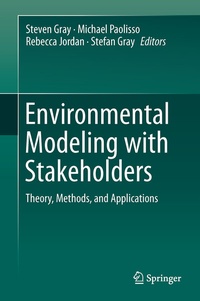
Environmental Modeling with Stakeholders
Theory, Methods, and Applications
Published on 16. December 2016
XXII, 370 pages
978-3-319-25053-3 (ISBN)
Description

This volume brings together, in a central text, chapters written by leading scholars working at the intersection of modeling, the natural and social sciences, and public participation. This book presents the current state of knowledge regarding the theory and practice of engaging stakeholders in environmental modeling for decision-making, and includes basic theoretical considerations, an overview of methods and tools available, and case study examples of these principles and methods in practice. Although there has been a significant increase in research and development regarding participatory modeling, a unifying text that provides an overview of the different methodologies available to scholars and a systematic review of case study applications has been largely unavailable. This edited volume seeks to address a gap in the literature and provide a primer that addresses the growing demand to adopt and apply a range of modeling methods that includes the public in environmental assessment and management.
The book is divided into two main sections. The first part of the book covers basic considerations for including stakeholders in the modeling process and its intersection with the theory and practice of public participation in environmental decision-making. The second part of the book is devoted to specific applications and products of the various methods available through case study examination. This second part of the book also provides insight from several international experts currently working in the field about their approaches, types of interactions with stakeholders, models produced, and the challenges they perceived based on their practical experiences.
The book is divided into two main sections. The first part of the book covers basic considerations for including stakeholders in the modeling process and its intersection with the theory and practice of public participation in environmental decision-making. The second part of the book is devoted to specific applications and products of the various methods available through case study examination. This second part of the book also provides insight from several international experts currently working in the field about their approaches, types of interactions with stakeholders, models produced, and the challenges they perceived based on their practical experiences.
More details
Series
Edition
1st ed. 2017
Language
English
Place of publication
Cham
Switzerland
Publishing group
Springer International Publishing
Target group
Professional and scholarly
Product notice
Reflowable
Illustrations
XXII, 370 p. 74 illus., 36 illus. in color.
File size
9,32 MB
ISBN-13
978-3-319-25053-3 (9783319250533)
DOI
10.1007/978-3-319-25053-3
Schweitzer Classification
Other editions
Additional editions
Steven Gray | Michael Paolisso | Rebecca Jordan
Environmental Modeling with Stakeholders
Theory, Methods, and Applications
Book
12/2016
Springer
€181.89
Shipment within 10-15 days
Persons
Steven Gray is an Assistant Professor in the Department of Community Sustainability at Michigan State University. His research focuses on the theory and practice of participatory modeling and developing decision-support software to help communities, resource managers, and other decision-makers to understand the social impacts of environmental change through modeling.
Michael Paolisso is a Professor in the Department of Anthropology at the University of Maryland whose research seeks to demonstrate how cultural models of the environment have a direct bearing on the use and management of natural resources, and how cognitive-cultural approaches and collaborative learning improve scientist and public understanding, dialogue, and collaboration in addressing environmental issues.
Rebecca Jordan is a Professor in the Department of Human Ecology at Rutgers University. Trained as a behavioral ecologist her scholarly work focusses on public participation in scientific research and the contribution of learning to the sustainability of coupled social-ecological systems.
Stefan Gray currently works as an adviser to the Parliamentary Commissioner for the Environment in Wellington, New Zealand. At the time of the production of this book, Stefan held a Research Fellowship funded by the Irish Environmental Protection Agency, supporting climate change adaptation at central and local government levels in Ireland. His research in Europe focused on issues related to expanding decision-making in environmental management to incorporate complex adaptive systems theory.
Michael Paolisso is a Professor in the Department of Anthropology at the University of Maryland whose research seeks to demonstrate how cultural models of the environment have a direct bearing on the use and management of natural resources, and how cognitive-cultural approaches and collaborative learning improve scientist and public understanding, dialogue, and collaboration in addressing environmental issues.
Rebecca Jordan is a Professor in the Department of Human Ecology at Rutgers University. Trained as a behavioral ecologist her scholarly work focusses on public participation in scientific research and the contribution of learning to the sustainability of coupled social-ecological systems.
Stefan Gray currently works as an adviser to the Parliamentary Commissioner for the Environment in Wellington, New Zealand. At the time of the production of this book, Stefan held a Research Fellowship funded by the Irish Environmental Protection Agency, supporting climate change adaptation at central and local government levels in Ireland. His research in Europe focused on issues related to expanding decision-making in environmental management to incorporate complex adaptive systems theory.
Content
Part I: The Process of Environmental Modeling with Stakeholders.- Cognitive, Material and Technological Considerations in Participatory Environmental Modeling.- Learning Through Participatory Modeling: Reflections on What it Means and How it is Measured.- Values in Participatory Modeling: Theory and Practice.- Eliciting Judgments, Priorities, and Values Using Structured Survey Methods.- Participatory Modeling and Structured Decision-making.- Ensuring that Ecological Science Contributes to Natural Resource Management using a Delphi-derived Approach.- Part II: The Application and Products of Environmental Modeling with Stakeholders.- Fuzzy-logic Cognitive Mapping: Introduction and Overview of the Method.- FCMs as a Common base for Linking Participatory Products and Models.- Extending Participatory Fuzzy Cognitive Mapping with a Control Nodes Methodology: A Case Study of a Development Bio-based Economy in the Humber Region, UK.- Effects of Livelihood-diversification on Sustainability of Natural Resources in the Rangelands of East Africa: Participatory Field Studies and Results of an Agent-based Model using the Knowledge of Indigenous Maasai Pastoralists of Kenya.- Level of Sustainable Activity: A Framework for Integrating Stakeholders into the Simulation Modeling and Management of Mixed-use Waterways.- Engaging Stakeholders in Environmental and Sustainability Decisions with Participatory System Dynamics Modeling.- Participatory Modeling and Community Dialog about Vulnerability of Lobster Fishing to Climate Change.- Case Study: Participatory Modeling to Assess Climate Impacts on Water Resources in the Big Wood Basin, Idaho.- Science based Modelling for Supporting Integrated Coastal Zone Management.- Assessing Flood Impacts, Wetland Changes and Climate Adaptation in Europe: The CLIMSAVE Approach.- Linking Participatory, Bayesian, and Agent-based Modeling Techniques to Simulate Coupled Natural-Human System: A Case Study with Ranchers in Sonora, Mexico.
