

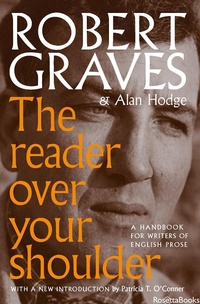
The Reader Over Your Shoulder
A Handbook for Writers of English Prose
Published on 12. February 2019
640 pages
978-0-7953-5046-7 (ISBN)
Description

"The best book on writing ever published" (Patricia T. O'Conner, author of
Woe Is I).
When Robert Graves and Alan Hodge decided to collaborate on this manual for writers, the world was in total upheaval. Graves had fled Majorca three years earlier at the start of the Spanish Civil War, and as they labored over their new project, they witnessed the fall of France and the evacuation of Allied forces at Dunkirk. Soon the horror of World War II would reach British soil as well, as the Luftwaffe began bombing London in an effort to destroy the resolve of the English people.
Graves and Hodge believed that at a time when their whole world was falling apart, the survival of English prose sentences-of writing that was clear, concise, and intelligible-had become paramount if hope were going to outlive the onslaught. They came up with forty-one principles for writing, the majority devoted to clarity, the remainder to grace of expression. They studied the prose of a wide range of noted authors and leaders, finding much room for improvement. Successful communication could mean the difference between war and peace, life and death, and they were determined to contribute to its survival. The importance of good writing continues today, as obfuscation, propaganda, manipulative language, and sloppy standards are all too common-and this classic guide is just as useful and important as ever.
Note: This edition restores the full, original 1943 text.
"To see what really expert mavens can do in applying their rule-based expertise to clearing up bad prose, get hold of a copy of The Reader Over Your Shoulder." -The Atlantic
When Robert Graves and Alan Hodge decided to collaborate on this manual for writers, the world was in total upheaval. Graves had fled Majorca three years earlier at the start of the Spanish Civil War, and as they labored over their new project, they witnessed the fall of France and the evacuation of Allied forces at Dunkirk. Soon the horror of World War II would reach British soil as well, as the Luftwaffe began bombing London in an effort to destroy the resolve of the English people.
Graves and Hodge believed that at a time when their whole world was falling apart, the survival of English prose sentences-of writing that was clear, concise, and intelligible-had become paramount if hope were going to outlive the onslaught. They came up with forty-one principles for writing, the majority devoted to clarity, the remainder to grace of expression. They studied the prose of a wide range of noted authors and leaders, finding much room for improvement. Successful communication could mean the difference between war and peace, life and death, and they were determined to contribute to its survival. The importance of good writing continues today, as obfuscation, propaganda, manipulative language, and sloppy standards are all too common-and this classic guide is just as useful and important as ever.
Note: This edition restores the full, original 1943 text.
"To see what really expert mavens can do in applying their rule-based expertise to clearing up bad prose, get hold of a copy of The Reader Over Your Shoulder." -The Atlantic
More details
Persons
Robert Graves (1895-1985) was an English novelist, poet, and translator of Classical Greek and Roman literature, and one of the most prominent English writers of the 20th century. He was an extremely prolific writer, who published more than 140 novels and collections of poetry. In addition to novels and poetry, he published groundbreaking analysis of Greek mythology, as well as memoir. Graves is best known for his historical novels, which include I, Claudius, Claudius, the God, The Golden Fleece, King Jesus, and Count Belisarius. Robert Graves served in combat in World War I and was gravely wounded at the Battle of the Somme. Following his recovery, he wrote several works of war poetry as well as a memoir of his time in combat, entitled Goodbye to All That. In 1934, Robert Graves was awarded the James Tait Black Memorial Prize for his historical novels dealing with the Roman Emperor Claudius.
Content
- Intro
- Acknowledgements
- Introduction by Patricia T. O'Conner
- Part I: The Reader Over Your Shoulder
- 1. The Peculiar Qualities of English
- 2. The Present Confusion of English Prose
- 3. Where Is Good English to Be Found?
- 4. The Use and Abuse of Official English
- 5. The Beginnings of English Prose
- 6. The Ornate and Plain Styles
- 7. Classical Prose
- 8. Romantic Prose
- 9. Recent Prose
- 10. The Principles of Clear Statement-I
- 11. The Principles of Clear Statement-II
- 12. The Principles of Clear Statement-III
- 13. The Graces of Prose
- Part II: Examinations and Fair Copies
- Sir Norman Angell
- Irving Babbitt
- Earl Baldwin of Bewdley
- Clive Bell
- Viscount Castlerosse (later the Earl of Kenmare)
- Bishop of Chichester
- G. D. H. Cole
- Marquess of Crewe
- Dr. Hugh Dalton, M.P.
- Daphne Du Maurier
- Sir Arthur Eddington
- T. S. Eliot
- Lord Esher
- Admiral C. J. Eyres
- Negley Farson
- Major-Gen. J. F. C. Fuller
- Major-Gen. Sir Charles Gwynn
- Viscount Halifax
- Cicely Hamilton
- 'Ian Hay'
- Ernest Hemingway
- Aldous Huxley
- Prof. Julian Huxley
- Paul Irwin
- Sir James Jeans
- Prof. C. E. M. Joad
- Senator Hiram Johnson
- J. M. Keynes (later Lord Keynes)
- Com. Stephen King-Hall
- Dr. F. R. Leavis
- Cecil Day Lewis
- Desmond MacCarthy
- Brig.-Gen. J. H. Morgan, K.C.
- J. Middleton Murry
- Sir Cyril Norwood
- 'Observator'
- An Editor of the Oxford English Dictionary
- Eric Partridge
- 'Peterborough'
- Ezra Pound
- J. B. Priestley
- D. N. Pritt, K.C., M.P.
- Herbert Read
- I. A. Richards
- Bertrand Russell
- Viscount Samuel
- George Bernard Shaw
- Stephen Spender
- J. W. N. Sullivan
- Helen Waddell
- Sir Hugh Walpole
- H. G. Wells
- Prof. A. N. Whitehead
- Sir Leonard Woolley
