

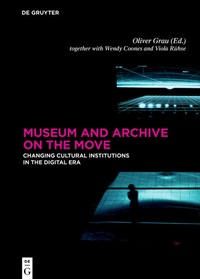
Museum and Archive on the Move
Description

The digital revolution fundamentally changed how cultural heritage is created, documented, analyzed, and preserved. The book focuses on this transformation's impact. How must museums and archives meet the challenges of digitally generated cultures and how does the digital revolution influence traditional object collection, research, and education? How do digital technologies and digital art and culture affect our interaction with images? Leading international experts from various disciplines break new ground. Pioneering interdisciplinary research results collected in this book are relevant to education, curators and archivists in the arts and culture sector and in the digital humanities.
Reviews / Votes
"The publication provides an excellent overview on the current issues at stake in museums, archives and institutions that need to deal with, but also hopefully can profit from, the possibilities opened by either the digitalisation of their collections, or the conservation and presentation of collections of digital art or other media. In other words, it is a highly recommended read to all professionals in the field."
Gabriela Galati, Leonardo. The International Society for the Arts, Sciences and Technology, December 2018, https://www.leonardo.info/review/2018/12/review-of-museum-and-archive-on-the-move-changing-cultural-institutions-in-the
"Museum and Archive on the Move provides an excellent synopsis of current thinking across the field. If your are planning a new museum or archive, we recommend that you read this book first. In museology terms, this book also offers thought-provoking aspirations and useful criticisms."
Danielle O'Donovan and Tom Lonergan, Museum International [ICOM's peer-reviewed journal], Vol. 70, No. 277-278, 2018, p. 176-177
"This volume, in overlapping fields of museum and archive studies, introduces emerging questions of media art in terms of its rare and very often unsuccessful preservation. Eminent media theorists, including Sean Cubitt, Erkki Huhtamo, Ryszard W. Kluszczynski, or curators such as Documenta XI curator Okwui Enwezor and Transmediale director Andreas Broeckmann, contribute to this crucial theme."
"Surely an ultimate source for the topic of media art musealisation and archivisation, as its best-known theorists and curators, this book will find place in university libraries, being a good compendium of topics for students in art history as well as in museology, but also in museums, where this critical knowledge is more than critical in practice."
Ana Peraica, Leonardo. The International Society for the Arts, Sciences and Technology, December 2017, https://www.leonardo.info/review/2017/12/review-of-museum-and-archive-on-the-move-changing-cultural-institutions-in-digital
More details
Other editions
Additional editions
Persons
Content
- Intro
- Contents
- Museum and Archive on the Move
- Museums
- Museum of Art and Science
- The Digital Collection of the Rijksmuseum
- Museum in Motion?
- Museums, Interactivity, and the Tasks of "Exhibition Anthropology"
- The Museum, Public Space and the Internet
- Digital Art's Complex Expression and Its Impact on Archives and Humanities
- Asia as a Methodology
- The Death of the African Archive and the Birth of the Museum
- Museum on Mars
- Archives
- Aesthetics and Anaesthetics
- From Archives to Collections
- Textualities, Materialities and Indeterminate Pasts
- Archives in Motion
- Revisiting the Network of "Les Immatériaux"
- The Phantoms of Multimedia
- Cultural Data
- "Weltregal" or the World on a Shelf
- Authors
- Illustration Credits
- Plates
