

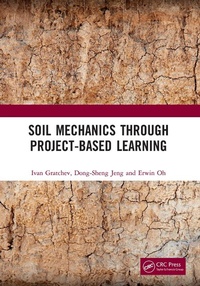
Soil Mechanics Through Project-Based Learning
1st Edition
Published on 21. November 2018
176 pages
978-0-429-01836-7 (ISBN)
Description

The currently available soil mechanics textbooks explain theory and show some practical applications through solving abstract geotechnical problems. Unfortunately, they do not engage students in the learning process as students do not "experience" what they study. This book employs a more engaging project-based approach to learning, which partially simulates what practitioners do in real life. It focuses on practical aspects of soil mechanics and makes the subject "come alive" through introducing real world geotechnical problems that the reader will be required to solve. This book appeals to the new generations of students who would like to have a better idea of what to expect in their employment future.
This book covers all significant topics in soil mechanics and slope stability analysis. Each section is followed by several review questions that will reinforce the reader's knowledge and make the learning process more engaging. A few typical problems are also discussed at the end of chapters to help the reader develop problem-solving skills. Once the reader has sufficient knowledge of soil properties and mechanics, they will be offered to undertake a project-based assignment to scaffold their learning. The assignment consists of real field and laboratory data including boreholes and test results so that the reader can experience what geotechnical engineering practice is like, identify with it personally, and integrate it into their own knowledge base. In addition, some problems include open-ended questions, which will encourage the reader to exercise their judgement and develop practical skills. To foster the learning process, solutions to all questions are provided to ensure timely feedback.
This book covers all significant topics in soil mechanics and slope stability analysis. Each section is followed by several review questions that will reinforce the reader's knowledge and make the learning process more engaging. A few typical problems are also discussed at the end of chapters to help the reader develop problem-solving skills. Once the reader has sufficient knowledge of soil properties and mechanics, they will be offered to undertake a project-based assignment to scaffold their learning. The assignment consists of real field and laboratory data including boreholes and test results so that the reader can experience what geotechnical engineering practice is like, identify with it personally, and integrate it into their own knowledge base. In addition, some problems include open-ended questions, which will encourage the reader to exercise their judgement and develop practical skills. To foster the learning process, solutions to all questions are provided to ensure timely feedback.
Reviews / Votes
This book is primarily aimed at soil mechanics students, but its project-based learning approach would be equally beneficial to any practising structural or civil engineer who is only occasionally confronted with soil mechanics problems. [...] The authors deliberately present only abstract versions of the corresponding theories or models. Each chapter contains problem solving with clear and detailed resolution, and concludes with a short, useful quiz. [...]Philippe Bouillard, Universite Libre de Bruxelles, Belgium, Civil Engineering, Volume 172 Issue CE4 November 2019, p. 154
More details
Edition
1. Auflage
Language
English
Place of publication
London
United Kingdom
Publishing group
Taylor & Francis Ltd
Target group
College/higher education
Professional and scholarly
Adult education
File size
3,44 MB
ISBN-13
978-0-429-01836-7 (9780429018367)
Copyright in bibliographic data and cover images is held by Nielsen Book Services Limited or by the publishers or by their respective licensors: all rights reserved.
Schweitzer Classification
Other editions
Additional editions
Ivan Gratchev | Dong-Sheng Jeng | Erwin Oh
Soil Mechanics Through Project-Based Learning
Book
11/2018
1st Edition
CRC Press
€86.10
Shipment within 10-20 days
Ivan Gratchev | Dong-Sheng Jeng | Erwin Oh
Soil Mechanics Through Project-Based Learning
Book
11/2018
1st Edition
CRC Press
€230.30
Shipment within 10-20 days
Persons
Dr Ivan Gratchev is a Senior Lecturer at the School of Engineering & Built Environment, Griffith University, Australia. His research interests are in geotechnical aspects of landslides, soil liquefaction, and rock mechanics. He has published numerous research articles in leading international journals and international conferences. During his academic career, Dr Gratchev has taught several geotechnical courses (including soil mechanics, rock mechanics and geotechnical engineering practice) using a project-based approach. His teaching achievements were recognised by his peers and students through a number of learning and teaching citations and awards.
Dong-Sheng Jeng is a professor at School of Engineering & Built Environment, Griffith University, Australia. His main research interests include coastal and ocean modelling, offshore geotechnics, porous flow, groundwater hydrodynamics, Artificial neural network and offshore wind energy. Alongside his research, he has authored or co-authored more than 250 journal articles and is an associate editor for a number of journals in the fields.
Associate Professor Erwin Oh is the Director International for Griffith Sciences at Griffith University. He is also an Associate Professor in Geotechnical Engineering. He completed his Bachelor of Engineering and Master of Engineering degrees in Taiwan, and he was awarded a Doctor of Philosophy degree from Griffith University. He teaches Geotechnical Engineering for undergraduate student and Advanced Foundation Engineering for postgraduate student. His research interests include soft soils behaviours, ground improvement techniques, and pavement rehabilitation. He has co-authored over 100 refereed journal and conference articles. Associate Professor Oh has strong research collaboration with international partners and is actively engaged with the industry.
Dong-Sheng Jeng is a professor at School of Engineering & Built Environment, Griffith University, Australia. His main research interests include coastal and ocean modelling, offshore geotechnics, porous flow, groundwater hydrodynamics, Artificial neural network and offshore wind energy. Alongside his research, he has authored or co-authored more than 250 journal articles and is an associate editor for a number of journals in the fields.
Associate Professor Erwin Oh is the Director International for Griffith Sciences at Griffith University. He is also an Associate Professor in Geotechnical Engineering. He completed his Bachelor of Engineering and Master of Engineering degrees in Taiwan, and he was awarded a Doctor of Philosophy degree from Griffith University. He teaches Geotechnical Engineering for undergraduate student and Advanced Foundation Engineering for postgraduate student. His research interests include soft soils behaviours, ground improvement techniques, and pavement rehabilitation. He has co-authored over 100 refereed journal and conference articles. Associate Professor Oh has strong research collaboration with international partners and is actively engaged with the industry.
Content
1. Introduction. 2. Soil formation and exploration. 3. Soil constituents. 4. Soil classification. 5. Soil compaction. 6. Stresses in soils. 7. Principles of water flow in soil. 8. Mohr Crcle and soil deformation. 9. Principles of soil deformation. 10. Consolidation of soft soil. 11. Shear strength of soil.
