

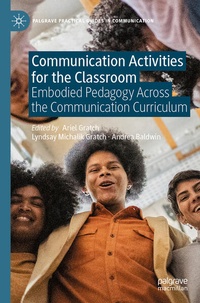
Communication Activities for the Classroom
Description

This book contains over 20 activities for use in the in-person communication studies classroom. Communication is an embodied act: our thoughts, ideas, and messages originate in our body and through our experiences. An embodied approach to pedagogy fosters inclusivity, creativity, and critical thinking, making classrooms more dynamic and equitable spaces. Drawing on a wide range of performance studies-based approaches and theories, the activities in this book can be applied across the communication studies curriculum, including relational communication, organizational communication, media studies, public address, and communication and culture. Whether you are hesitant to incorporate performance in your classroom or you regularly invite your students to "get up and play," the activities in this book provide a step-by-step guide that is accessible to all communication teachers.
More details
Other editions
Additional editions
Persons
Ariel Gratch, PhD, Syracuse University
Bio: Ariel Gratch is author of the textbook, Speech Performance: Public Speaking for All Occasions, co-author of Digital Performance in Everyday Life with Lyndsay Michalik Gratch, has published numerous essays, and regularly performs as a storyteller.
Lyndsay Michalik Gratch, PhD, Syracuse University
Bio: Lyndsay Michalik Gratch is an Associate Professor of Communication and Rhetorical Studies at Syracuse University. Gratch is co-author of Digital Performance in Everyday Life (Routledge, 2022), author of Adaptation Online: Creating Memes, Sweding Movies, and Other Digital Performances (Lexington Books, 2017), and is a Contributing Editor for Liminalities: A Journal of Performance Studies.
Andrea Baldwin PhD, University of Houston-Clear Lake
Bio: Andrea Baldwin is a Senior Lecturer in Communication at the University of Houston- Clear Lake and advisor to the UHCL Storytellers. Baldwin received a Ph.D from Southern Illinois University-Carbondale. Her research explores pedagogical experiences in spaces outside of the classroom and genealogical embodied mentoring in the academy.
Content
Part 1: Relational Communication.- Chapter 01: Sculpting Gendered Terms.- Chapter 02 Leadership Stories and Leaving Legacies.- Chapter 03 Exploring Empathy and Compassion via Random Acts of Kindness.- Chapter 04 Memorializing Loss: Materializing Memory Through Everyday Objects.- Chapter 05 Identity Performance and Tim O'Brien's The Things They Carried.- Part 2: Media and Communication.- Chapter 06 Digital Persona(e).- Chapter 07 Culture Jamming in the Intercultural Communication Classroom.- Chapter 08 Skepticism and X/Twitter: Meta-Tweeting as Embodied Communication Pedagogy.- Chapter 09 Immersing the Body in Ancient and Modern Media Practices: Using the Cricut and VR to Explore Culture and History.- Chapter 10 Crafting Digital Narratives: Integrating Feminist HCI Principles and Digital Identities in a Semester-Long Transmedia Storytelling Project.- Part 3: Organizational and Small Group Communication.- Chapter 11 Staging Group Dynamics: Teaching Group Roles, Types of Conflict, and Conflict Management Styles through Dialogic Performance.- Chapter 12 Creating Classroom Culture: Artifacts, Values, and Behaviors.- Chapter 13 "Persuade or Pivot?" A Persuasive Take on Would You Rather?.- Chapter 14 Behavioral Narrative Interviews.- Chapter 15 Creating A New Gender Myth: Social Construction, Gender, and Storytelling.- Part 4: Public Address.- Chapter 16 Workshopping "Freedom of Expression" in Speech: Practicing Public Performance Poetically.- Chapter 17 Designing Activist Street Actions for Social Change.- Chapter 18 A Workshop in Embodied Rhetorical Criticism: Visual Culture, Community and Place/Space.- Chapter 19 The Impromptu Construction Wheel.- Chapter 20 Telling Each Other's Stories as a Co-Creative Activity.- Part 5: Communication and Cultur.- Chapter 21 Whatchu see? - Exploring Mundane Oppositional Gazes and Counter-Narratives in the Classroom.- Chapter 22 Cultural Recipe Book.- Chapter 23 Embodied Pedagogy Fixed and Fluid Rumor: Words Last.- Chapter 24 Everyday Life Performance (ELP) at a Sprint: Reperforming in the Communication Classroom.- Part 6: Creating Embodied Pedagogy.
