

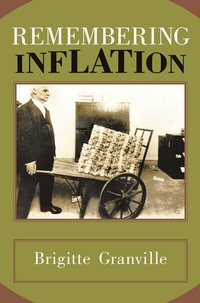
Remembering Inflation
1st Edition
Published on 16. June 2015
296 pages
978-1-4008-4644-3 (ISBN)
Description

Why we need to heed the lessons of high inflation
Today's global economy, with most developed nations experiencing very low inflation, seems a world apart from the "Great Inflation" that spanned the late 1960s to early 1980s. Yet, in this book, Brigitte Granville makes the case that monetary economists and policymakers need to keep the lessons learned during that period very much in mind, lest we return to them by making the same mistakes we made in the past.
Granville details the advances in macroeconomic thinking that gave rise to the "Great Moderation"-a period of stable inflation and economic growth, which lasted from the mid-1980s through the most recent financial crisis. She makes the case that the central banks' management of monetary policy-hinging on expectations and credibility-brought about this period of stability, and traces the roots of this success back to the eighteenth-century foundations of modern monetary thought.
Tackling fundamental questions such as the causes of inflation and its relation to unemployment and growth, the natural rate of inflation hypothesis, the fiscal theory of the price level, and the proper goals of central banks, the book aims above all to demonstrate the dangers of forgetting the role of credibility in establishing sound monetary policy. With the lessons of the past firmly in mind, Granville presents stimulating ideas and proposals about inflation-targeting principles, which provide tools for present-day monetary authorities dealing with the forces of globalization, mercantilism, and reserve accumulation.
Today's global economy, with most developed nations experiencing very low inflation, seems a world apart from the "Great Inflation" that spanned the late 1960s to early 1980s. Yet, in this book, Brigitte Granville makes the case that monetary economists and policymakers need to keep the lessons learned during that period very much in mind, lest we return to them by making the same mistakes we made in the past.
Granville details the advances in macroeconomic thinking that gave rise to the "Great Moderation"-a period of stable inflation and economic growth, which lasted from the mid-1980s through the most recent financial crisis. She makes the case that the central banks' management of monetary policy-hinging on expectations and credibility-brought about this period of stability, and traces the roots of this success back to the eighteenth-century foundations of modern monetary thought.
Tackling fundamental questions such as the causes of inflation and its relation to unemployment and growth, the natural rate of inflation hypothesis, the fiscal theory of the price level, and the proper goals of central banks, the book aims above all to demonstrate the dangers of forgetting the role of credibility in establishing sound monetary policy. With the lessons of the past firmly in mind, Granville presents stimulating ideas and proposals about inflation-targeting principles, which provide tools for present-day monetary authorities dealing with the forces of globalization, mercantilism, and reserve accumulation.
More details
Other editions
Additional editions
Brigitte Granville
Remembering Inflation
Book
07/2013
Princeton University Press
€51.00
Shipment within 10-20 days
Person
Brigitte Granville is professor of international economics and economic policy at Queen Mary University of London. Her books include Sovereign Debt: Origins, Crises, and Restructuring.
Content
Preface ix
Acronyms xv
Chapter 1 The End of a Mirage
More Money Increases Inflation but Not Employment 1
Chapter 2 Origins of Inflation
Monetary, Fiscal, and Financial Links 33
Chapter 3 Ending Inflation Without Prolonged Recession
Introducing Credibility 54
Chapter 4 The Coordination of Monetary and Fiscal Policy 93
Chapter 5 Who Is Voting for Low Inflation and Why? 125
Chapter 6 Monetary and Financial Stability
Conflict or Complementarity 154
Chapter 7 Inflation in an Open World
Does That Change the Rules? 186
Conclusion
Adapting to Expectations 214
References 223
Index 255
Acronyms xv
Chapter 1 The End of a Mirage
More Money Increases Inflation but Not Employment 1
Chapter 2 Origins of Inflation
Monetary, Fiscal, and Financial Links 33
Chapter 3 Ending Inflation Without Prolonged Recession
Introducing Credibility 54
Chapter 4 The Coordination of Monetary and Fiscal Policy 93
Chapter 5 Who Is Voting for Low Inflation and Why? 125
Chapter 6 Monetary and Financial Stability
Conflict or Complementarity 154
Chapter 7 Inflation in an Open World
Does That Change the Rules? 186
Conclusion
Adapting to Expectations 214
References 223
Index 255
