

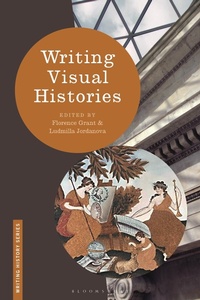
Writing Visual Histories
1st Edition
Published on 12. November 2020
256 pages
978-1-350-02346-8 (ISBN)
Description

What can visual artifacts tell us about the past? How can we interpret them rigorously, weaving their formal and material qualities into rich social contexts to reach wider historical conclusions? Unfolding key historiographical and methodological issues, Writing Visual Histories equips students to answer these questions, showing visual analysis to be a key skill in historical research.
A multifaceted structure makes this a practical guide for writing and reflecting on visual histories. A first section includes six case studies -- on topics ranging from medieval heraldry to Life magazine. These examples are followed by an exploration of essential concepts that inform historical thinking about visual matters, a treatment of disciplinary practices, and discussion of the practicalities (such as accessing museum collections and organising permissions) that scholars working with visual sources have to navigate.
This book is an invaluable tool kit for opening up a historical understanding of visual phenomena and practices of looking, and for writing that takes an integrated approach to studies of the past.
A multifaceted structure makes this a practical guide for writing and reflecting on visual histories. A first section includes six case studies -- on topics ranging from medieval heraldry to Life magazine. These examples are followed by an exploration of essential concepts that inform historical thinking about visual matters, a treatment of disciplinary practices, and discussion of the practicalities (such as accessing museum collections and organising permissions) that scholars working with visual sources have to navigate.
This book is an invaluable tool kit for opening up a historical understanding of visual phenomena and practices of looking, and for writing that takes an integrated approach to studies of the past.
More details
Series
Edition
1. Auflage
Language
English
Place of publication
London
United Kingdom
Publishing group
Bloomsbury Publishing PLC
Target group
Professional and scholarly
Illustrations
27 bw illus and 9 colour plates
ISBN-13
978-1-350-02346-8 (9781350023468)
Copyright in bibliographic data and cover images is held by Nielsen Book Services Limited or by the publishers or by their respective licensors: all rights reserved.
Schweitzer Classification
Other editions
Additional editions
Florence Grant | Ludmilla Jordanova
Writing Visual Histories
Book
11/2020
Bloomsbury Academic
€32.50
Shipment within 15-20 days
Persons
Florence Grant holds a PhD in History from King's College London and is currently an independent writer and editor based in Western North Carolina, USA
Ludmilla Jordanova is Emeritus Professor of History and Visual Culture at Durham University, UK. She is also the author of History in Practice, 3rd Edition (Bloomsbury, 2019)
Ludmilla Jordanova is Emeritus Professor of History and Visual Culture at Durham University, UK. She is also the author of History in Practice, 3rd Edition (Bloomsbury, 2019)
Content
List of Illustrations
List of Contributors
Acknowledgements
Introduction
1. Heraldry Topsy-Turvy: Depictions and Performances of Dishonour and Death, Marcus Meer
2. Costume Imagery and the Visualisation of Humanity in Early Modern Europe, Katherine Bond
3. Identity and Continuity: The Visual Culture of an Institution over 500 Years, Ludmilla Jordanova
4. Making an Exhibition of Himself: John Wilkes through Visual Sources, Jonathan Conlin
5. Writing the History of the Photographic Book: The Case of Weimar Germany, J. J. Long
6. The Picture Magazine: Life and the Limits of Photography, Melissa Renn
Concepts
Agency
Art
Discourse
Genre
Iconography
Medium
Reception
Reproduction
Rhetoric
Skill
Style
Visual Culture
Practices
Description
Contextualization
Periodization
Practicalities
Using Image Databases
Organizing Permissions
Writing Captions
Publishing with Pictures
Conclusions
Notes
Bibliography
Index
List of Contributors
Acknowledgements
Introduction
1. Heraldry Topsy-Turvy: Depictions and Performances of Dishonour and Death, Marcus Meer
2. Costume Imagery and the Visualisation of Humanity in Early Modern Europe, Katherine Bond
3. Identity and Continuity: The Visual Culture of an Institution over 500 Years, Ludmilla Jordanova
4. Making an Exhibition of Himself: John Wilkes through Visual Sources, Jonathan Conlin
5. Writing the History of the Photographic Book: The Case of Weimar Germany, J. J. Long
6. The Picture Magazine: Life and the Limits of Photography, Melissa Renn
Concepts
Agency
Art
Discourse
Genre
Iconography
Medium
Reception
Reproduction
Rhetoric
Skill
Style
Visual Culture
Practices
Description
Contextualization
Periodization
Practicalities
Using Image Databases
Organizing Permissions
Writing Captions
Publishing with Pictures
Conclusions
Notes
Bibliography
Index
