

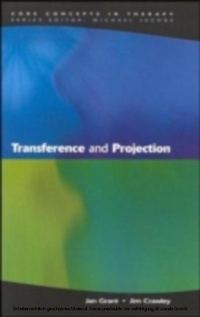
Transference And Projection
1st Edition
Published on 1. June 2002
174 pages
978-0-335-23164-5 (ISBN)
Description

This book describes, defines and demonstrates the clinical applications of transference and projection and how they are used by psychotherapists as 'mirrors to the self' - as reflections of a client's internal structure and core ways of relating to other people. There is an emphasis on understanding transference as a normal organizing process that helps individuals make meaning of interpersonal experiences, and on how to respond effectively to it in the day-to-day practice of counselling and psychotherapy.
More details
Other editions
Additional editions
Book
06/2002
Open University Press
€38.50
Shipment within 15-20 days
Content
- Front cover
- Half title
- Title
- Copyright
- Contents
- Series editor's preface
- Preface
- Acknowledgements
- Chapter 1 Mirrors to the self: an introduction to transference
- Introducing transference
- A working definition of transference
- Transference and the unconscious
- Why is transference important?
- Three major ways of understanding transference
- Communicating the transference
- Transference and brief psychotherapy
- Using transference and projection to understand the internal self
- Promotion of the transference
- Working with transference and projection
- Resistance to transference
- Interpretations and transference
- Conclusion
- Chapter 2 Projection and projective identification
- Introduction
- Projection
- Projection in daily life
- Projection in cyberspace
- Projection in therapy groups
- Projective identification
- Why is projective identification important?
- Some principles in working with projective identification
- Conclusion
- Chapter 3 Early development of the understanding of transference
- Introduction
- Freud's discovery of transference
- Transference in the work of Melanie Klein
- Chapter 4 Developments in understanding transference: psychodynamic psychotherapies
- Introduction
- Object relations
- Working with transference in object relations therapy
- Self psychology
- Working with transference in self psychology
- Inter subjective approaches
- Working with transference from an intersubjective perspective
- Brief psychodynamic psychotherapy
- Working with transference in brief psychodynamic therapy
- Conclusion
- Chapter 5 Schemas and scripts: cognitive-behavioural therapy and transference
- Introduction
- Cognitive-behavioural therapy and the therapeutic relationship
- Schema and script theory
- Transference phenomena as in vivo interventions
- Cognitive therapy approaches to understanding transference
- Working with 'transference' in cognitive-behavioural therapy
- Working with 'projection' in cognitive-behavioural therapy
- Conclusion
- Chapter 6 The real relationship: transference and humanistic- existential/experiential therapies
- Introduction
- Person-centred/humanistic approaches
- Existential and experiential approaches
- Gestalt therapy
- Gestalt therapy, projection and projective identification
- Psychodrama
- Conclusion
- Chapter 7 The transference prism: couples and family therapy
- Introduction
- Understanding couple and family relationships
- The process of conjoint therapy
- A resource for facilitating change in relationships
- Conclusion
- Chapter 8 Recognizing and responding to transference
- Introduction
- The essential features of transference
- Transference as an unconscious organizing activity
- The complex origins of transference
- Transference involves persistent perceptions of the other
- Recognizing transference
- Positive and negative transferences
- Erotic transference
- Self object transferences: mirroring, idealizing and twinship transferences
- The two triangles of transference
- Transference and change
- Responding to transference and projection
- Conclusion
- References
- Index
- Back cover
