

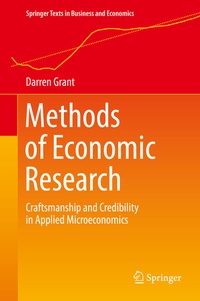
Methods of Economic Research
Description

This textbook articulates the elements of good craftsmanship in applied microeconomic research and demonstrates its effectiveness with multiple examples from economic literature. Empirical economic research is a combination of several elements: theory, econometric modelling, institutional analysis, data handling, estimation, inference, and interpretation. A large body of work demonstrates how to do many of these things correctly, but to date, there is no central resource available which articulates the essential principles involved and ties them together. In showing how these research elements can be best blended to maximize the credibility and impact of the findings that result, this book presents a basic framework for thinking about craftsmanship. This framework lays out the proper context within which the researcher should view the analysis, involving institutional factors, complementary policy instruments, and competing hypotheses that can influence or explain the phenomena being studied. It also emphasizes the interconnectedness of theory, econometric modeling, data, estimation, inference, and interpretation, arguing that good craftsmanship requires strong links between each. Once the framework has been set, the book devotes a chapter to each element of the analysis, providing robust instruction for each case. Assuming a working knowledge of econometrics, this text is aimed at graduate students and early-career academic researchers as well as empirical economists looking to improve their technique.
More details
Other editions
Additional editions
Person
Darren Grant has worked as a Navy contractor, a health management program administrator, a high school teacher and coach, and an economics professor, in various towns and cities across the South. He has published applied research in leading field journals in policy analysis, health economics, the economics of education, industrial organization, public choice, behavioral economics, and labor economics, using models that run the gamut of those found in the profession: parametric and nonparametric, linear and nonlinear, reduced form and structural, and everything in-between. Much of what he has learned about doing economic research he has learned the hard way.
