

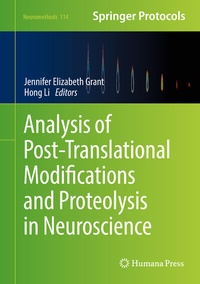
Analysis of Post-Translational Modifications and Proteolysis in Neuroscience
Description

This volume highlights proteomics studies of quantitative PTM changes in both peripheral and central nervous system proteomes utilizing the most recent advances in mass spectrometry. Chapters include practical information pertaining to the fundamentals of sample preparation, liquid chromatography, and tandem mass spectrometry instrumental analysis and will elucidate best practices in the interpretation of data using modern bioinformatics approaches. Written for the popular Neuromethods series, chapters include the kind of detail and key implementation advice that ensures successful results in the laboratory.
Authoritative and practical, Analysis of Post-Translational Modifications and Proteolysis in Neuroscience aims to ensure successful results in the further study of this vital field.
More details
Other editions
Additional editions
Content
Proteomic Analysis of Post-Translational Modifications in Neurobiology.- A Boronic Acid-based Enrichment for Site-specific Identification of the N-glycoproteome using MS-based Proteomics.- Site-specific Localization of D-Amino Acids in Bioactive Peptides by Ion Mobility Spectrometry.- Quantitative Profiling of Reversible Cysteome Modification under Nitrosative Stress.- Label-free LC-MS/MS Comparative Analysis of Protein S-nitrosome in Synaptosomes from Wild Type and APP Transgenic Mice.- Proteomics Identification of Redox-Sensitive Nuclear Protein Targets Of Human Thioredoxin 1 from SHSY-5Y Neuroblastoma Cell Line.- Identification and Quantification of K63-Ubiquitinated Proteins in Neuronal Cells by High-Resolution Mass Spectrometry.- Phosphorylation Site Profiling of NG108 Cells Using Quadrupole/Orbitrap Mass Spectrometry.- Phosphoproteomics of Tyrosine Kinases in the Nervous System.- Analysis of PINK1 and CaMKII Substrates Using Mass Spectrometry-Based Proteomics.- Liquid Chromatography-Tandem Mass Spectrometry Analysis of Tau Phosphorylation.- Identification of Protease Substrates in Complex Proteomes by iTRAQ-TAILS.- Proteolytic Processing of Neuropeptides.- Isotope Dilution Analysis of Myelin Basic Protein Degradation after Brain Injury.- Identification and Characterization of Protein Post-Translational Modifications byDifferential Fluorescent Labeling.- Mass Spectrometric Detection of Detyrosination and Polyglutamyation on the C-Terminal Region of Brain Tubulin.- Determination of polyhydroxybutyrate (PHB) Post-Translational Modifications of Proteins Using Mass Spectrometry.
