

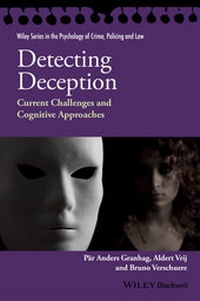
Detecting Deception
Description

Reviews / Votes
"All practitioners, researchers, and consumers could benefit from reading this book. It is an excellent reference for most all items covered. As alternative technologies develop and improve, it behooves us to stay abreast and open-minded... I highly recommend this book to all examiners interested in improving their knowledge on cognitive approaches to interviewing, ethical interrogative strategies and avoiding false confessions." Mark Handler, American Polygraph Association Magazine, 2015 You may think you can tell if someone is lying, but DetectingDeception will make you think again. This thorough andaccomplished collection of chapters by leading experts in the fieldbrings together the science of "truthfulness", andtells us what it means for psychologists, law enforcement, and allwho care about justice.--Elizabeth F. Loftus, Ph.D,Distinguished Professor, University of California-Irvine Granhag, Vrij, and Verschuere do the research and practitionercommunities a great service by providing a multi-faceted, current(and into the future) account of cognitive and social approaches todetecting deception. The book's strength lies in itsworld-recognized contributors, balanced presentation of supportedand unsupported ideas, theoretical and applied perspectives, and abroad spectrum of approaches.--Dr Ronald P. Fisher, FloridaInternational University Fundamental to the objectives of both investigativeinterviewing in the law-enforcement domain and interrogationsconducted to support intelligence needs is the requirement toobjectively assess the credibility of the individual underquestioning. For far too long, practitioners have rendered suchconclusions based wholly on intuitive judgments often shaped bybias, unchallenged assumptions, and misinformed supposition. Inthis vital work, an exceptionally impressive array of scholars andresearchers offers a rational path toward a more definitive andevidence-based approach to gauging veracity. Rather than purelytheoretical abstractions, the authors present practitioners with acomprehensive framework of strategies, methods, and metrics thatlends itself to immediate application in the real-world. In nosmall measure, this book takes a monumental step toward chippingaway at the myth of interrogation as purely an art and replacing itwith the promise of interrogation as a systematic, science-basedprocess for eliciting meaningful information in support of justiceand enlightened public policy.--Colonel Steven M. Kleinman,U.S. Air Force (Retired), Career human intelligenceofficerMore details
Other editions
Additional editions
Persons
Content
Introduction
Deception, a deliberate attempt to convince someone of something the liar believes is untrue, is a fact of everyday life. DePaulo and her colleagues (1996) asked participants to keep a diary for a week of all their social interactions that lasted more than 10 min and to note how often they lied during these interactions. Almost all participants admitted that they had lied during the week they kept a diary. They lied in one out of every four social interactions and to more than 30% of all the people they interacted with.
The overwhelming majority of lies people tell are not serious, and many lies told in daily life are social lies (e.g. 'I like your hair cut'). Conversations could become awkward and unnecessarily rude, and social interactions, including friendships and romantic relationships, could easily turn sour if people were to tell each other the truth all the time. In order to maintain a good working relationship with colleagues, it is better to pretend to be busy when invited for lunch than to admit that you find their company boring and would rather avoid them. Similarly, it may be kinder to respond with enthusiasm when receiving an expensive present from a friend even when you don't like the gift. Social relationships benefit from people making each other compliments now and again because people like to be liked and like to receive compliments (Aron, Dutton, Aron, & Iverson, 1989).
However, sometimes the situation is different. Sometimes the lies that are told are serious, and we would like to detect them. Who would not have liked to know earlier that Mohammad Atta and 18 others came to the United States with the intention to carry out four coordinated suicide attacks on the New York Twin Towers, the Pentagon and the White House? In a similar vein, the police detective wants to know whether the suspect's alibi is reliable, the customs officer wants to know whether the traveler really has nothing to declare, the immigration officer wants to know whether the asylum seeker's life in his native country is indeed in danger as he claims, and the employer wants to know whether the candidate is indeed as capable as the candidate says. Being able to detect these sorts of lies would benefit individuals or the society as a whole.
In order to detect serious lies, researchers have been examining how liars respond and how they could be detected. There are four general approaches to detect lies. Investigators could measure someone's (i) physiological responses, (ii) observe their behaviour, (iii) analyse their speech, or (iv) measure their brain activity.
Throughout history, it has been assumed that lying is accompanied by physiological activity within the liar's body. The underlying assumption was that the fear of being detected was an essential element of deception (Trovillo, 1939). Early lie detection attempts were based on the idea that fear is associated with a dry mouth. Therefore, the Chinese in 1000 B.C., but also people in India and Western Africa, used to force suspected liars to chew rice powder and then to spit it out. If the resultant powder was dry then the person was judged to have been lying (Kleinmuntz & Szucko, 1984; Trovillo, 1939). Based on the same dry mouth assumption, the accused in north Bengal was told to prove his innocence by applying his tongue to a red-hot iron nine times. The full extent of this ordeal becomes clear when one realizes that the accused was also instructed to carry the red-hot iron in their hands (Trovillo, 1939).
Analyses of non-verbal behaviour also have a long history, and it also assumes fear underlies deception. A Hindu writing from 900 B.C. mentioned that liars rub the great toe along the ground and shiver and they rub the roots of their hair with their fingers (Trovillo, 1939), and Münsterberg (1908) described the utility of observing posture, eye movements, and knee jerks for lie detection purposes.
Lie detection through analysing speech also became apparent throughout history. In around 900 B.C., a papyrus of the Vedas described how to identify a poisoner. In addition to some physiological and behavioural cues, it says that a poisoner 'does not answer questions, or they give evasive answers; he speaks nonsense' (Trovillo, 1939, p. 849). Tardieu, a French forensic expert, already acknowledged in the 1850s that in children's alleged sexual abuse cases, certain characteristics in the story needs to be considered, such as 'quantity of detail' (Lamers-Winkelman, 1999). Walker (1886), an American forensic medical doctor, claimed that mere reliance upon the physical examination in alleged child sexual abuse cases is unreliable. Rather, according to Walker, children should be encouraged to tell their stories in their own words, and the way in which children tell their stories and the expressions they use are amongst the best guides to distinguish truth from deception in children (see Lamers-Winkelman, 1999).
Since the 1950s, the search for (non)verbal cues and physiological cues to deceit has accelerated. The development of methods to monitor neural activity non-invasively in humans, such as electroencephalography (EEG) and functional magnetic resonance imaging (fMRI), has enabled researchers to examine brain activity during deceit, the fourth way of detecting lies nowadays used to detect deceit. The use of EEG to detect deceit dates back to the late 1980s (Rosenfeld et al., 1988), whereas the first fMRI article on deception was published in 2001 (Spence et al., 2001).
THE PRESENT VOLUME
The field of 'deception detection' is one of the most expansive sub-fields of legal psychology. All major scientific journals in the field regularly publish papers on lie detection, and to date more than 150 articles about deception are published each year. Furthermore, most conferences on 'psychology and law' contain special seminars on how to detect deceit. Hence, it makes sense to now and then take stock of the field.
The present state-of-the-art volume differs from previous volumes in several ways. First, in addition to reviewing the most established approaches for detecting deceit, it also acknowledges a number of new challenges (e.g., how to discriminate between true and false intentions and how to covertly detect deceit). Second, the present volume takes a strong cognitive approach to deception detection. This in contrast to the more traditional anxiety-based approaches (basically, fear and/or anxiety is assumed to be stronger in liars than in truth tellers). The cognitive approach is visible by paying particular attention to the mental processes at play when lying and telling the truth. For example, the volume makes clear that concepts such as 'memory', 'cognitive load', 'reality monitoring', 'planning', 'episodic future thought', 'strategizing' and 'perspective-taking' are highly relevant for deception detection. Third, many of the chapters in the volume reflect a new wave in deception research - 'interviewing to detect deception'. For this new direction, the interviewer plays a vital role and the aim is to elicit and enhance cues to deceit by interviewing strategically (Vrij & Granhag, 2012). This new strand of research contrasts the traditional way of conducting deception detection research, in which observers assess short video clips in which there are few (if any) cues to deceit and truth.
The volume contains 14 chapters, organized into three main sections. The first section, 'Established Approaches', contains five chapters and offer comprehensive and up-to-date reviews of the most basic approaches to deception detection. The second section, 'Current Challenges', contains three chapters and draws attention to some current and future challenges in the field. The third and final section is 'Improving lie detection' and it contains six chapters. In this section, new and constructive approaches for detecting deceit are described and developed. All in all, we believe that the volume will be perceived as instructive for practitioners in the field and inspiring for academics.
REFERENCES
- Aron, A., Dutton, D. G., Aron, E. N., & Iverson, A. (1989). Experiences of falling in love. Journal of Social and Personal Relationships, 6, 243-257.
- DePaulo, B. M., Kashy, D. A., Kirkendol, S. E., Wyer, M. M., & Epstein, J. A. (1996). Lying in everyday life. Journal of Personality and Social Psychology, 70, 979-995.
- Kleinmuntz, B., & Szucko, J. J. (1984). Lie detection in ancient and modern times: A call for contemporary scientific study. American Psychologist, 39, 766-776.
- Lamers-Winkelman, F. (1999). Statement validity analysis: Its application to a sample of Dutch children who may have been sexually abused. Journal of Aggression, Maltreatment & Trauma, 2, 59-81.
- Münsterberg, H. (1908). On the witness stand: Essays on psychology and crime. New York, NY: Doubleday.
- Rosenfeld, J. P., Cantwell, B., Nasman, V. T., Wojdac, V., Ivanov, S., & Mazzeri, L. (1988). A modified, event-related potential-based guilty knowledge test. International Journal of Neuroscience, 42, 157-161.
- Spence, S. A., Farrow, T. F. D., Herford, A. E., Wilkinson, I. D., Zheng, Y., & Woodruff, P. W. (2001). Behavioral and...
