

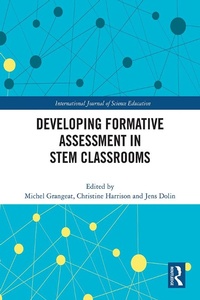
Developing Formative Assessment in STEM Classrooms
1st Edition
Published on 3. June 2024
156 pages
978-1-040-03087-5 (ISBN)
Description

This book, drawn from the practical experience of the European Assess Inquiry in Science, Technology and Mathematics Education (ASSIST-ME) project, aims to support researchers, teacher educators and teachers in navigating the complex nature of formative assessment.
It delves into how formative assessment methods may adapt different features within STEM classroom practices and how formative and summative assessment could be coordinated. The book illustrates how ideas about inquiry and assessment are played out in the classroom, revealing both how the pedagogical approach fits with the assessment choices made and the support that teachers need, to engage with these changes. It both informs and presents some of the challenges related to the uptake and development of inquiry learning in STEM classrooms. The chapters in this volume address three questions:
What formative assessment objectives and methods are relevant and appropriate in science education ?
How do teachers monitor student learning as it unfolds during inquiry-based teaching-learning sequences?
To what extent does a partnership between researchers and teachers make it possible to implement effective assessment methods and acquire relevant professional knowledge?
Taken together, they explore how national educational systems can foster and build the systemic support measures and tools that teachers need to integrate assessment into their classroom practices that fit alongside or within their summative assessment practices. The chapters included in this book were originally published in International Journal of Science Education.
It delves into how formative assessment methods may adapt different features within STEM classroom practices and how formative and summative assessment could be coordinated. The book illustrates how ideas about inquiry and assessment are played out in the classroom, revealing both how the pedagogical approach fits with the assessment choices made and the support that teachers need, to engage with these changes. It both informs and presents some of the challenges related to the uptake and development of inquiry learning in STEM classrooms. The chapters in this volume address three questions:
What formative assessment objectives and methods are relevant and appropriate in science education ?
How do teachers monitor student learning as it unfolds during inquiry-based teaching-learning sequences?
To what extent does a partnership between researchers and teachers make it possible to implement effective assessment methods and acquire relevant professional knowledge?
Taken together, they explore how national educational systems can foster and build the systemic support measures and tools that teachers need to integrate assessment into their classroom practices that fit alongside or within their summative assessment practices. The chapters included in this book were originally published in International Journal of Science Education.
More details
Edition
1. Auflage
Language
English
Place of publication
London
United Kingdom
Publishing group
Taylor & Francis Ltd
Target group
College/higher education
Professional and scholarly
ISBN-13
978-1-040-03087-5 (9781040030875)
Copyright in bibliographic data and cover images is held by Nielsen Book Services Limited or by the publishers or by their respective licensors: all rights reserved.
Schweitzer Classification
Other editions
Additional editions
Michel Grangeat | Christine Harrison | Jens Dolin
Developing Formative Assessment in STEM Classrooms
Book
10/2025
1st Edition
Routledge
€61.90
Shipment within 10-20 days
Michel Grangeat | Christine Harrison | Jens Dolin
Developing Formative Assessment in STEM Classrooms
Book
06/2024
1st Edition
Routledge
€192.30
Shipment within 10-20 days
Persons
Michel Grangeat is Professor Emeritus of Educational Sciences at University of Grenoble Alpes, France. Michel's research focuses on the activities of professionals in the field of human relations and in collective contexts. The activities studied are those aimed at improving the well-being, development and learning of individuals, whether adults or children.
Christine Harrison is Professor of Science Education at King's College London, UK. Her research focuses on teachers' conceptualisation of classroom assessment and particularly how Assessment for Learning pedagogy is implemented in STEM classrooms. Her research studies enable her to work alongside teachers through a close-to-practice approach that both learns from and informs practice.
Jens Dolin is Professor Emeritus of Science Education at University of Copenhagen, Denmark. He has a broad research portfolio in the learning and teaching of science with foci on development of students' science competences and bildung, especially through cross-curricular education. The last decade the assessment aspects have been central together with addressing and involving policy stakeholders in the educational processes.
Christine Harrison is Professor of Science Education at King's College London, UK. Her research focuses on teachers' conceptualisation of classroom assessment and particularly how Assessment for Learning pedagogy is implemented in STEM classrooms. Her research studies enable her to work alongside teachers through a close-to-practice approach that both learns from and informs practice.
Jens Dolin is Professor Emeritus of Science Education at University of Copenhagen, Denmark. He has a broad research portfolio in the learning and teaching of science with foci on development of students' science competences and bildung, especially through cross-curricular education. The last decade the assessment aspects have been central together with addressing and involving policy stakeholders in the educational processes.
Content
Foreword: Developing Formative Assessment in STEM Classrooms Introduction: Exploring assessment in STEM inquiry learning classrooms 1. Forms and functions of on-the-fly formative assessment conversations in physics inquiry lessons 2. French teachers' informal formative assessment in the context of inquiry-based learning 3. Making learning effective - quantity and quality of pre-service teachers' feedback 4. Analysing formal formative assessment activities in the context of inquiry at primary and upper secondary school in Switzerland 5. Development of teachers' perspective on formative peer assessment 6. The what, when & how factors: reflections on classroom assessment in the service of inquiry
