

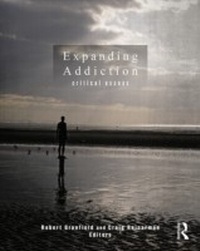
Expanding Addiction: Critical Essays
1st Edition
Published on 9. December 2014
346 pages
978-1-135-01598-5 (ISBN)
Description

The study of addiction is dominated by a narrow disease ideology that leads to biological reductionism. In this short volume, editors Granfield and Reinarman make clear the importance of a more balanced contextual approach to addiction by bringing to light critical perspectives that expose the historical and cultural interstices in which the disease concept of addiction is constructed and deployed. The readings selected for this anthology include both classic foundational pieces and cutting-edge contemporary works that constitute critical addiction studies. This book is a welcome addition to drugs or addiction courses in sociology, criminal justice, mental health, clinical psychology, social work, and counseling.
Reviews / Votes
More than a collection of essays, this eminently readable and thought-provoking volume makes plain the importance of recognizing - and addressing - addiction's many complex causes. Its call for, and articulation of, "critical addiction studies" will be highly useful to educators from a wide range of disciplines, including sociology, anthropology, neurobiology, public policy, criminology, and psychology.-Katherine Beckett, Sociology, University of Washington
During a period when the addiction-as-disease paradigm is increasingly dominating scientific and policy discourse across a wide range of domains, this remarkable and timely anthology provides a much-needed corrective to the influence of biological reductionism and the simplification of a complex and multi-faceted phenomenon. Brilliantly compiled and introduced, Expanding Addiction reminds us of the inadequacies of considering what are called addictive behaviours in the absence of historical and socio-cultural contexts. It is essential reading for students and policymakers alike.
-David R. Bewley-Taylor, International Relations and Public Policy, Swansea University, and author of International Drug Control: Consensus Fractured.
With popular television shows like Addicted airing alongside of an ever-expanding drug treatment industry, why do we still know so little about addiction? Expanding Addiction provides an answer. This essential book is a much-needed addition to knowledge in the field of addiction. Granfield and Reinarman's rich anthology introduces readers to critical addiction studies -- a sociological analysis of addiction. This outstanding anthology consists of groundbreaking classical foundational and contemporary essays by leading experts that challenge the disease model and narrow neurological explanations of addiction. The authors examine the historical construction of addiction and make clear how social, political, and cultural factors shape our ideas about addiction, social responses, and treatment of people classified as "addicts." Expanding Addiction also challenges readers to reexamine why more and more behaviors such as gambling, sexual desire, and computer use are labeled addiction and question why coerced treatment and punishment are central to a growing treatment industry. Expanding Addiction is essential reading for anyone interested in understanding and changing the way our society deals with addiction.
-Susan Boyd, Faculty of Human and Social Development, University of Victoria
This collection of essays shows how behaviors labeled as addictive are in fact socially constructed, and much more scientifically understood as occurring in a social and political context than as behaviors resulting from "possession" of the brain by a foreign substance. The introductory chapter alone would advance a reader's understanding of what is called addictive behavior more than all the newspaper and magazine articles most people have read in the last 25 years. If there is an antidote for disinformation, this book is it.
-Ira Glasser, current President, Drug Policy Alliance
Both the study of addiction and the practice of treatment have long been dominated by a narrow view of addiction as simply a problem of individual biology-as a "disease of the brain." In this rich and timely collection, Granfield and Reinarman bring together both classic and recent arguments that help to right the balance, highlighting the often neglected social, economic, cultural and political contexts that shape both the experience of addiction and its very definition. Expanding Addiction is essential reading for anyone seeking a deeper understanding of addiction and more intelligent social policies to address it.
-Elliott Currie, Criminology, Law, and Society, University of California, Irvine, author of Reckoning: Drugs, the Cities, and the American Future and Crime and Punishment in America.
More details
Language
English
Place of publication
London
United Kingdom
Publishing group
Taylor & Francis Ltd
Target group
College/higher education
Illustrations
6 s/w Tabellen
6 Tables, black and white
File size
1,83 MB
ISBN-13
978-1-135-01598-5 (9781135015985)
Copyright in bibliographic data and cover images is held by Nielsen Book Services Limited or by the publishers or by their respective licensors: all rights reserved.
Schweitzer Classification
Other editions
Additional editions
Robert Granfield | Craig Reinarman
Expanding Addiction: Critical Essays
Book
12/2014
1st Edition
Routledge
€89.43
Shipment within 15-20 days
Book
12/2014
1st Edition
Routledge
€255.40
Shipment within 15-20 days
Persons
Robert Granfield is Professor of Sociology and Vice Provost for Faculty Affairs at the University at Buffalo (UB). He is also an associate research scientist at the Research Institute on the Addictions at UB. Dr. Granfield is the author of Making Elite Lawyers: Visions of Law at Harvard and Beyond and co-author of Coming Clean: Overcoming Addiction without Treatment; Recovery From Addiction: A Practical Guide to Treatment Self-Help and Quitting on your Own, and Private Lawyers in the Public Interest: The Evolving Role of Pro Bono in the Legal Profession. He has also published numerous articles on law, drug use, and addiction.
Craig Reinarman is Professor of Sociology and Legal Studies at the University of California, Santa Cruz. He has been a Postdoctoral Fellow at the Alcohol Research Group at UC Berkeley, a Visiting Scholar at the Center for Drug Research at the University of Amsterdam, and a principal investigator on research grants from the National Institute of Drug Abuse. He is the author of American States of Mind and co-author of Cocaine Changes and Crack in America: Demon Drugs and Social Justice. He has published widely on drug use, addiction, law, treatment, and policy.
Craig Reinarman is Professor of Sociology and Legal Studies at the University of California, Santa Cruz. He has been a Postdoctoral Fellow at the Alcohol Research Group at UC Berkeley, a Visiting Scholar at the Center for Drug Research at the University of Amsterdam, and a principal investigator on research grants from the National Institute of Drug Abuse. He is the author of American States of Mind and co-author of Cocaine Changes and Crack in America: Demon Drugs and Social Justice. He has published widely on drug use, addiction, law, treatment, and policy.
Content
INTRODUCTION 1. Addiction Is Not Just a Brain Disease by Craig Reinarman and Robert Granfield Part I: HISTORICIZING ADDICTION 2. Discovering Addiction: Enduring Conceptions of Habitual Drunkenness in America by Harry G. Levine 3. The Cultural Framing of Addiction by Robin Room 4. Deviant Drinking as a Disease: Alcoholism as a Social Accomplishment by Joseph Schneider 5. The NIDA Brain Disease Paradigm: History, Resistance, and Spinoffs by David Courtright Part II: LOCATING ADDICTION 6. What Neurobiology Cannot Tell Us About Addiction by Harold Kalant 7. Praxis, Interaction and the Loss of Self-Control by Darin Weinberg 8. Framing Nicotine Addiction as a "Disease of the Brain": Social and Ethical Consequences by Molly Dingel, Katrina Karkazis, and Barbara Koenig 9. The Roots of Addiction in a Free Market Society by Bruce Alexander 10. The Extraordinary Science of Addictive Junk Food by Michael Moss Part III: TREATING ADDICTION 11. Financing and Ideology in Alcohol Treatment by Constance Weisner and Robin Room 12. Ideological Implications of Addiction Theories and Treatment by Kathryn Fox 13. Disciplining Addictions: The Bio-Politics of Methadone and Heroin in the U.S. by Philippe Bourgois 14. Drug Courts and the Logic of Coerced Treatment by Rebecca Tiger 15. Social Capital and Natural Recovery: Overcoming Addiction Without Treatment by Robert Granfield and William Cloud Part IV: EXPANDING ADDICTION 16. Discursive Formation, Life Stories, and the Emergence of Co-dependency: Power/Knowledge and the Search for Identity by John S. Rice 17. Regulated Passion: The Invention of Inhibited Sexual Desire and Sex Addiction by Janice Irvine 18. Gambling and the Contradictions of Consumption: A Genealogy of the "Pathological" Subject by Gerda Reith 19. Governing (through) the Internet: Pathological Computer Use as Mobilized Knowledge by Lori Reed 20. Constraint theory: A Cognitive, Motivational Theory of Dependence by Richard Hammersley 21. The More the Merrier: A Multi-Sourced Model of Addiction by Velibor Kovac
