

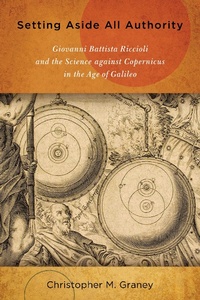
Setting Aside All Authority
Giovanni Battista Riccioli and the Science Against Copernicus in the Age of Galileo
Published on 15. April 2015
277 pages
978-0-268-08077-8 (ISBN)
Description

Setting Aside All Authority is an important account and analysis of seventeenth-century scientific arguments against the Copernican system. Christopher M. Graney challenges the long-standing ideas that opponents of the heliocentric ideas of Copernicus and Galileo were primarily motivated by religion or devotion to an outdated intellectual tradition, and that they were in continual retreat in the face of telescopic discoveries.
Graney calls on newly translated works by anti-Copernican writers of the time to demonstrate that science, not religion, played an important, and arguably predominant, role in the opposition to the Copernican system. Anti-Copernicans, building on the work of the Danish astronomer Tycho Brahe, were in fact able to build an increasingly strong scientific case against the heliocentric system at least through the middle of the seventeenth century, several decades after the advent of the telescope. The scientific case reached its apogee, Graney argues, in the 1651 New Almagest of the Italian Jesuit astronomer Giovanni Battista Riccioli, who used detailed telescopic observations of stars to construct a powerful scientific argument against Copernicus. Setting Aside All Authority includes the first English translation of Monsignor Francesco Ingoli's essay to Galileo (disputing the Copernican system on the eve of the Inquisition's condemnation of it in 1616) and excerpts from Riccioli's reports regarding his experiments with falling bodies.
Graney calls on newly translated works by anti-Copernican writers of the time to demonstrate that science, not religion, played an important, and arguably predominant, role in the opposition to the Copernican system. Anti-Copernicans, building on the work of the Danish astronomer Tycho Brahe, were in fact able to build an increasingly strong scientific case against the heliocentric system at least through the middle of the seventeenth century, several decades after the advent of the telescope. The scientific case reached its apogee, Graney argues, in the 1651 New Almagest of the Italian Jesuit astronomer Giovanni Battista Riccioli, who used detailed telescopic observations of stars to construct a powerful scientific argument against Copernicus. Setting Aside All Authority includes the first English translation of Monsignor Francesco Ingoli's essay to Galileo (disputing the Copernican system on the eve of the Inquisition's condemnation of it in 1616) and excerpts from Riccioli's reports regarding his experiments with falling bodies.
Reviews / Votes
"Christopher M. Graney's Setting Aside All Authority makes a fine contribution to the history of science and especially the history of astronomy. The case Graney presents for the rationality of denying Copernicanism, as late as the mid seventeenth century, is cogent, and he presents a good deal of novel historical material that urges a reevaluation of a major figure-Riccioli. The book will interest not only historians but also philosophers of science, and scientists in the relevant specialties (astronomy, physics) together with their students at both the undergraduate and graduate level." -Peter Barker, University of Oklahoma"Graney's deep knowledge of the era's astronomical debates partly derives from his own translations of writings by Riccioli and others from their original Latin, which highlight some of the technical discussions among astronomers at the time. The Latin and English translations of these writings are included as appendices, making Setting Aside All Authority a valuable read for scholars and armchair historians alike." -Earth Magazine
"Graney's lucid account of Riccioli's arguments in their historical context complemented by ample helpful diagrams will inform and entertain specialist and nonspecialist alike. A scientist turned energetic historian, Graney offers compelling grounds for a complete revision of what we thought we knew about the Copernican Revolution." -The Historian
"[A] valuable contribution to the current debate about the science and religion conflict thesis. . . . Graney's analysis of New Amalgest, aided by his (and Christina Graney's) careful reading and translation of Riccioli's difficult Latin prose, stunningly disproves Riccioli's critics. . . . Graney's writing is also clear and succinct and is accompanied by some effective illustrations and diagrams, all helping to make the book accessible and enjoyable for undergraduate students of all levels." -European History Quarterly
"Though Riccioli was one of the most important and widely-known astronomers in the Society of Jesus of the seventeenth century, he has received relatively little attention from historians of science. . . . Ultimately, he [Graney] has managed a rare feat: taking his own expertise and passion for physics and applying them to sources and contents rarely encountered in the college classroom." -Journal of Jesuit Studies
"Christopher Graney relates this story of the testing of a profoundly important scientific theory in a uniquely engaging style. This accessible presentation of science and history makes this book ideal for undergraduates and recommended for academic libraries." -Catholic Library World
"Graney's book is a first-class addition to the literature on the history of astronomy in the seventeenth century and an absolute must read for anyone claiming serious interest in the topic." -The Renaissance Mathematicus blog
"Christopher Graney's recent monograph is best described by one word: scientific. It is a book about knowledge, process, and context. If only more history was like this." -Paragon
"The most exciting history of science book so far this century, Graney's brilliant portrait of Riccioli and his science-amiable but punchy, rigorous but accessible-ought to stimulate a complete revision of what we thought we knew about the Copernican Revolution. Rarely have scientific analysis, historical scholarship, and writerly flair come together with such force." -Dennis Danielson, author of Paradise Lost and the Cosmological Revolution
"Graney's snapshot of anti-Copernican science proves false the anachronistic claim that religion and science have always been enemies in an uncomplicated sense, and he invites those who think they know the truth of Galileo's travails and secular martyrdom to rethink." -The Journal of Religion
"Setting Aside All Authority is a fascinating book that outlines the strength of opposing arguments at the time of gravity problem's emergence and the scientific limitations of all sides. It makes the victory of heliocentrism far more scientifically interesting than the conventional history suggests." -America Magazine
"By discussing their works in an accessible manner, Graney creates a more nuanced view of the scientific revolution, while reaching out to a broader public at the same time." -Incontri
"One of Graney's great achievements in this volume is to contribute a tool, not to any side, but to the advocate of peaceful discourse." -The Journal of Religion
More details
Language
English
Place of publication
Notre Dame IN
United States
Target group
Professional and scholarly
Product notice
Reflowable
Illustrations
34 halftones, 13 line drawings, and 4 tables - 34 Halftones, unspecified - 4 Tables, unspecified - 13 Line drawings, unspecified
ISBN-13
978-0-268-08077-8 (9780268080778)
Copyright in bibliographic data and cover images is held by Nielsen Book Services Limited or by the publishers or by their respective licensors: all rights reserved.
Schweitzer Classification
Other editions
Additional editions
Christopher M. Graney
Setting Aside All Authority
Giovanni Battista Riccioli and the Science Against Copernicus in the Age of Galileo
Book
09/2022
University of Notre Dame Press
€116.60
Shipment within 10-20 days
Christopher M. Graney
Setting Aside All Authority
Giovanni Battista Riccioli and the Science Against Copernicus in the Age of Galileo
Book
04/2015
University of Notre Dame Press
€37.30
Shipment within 10-20 days
Person
Christopher M. Graney is professor of physics at Jefferson Community & Technical College.
Content
List of Illustrations and Tables
Acknowledgments
- Giovanni Battista Riccioli's New Almagest
- The Universe that Riccioli Saw
- The Anti-Copernican Astronomer
- Stars and Adventitious Rays
- Science against Copernicus, God's Starry Armies for Copernicus
- Jesuits on the Tower
- 126 Arguments
- An Angel and a Cannon
- The Telescope against Copernicus
- It Can No Longer Be Called "False and Absurd"
Appendix A: Francesco Ingoli's 1616 Essay to Galileo
Appendix B: Giovanni Battista Riccioli's Reports Regarding His Experiments with Falling Bodies
Notes
Works Cited
Index
