

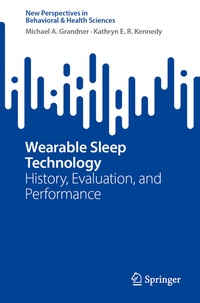
Wearable Sleep Technology
Description

This book is about wearable sleep technology. Sleep assessment technologies, or "sleep trackers", that can be used outside of the laboratory are becoming increasingly popular. They are utilized in scientific research, among behavioral sleep medicine clinicians, and by members of the general public who are interested in learning more about their sleep. There are few guidelines currently available to help users discern which device is most suitable for their needs. Bold marketing claims often suggest that devices are more accurate than they are. By understanding the history of how these devices were developed, the limitations of the current proxy measures of sleep, and the inherent bias in validation studies of the most popular devices used today, readers can learn about what to realistically expect from device performance. This book comprehensively explains how sleep trackers work, how they can be evaluated by users, and how they can be used in practice.
More details
Other editions
Additional editions
Persons
Michael A. Grandner is a licensed clinical psychologist board-certified in Behavioral Sleep Medicine, director of the Sleep and Health Research Program at the University of Arizona College of Medicine-Tucson, director of the Behavioral Sleep Medicine Clinic at the Banner-University Medical Center in Tucson, AZ, and associate professor of Psychiatry, Medicine, Psychology, Nutritional Sciences, and Clinical and Translational Science. He has worked with sleep wearable technology for over 20 years and has extensive experience with these devices in research and in clinic.
Kathryn E.R. Kennedy is a member of the Sleep and Health Research Program at the University of Arizona College of Medicine-Tucson. She is interested in sleep wearable technologies used to measure and intervene with sleep, as well as other novel therapeutics. She has a background in basic laboratory science and has transitioned into a career focused on translational approaches linking sleep, health, and behavior. She is currently completing her Ph.D. as part of the Graduate Interdisciplinary Program in Physiology at the University of Arizona College of Medicine-Tucson.
Content
1. Introduction.- 2. Rationale,- 3. History.- 4. Movement Sensors.- 5. Heart Rate Sensors.- 6. Other Sensors.- 7. Algorithms.- 8. Performance and Accuracy.- 9. How to Choose a Device.- 10. Current Devices.- 11. Device Management.- 12. Scoring and Interpretation.- 13. Skepticism and Limitations.- 14. Across the Lifespan.- 15. Use In Sleep Disorders.- 16. Use in Special Populations.- 17. Beyond Sleep-Wake Assessment.- 18. Future Directions.- 19. Resources and Further Reading.
