

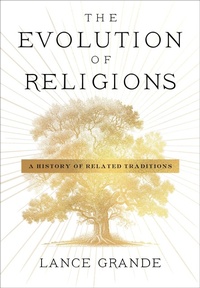
The Evolution of Religions
A History of Related Traditions
1st Edition
Published on 13. February 2024
688 pages
978-0-231-55931-7 (ISBN)
Description

This extraordinarily ambitious and comprehensive book demonstrates how evolutionary theory can yield new insight into the development of organized religion. Lance Grande examines the growth and diversification of hundreds of religions over time, highlighting their historical interrelationships.
More details
Other editions
Additional editions
Book
02/2024
Columbia University Press
€55.71
Shipment within 10-20 days
Book
02/2024
Columbia University Press
€201.79
Shipment within 10-20 days
Person
Lance Grande is the Negaunee Distinguished Service Curator, Emeritus, of the Field Museum of Natural and Cultural History in Chicago. He is a specialist in evolutionary systematics, paleontology, and biology who has a deep interest in the interdisciplinary applications of scientific method and philosophy. His many books include Curators: Behind the Scenes of Natural History Museums (2017) and The Lost World of Fossil Lake: Snapshots from Deep Time (2013).
Content
Preface: A Modern Evolutionary Approach to History of Religion Studies
Introductory Section: Applying Evolutionary Theory and Philosophy to Aspects of Human Culture
1. Religions, Classification, and Phylogenetic Pattern
2. Explaining Hypothetical Patterns with Evolutionary Process Theory
Main Section: The Historical Diversification (Evolution) of Religions
3. Early Supernaturalism and the Development of Organized Religion
4. Indigenous Eastern Organized Religion and Asian Cyclicism
5. Afro-Euro-Mediterranean Organized Religion, Beginning with Old World Hard Polytheism
6. Linear Monotheism
7. The Early Diversification of Abrahamic Monotheism
8. Traditional Christianity
9. Reformation Christianity
10. Biblical Demiurgism: A Subgroup of "Gnosticism"
11. Islam
Summary Section: Four Historical Trends in the Evolution of Religions and Considerations for the Future of Humanity
12. Organized Religions and the Evolution of Human Society
Acknowledgments
Glossary of Select Terms
Notes
Chapter Citations
References
Figure Credits
Subject Index
Introductory Section: Applying Evolutionary Theory and Philosophy to Aspects of Human Culture
1. Religions, Classification, and Phylogenetic Pattern
2. Explaining Hypothetical Patterns with Evolutionary Process Theory
Main Section: The Historical Diversification (Evolution) of Religions
3. Early Supernaturalism and the Development of Organized Religion
4. Indigenous Eastern Organized Religion and Asian Cyclicism
5. Afro-Euro-Mediterranean Organized Religion, Beginning with Old World Hard Polytheism
6. Linear Monotheism
7. The Early Diversification of Abrahamic Monotheism
8. Traditional Christianity
9. Reformation Christianity
10. Biblical Demiurgism: A Subgroup of "Gnosticism"
11. Islam
Summary Section: Four Historical Trends in the Evolution of Religions and Considerations for the Future of Humanity
12. Organized Religions and the Evolution of Human Society
Acknowledgments
Glossary of Select Terms
Notes
Chapter Citations
References
Figure Credits
Subject Index
