

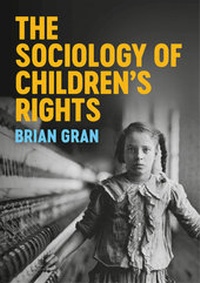
The Sociology of Children's Rights
Description

Brian Gran helps us understand what is at stake when children's rights are compromised. This insightful text grounds readers in core theories and key data about children's legal entitlements. The chapters tackle central questions about what rights accrue to young people, whether they advance equality, and how they influence children's identities, freedoms, and societal participation. Ultimately, this book shows how current frameworks hinder young people from possessing and benefiting from human rights, arguing that they function as cynical invitations to question whether we truly believe children are endowed with human rights.
The Sociology of Children's Rights offers a critical and accessible introduction to understanding a complex issue in the contemporary world, and is a compelling read for students and researchers concerned with human rights in sociology, political science, law, social work, and childhood studies.
More details
Other editions
Additional editions



Person
Content
1 What Are Children's Rights?
2 Institutions and Children's Rights
3 Children's Political Rights
4 Meanings of Children's Rights
5 What Do Children's Rights Do? What Children's
Rights Are Missing?
6 What Is Right with Children's Rights?
Appendix
Introduction
Through this book, The Sociology of Children's Rights, we will employ sociology to study children's rights. A sociological perspective enables us to go beyond rights on paper to think about how rights matter to young people. We will consider international treaties that state children's rights, the institutions societies have established to implement children's rights, and whether and how children's rights matter to young people. As we approach children's rights as part of an international framework, we will try to answer the question of whether we truly take children's rights seriously? First, however, a short story.
A story
It's the first day of school. You are the new student; your parents and you fled to this country before the fighting started. Your parents said that when the electricity and water stopped, it was time to go. Here you are, nearly 5,000 km away, and life is dramatically different. Not only are you "the new kid," you are learning a new language. Your parents are taking you to a building where you practice your religious faith with others from your country, although it is a warehouse from Monday through Friday. Your parents are having trouble finding the food you can eat. Some of the kids tease you because of how you dress. You are discovering that your new country looks, works, and smells very different from home. You miss your sister.
Your 14-year-old sister insisted on staying behind. She said she wants to mind the family business. You think she stayed behind to be with her boyfriend, who is 15 and whom your sister wants to marry. Back home, she can marry him next year. You worry that your sister will be forced into the military, or worse. You miss her and wish she was with you. You worry that you may never see her again.
Today, though, is the first day of school. Your school day started with a talk given by an ombudsperson. This ombudsperson explained to the students that they possess rights. He organized games for students to play to learn about rights. The ombudsperson talked about a children's rights convention and praised the United Nations. In your home country, the UN is ridiculed and people think it is weak, albeit dangerous. At home, teachers never taught about children's rights; you had never heard of an ombudsperson. The ombudsperson said that every child has the right to be safe, to grow up with food and an education, and to live with their families. Before he left, he handed out pencils to every student. On the pencil is a telephone number any child can telephone if they think their rights, or another child's rights, are being violated. Could this ombudsperson help your sister?
Young people arriving to new countries is common. For 2019, the UN estimates over 272 million people migrated, which is 3.5% of the world's population. Of these international migrants, 1 in 6 were people aged 20 and younger (United Nations 2020: www.un.org/en/sections/issues-depth/migration/index.html). According to UNICEF and the International Organization for Migration (IOM), of the 870,000 refugees who arrived in Europe in the year 2015, 20% were children (IOM and UNICEF 2015). For the year 2014, 23,000 asylum applicants to the European Union were unaccompanied young people (IOM and UNICEF 2015). These young people traveled without parents or caretakers. Reasons why young people travel without adults are time-sensitive. More than 23,000 asylum applications were made for young people just to Sweden for 2015, more than the 2014 total to the European Union (IOM and UNICEF 2015). For the month of October 2015, this number for Sweden was 9,300. Given recent events, these numbers may be higher and - depending on your perspective - worse.
Many young people grow up in dire circumstances. Harsh situations are compounded when young people do not have access to social services that are crucial to their futures, such as health care and education. Many young people experience malnutrition. UNICEF (2015) indicates that half of the deaths of children aged 5 and younger are attributable to undernutrition. Many do not have access to drinkable water and sanitation. Almost 10% of the deaths of children aged 5 and younger are due to unsafe water and lack of sanitation. Even in societies where young people possess rights to shelter, food, health care, and education, many young people do not have those rights enforced. Young people who do not live with and grow up with their parents are not uncommon, too. UNICEF estimates approximately 15.1 million children are "double orphans," both parents having passed away (UNICEF 2017: www.unicef.org/media/media_45279.html).
Many young people will probably grow up in a family that is broken. In our story, parents and the son live in one society while the daughter lives in another. Most national governments agree that young people should grow up with their families; most societies have established norms addressing at what age a young person can live on her own (Feldman and Quatman 1988). According to the UN Convention on the Rights of the Child (UNCRC) - the text of which can be found in Appendix 1 - governments are not to interfere with a young person's family (Article 16). If the young person is separated from her family, the child has a right to family reunification (Article 22). As a young person's right, this Article has received great attention, given historical precedent of military conflicts and wars that foment separation of children from their parents. This Article has generally not received the same attention when parents do not share households, such as circumstances where parents split up. Do young people possess a right to grow up in a household with all parents present? In the situation of break-up between parents, such as marital dissolution, does a young person possess a right to grow up with both parents if it is in their best interest? If so, how is a right to grow up with a family implemented? These questions, which may at first seem outlandish, are real. They challenge children's rights. On paper, even if young people are entitled to rights, do those rights matter to their daily lives?
Why sociology?
Why are we studying a sociology of children's rights? What is sociology of children's rights? Before I try to answer this question, let's spend a moment talking about what sociology is. Simply put, sociology is the study of society (Romero 2020). As a social science, sociology's cousins include anthropology, economics, geography, political science, and psychology. How is sociology distinct from these disciplines? One difference is that sociology typically focuses on people doing things together (Becker 1986). While many sociologists are interested in what people do alone, their primary interest is in what people do together, whether as a pair (a 'dyad'), a bigger group (a 'triad' is three or more people), a community, people who live within a country's borders, or people who cross national borders. From your friend and you to all people of the world, sociologists want to understand what we do together, how we do things together, where we do things together, and why we do things together (or not).
What is interesting about what people do together? Think of how different you are from your best friend or a family member. No matter who you are or where you live, life is different. Every day, life is different across the world. No person has the same "day" as anyone else. Even people who go to the same school, who attend the same physical education class, and eat lunch during the same period - their experiences are not the same. Even when two people are in the same room listening to the same lecture, what they hear and experience can be drastically different (Darling-Hammond, Flook, Cook-Harvey, Barron, and Osher 2020). How can all of us have different experiences when we share time and space?
Even when we share time and space, our experiences can be vastly different. Our backgrounds shape our beliefs and values. The socio-economic situation of our family affects where we live and whether we have enough food to focus on schoolwork. The societies in which we live can strongly communicate that our skin color and gender open and close doors to opportunities (Collins 1990). Backgrounds, situations, experiences, and understandings not only can vary across students within a single classroom, these social factors can and will change over the course of our lives.
Yet, in many ways, societies do their best to ensure our days are the same. Across the world, we organize days according to expectations and schedules. Whether sunrise is the start of the day or we are on our way to work and school by 8:00 a.m., we have set up rules that shape how we live together. Our institutions teach us right from wrong, including what it means to be "late." These structures, institutions, and rules help us develop social groups (Stinchcombe 1965). We often see the same people on campus. We make friends in the classes we attend and get to know people who study the same subjects. We notice when a student is "new." We come to recognize people who ride the same bus each day, and notice when a rider is new to our bus. How and where we spend our time in society often identifies who is and who is not a member of our society.
Societies have set up, as well as inherited, obstacles that stop people from doing things together. Take citizenship. Citizenship is often...
