

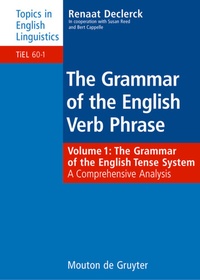
The Grammar of the English Tense System
Description

The Grammar of the English Tense System forms the first volume of a four-volume set, The Grammar of the English Verb Phrase . The other volumes, to appear over the next few years, will deal with mood and modality, aspect and voice.
The book aims to provide a grammar of tense which can be used both as an advanced reference grammar (for example by MA-level or postgraduate students of English or linguistics) and as a scientific study which can act as a basis for and stimulus to further research. It provides not only a wealth of data but also a unique framework for the study of the English tense system, which achieves great predictive and explanatory power on the basis of a limited number of relatively simple rules.
The framework provided allows for an analysis of the semantics of individual tenses which reflects the role of tenses not only in locating situations in time relative to speech time but also in relating situations in time relative to one another to form temporally coherent discourse. Attention is paid to the relations between tenses. On the one hand, we can identify sets of tenses linked to particular temporal areas such as the past or the future. These sets of tenses provide for the expression of a system of temporal relations in a stretch of discourse in which all the situations are located within the same temporal area. On the other hand, there are many contexts in which speakers might in theory choose between two or more tenses to locate a situation (e.g., when we choose between the past tense and the present perfect to locate a situation before speech time), and the book examines the difference that a choice of one or the other tense may make within a discourse context.
The book moves from a detailed exploration of the meaning and use of individual tenses to a thorough analysis of the way in which tenses can be seen to function together as sets, and finally to a detailed examination of tenses in, and tenses interacting with, temporal adverbials.
Original data is used frequently throughout the book to illustrate the theory discussed.
Reviews / Votes
"There is a wealth of data which have been carefully and closely examined, laying open several important distinctions. This book spells out its intellectual assumptions, and follows them through consistently."Nikolas Gisborne in: English Language and Linguistics 12-3/2008 "This is unquestionably a challanging book that no one with a serous interest in tense in English can affort to ignore."Peter C. Collins in: Folia Linguistica 41/2007More details
Other editions
Additional editions
Persons
Content
2 - Table of contents [Seite 7]
3 - 1. Introduction [Seite 9]
4 - 2. Towards a theory of tense and time [Seite 99]
5 - 3. The absolute use of the present tense [Seite 179]
6 - 4. The absolute past tense [Seite 201]
7 - 5. The absolute use of the present perfect [Seite 217]
8 - 6. The present perfect vs the preterite in clauses without temporal adverbials [Seite 323]
9 - 7. Absolute tense forms referring to the post-present [Seite 343]
10 - 8. Temporal domains and relative tenses: theoretical foundations [Seite 369]
11 - 9. Temporal subordination in the various time-zones [Seite 449]
12 - 10. Two tense systems withpost-present reference [Seite 537]
13 - 11. Tense choice determined by temporal focus [Seite 579]
14 - 12. Preterite vs present perfect in clauseswith temporal adverbials [Seite 597]
15 - 13. Adverbial when-clauses and the use of tenses [Seite 643]
16 - 14. Adverbial before-clauses and after-clauses [Seite 693]
17 - Backmatter [Seite 767]
