
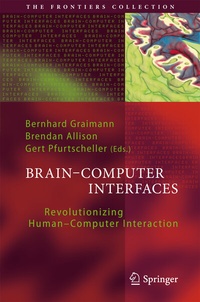
Brain-Computer Interfaces
Description
Alles über E-Books | Antworten auf Fragen rund um E-Books, Kopierschutz und Dateiformate finden Sie in unserem Info- & Hilfebereich.
A brain-computer interface (BCI) establishes a direct output channel between the human brain and external devices. BCIs infer user intent via direct measures of brain activity and thus enable communication and control without movement. This book, authored by experts in the field, provides an accessible introduction to the neurophysiological and signal-processing background required for BCI, presents state-of-the-art non-invasive and invasive approaches, gives an overview of current hardware and software solutions, and reviews the most interesting as well as new, emerging BCI applications. The book is intended not only for students and young researchers, but also for newcomers and other readers from diverse backgrounds keen to learn about this vital scientific endeavour.
More details
Other editions
Additional editions

Content
System requirements
File format: PDF
Copy protection: Watermark-DRM (Digital Rights Management)
System requirements:
- Computer (Windows; MacOS X; Linux): Use the free software Adobe Reader, Adobe Digital Editions, or any other PDF viewer of your choice (see eBook Help).
- Tablet/Smartphone (Android; iOS): Install the free app Adobe Digital Editions or another reading app for eBooks, e.g., PocketBook (see eBook Help).
- E-reader: Bookeen, Kobo, Pocketbook, Sony, Tolino and many more (only limited: Kindle).
The file format PDF always displays a book page identically on any hardware. This makes PDF suitable for complex layouts such as those used in textbooks and reference books (images, tables, columns, footnotes). Unfortunately, on the small screens of e-readers or smartphones, PDFs are rather annoying, requiring too much scrolling.
This eBook uses Watermark-DRM, a „soft” copy protection. This means that there are no technical restrictions to prevent illegal distribution. However, there is a personalised watermark embedded in the eBook that can be used to identify the purchaser of the eBook in the event of misuse and to provide evidence for legal purposes.
For more information, see our eBook Help page.